Your body just accomplished something extraordinary, but now you might wonder where to begin with your first postpartum workout. Rebuilding abdominal strength after pregnancy isn’t about rushing back to old routines or doing endless crunches. Safe, effective postpartum core exercises respect your body’s recovery while helping you regain stability, reduce diastasis recti, and feel strong again.
Low-impact, high-intensity training offers new mothers a controlled way to strengthen deep core muscles and pelvic floor without jarring movements that can set back recovery. Slow, deliberate exercises allow you to reconnect with your abdominal wall and build functional strength for daily activities like lifting and carrying your baby. For mothers seeking this specialized approach to postpartum fitness, Lagree in London provides expert guidance in rebuilding core strength at your own pace.
Summary
- Pregnancy stretches the abdominal wall by up to 115% at full term and disrupts the neural pathways that once allowed your core muscles to fire automatically. According to BabyCenter’s research on postpartum recovery, 100% of pregnant women experience diastasis recti to some degree. The body heals remarkably well after delivery, but healing and rebuilding strength are different processes. Without deliberate, targeted movement that retrains these muscles to work together, many women plateau far below their pre-pregnancy capacity.
- The biggest mistake in postpartum core training isn’t doing too little. It’s doing the wrong kind of work entirely. Traditional crunches isolate the rectus abdominis in a fixed position with no demand for your body to stabilize against gravity or movement. Research published in the British Journal of Sports Medicine found that postpartum women show altered muscle recruitment patterns that persist long after tissue healing. You can have strong abs and still struggle with everyday tasks if those muscles don’t activate at the right time or in the right sequence.
- Strength without stability is like power without steering. After months of postural adaptations during pregnancy, many women unknowingly compensate by overusing their lower back, shoulders, or hip flexors during everyday movement. Controlled movement patterns teach your body to distribute force properly. Slower repetitions demand more precise muscle activation and better body awareness throughout each range of motion. When you can’t rely on momentum, you’re forced to engage the right muscles at the right time, which is exactly what postpartum bodies need to relearn.
- A focused 30-minute session performed three times per week will almost always produce better outcomes than sporadic 90-minute workouts that leave you depleted. Research from UCLA Health shows that just 15 minutes of mixed fast and slow running twice a day was enough to produce measurable cardiovascular improvements. The key wasn’t duration. It was regularity and intensity applied in a way people could sustain. A workout that leaves you energized rather than exhausted is one you can repeat two days later, increasing overall training frequency and accelerating progress.
- BMC Pregnancy and Childbirth reports that 25% of women experience activity limitations during the first year postpartum. Many women feel caught between two extremes, either avoiding movement entirely or returning to previous routines only to discover their body responds with pain, heaviness, or worsening symptoms like leaking or abdominal doming. The gap between medical clearance and physical readiness creates confusion. You’re told you can exercise, but your body signals that something still isn’t right.
- Lagree in London addresses this gap by using slow, controlled resistance work on the Megaformer to rebuild deep core activation and pelvic floor coordination, without the jarring impact that can overwhelm recovering tissue.
Why So Many Women Struggle to Regain Core Strength After Pregnancy
Pregnancy fundamentally rewires your core functions. Your abdominal wall lengthens by up to 115% at full term, your pelvic floor bears increasing downward pressure for months, and the connective tissue between your rectus abdominis muscles (the linea alba) thins and widens to make space. According to BabyCenter’s research on postpartum recovery, 100% of pregnant women experience diastasis recti to some degree. These structures don’t simply snap back into place after delivery.
“100% of pregnant women experience diastasis recti to some degree during pregnancy.” — BabyCenter Research on Postpartum Recovery
🔑 Key Takeaway: Your core undergoes massive structural changes requiring intentional rehabilitation. Natural recovery alone isn’t enough for most women.
⚠️ Important: The 115% abdominal wall lengthening means your core muscles work from a completely different baseline after pregnancy.

The neuromuscular disconnect
Your brain loses its ability to communicate well with your core muscles during pregnancy. The neural pathways that once fired automatically when you lifted, twisted, or stabilized become disrupted. After birth, you’re dealing with weakened muscles that have forgotten how to work together. Your transverse abdominis may not engage when you cough. Your pelvic floor might not activate before you lift your baby. This disconnect explains why movements that once felt easy now feel unstable or uncertain.
When time alone isn’t enough
Your body heals after pregnancy, but healing and rebuilding strength are two different things. Tissue repairs, swelling subsides, and hormones return to normal. Yet BMC Pregnancy and Childbirth reports that 25% of women have trouble with activities during the first year after giving birth. Scar tissue forms differently from the original tissue, and the linea alba may partially close but remain wider and less responsive. Without purposeful, focused movement that teaches these muscles to work together again, many women plateau well below their pre-pregnancy baseline.
Why do women feel caught between extremes after medical clearance?
Women cleared for exercise at six or eight weeks often feel caught between two extremes. Some avoid movement entirely, unsure which exercises might cause harm or slow recovery. Others return to their previous routines—running, HIIT classes, traditional strength training—only to discover their body responds with pain, heaviness, or worsening symptoms like leaking or abdominal doming.
Medical clearance doesn’t guarantee physical readiness. Your body signals that something still isn’t right, creating frustration about the gap between your current state and where you were before pregnancy.
How does controlled resistance work to rebuild core stability?
High-impact movements that once felt manageable now stress a core system that hasn’t regained stability. BST Lagree in London offers a different path forward. Our Megaformer’s slow, controlled resistance work rebuilds deep core activation and pelvic floor coordination without the jarring impact that can overwhelm recovering tissue, strengthening the stabilizing muscles that pregnancy disrupted through deliberate, progressive loading.
Why do most postpartum exercises miss the mark?
Most postpartum exercise guidance focuses on what to do—planks, bridges, breathing exercises—without addressing how these movements should feel or whether your core is engaging properly. You can perform a hundred pelvic tilts without correctly activating your transverse abdominis.
What happens when proper muscle activation is ignored?
You can hold a plank while your rectus abdominis domes outward, reinforcing poor patterns instead of correcting them. Without feedback on the quality of muscle activation, many women unknowingly practice compensatory movement patterns that delay recovery.
The body compensates by using muscles not designed for that job, leaving the core weak even as other areas grow stronger.
The Hidden Mistake in Most Postpartum Core Workouts
The biggest mistake in postpartum core training is doing the wrong kind of work entirely. Most programs treat the core as just the abs when your body needs to rebuild how multiple muscle systems work together under load, not how well you can crunch.

⚠️ Warning: Traditional ab exercises like crunches can actually worsen diastasis recti and create more intra-abdominal pressure instead of teaching your deep core muscles to work as an integrated system.
🔑 Takeaway: Effective postpartum recovery focuses on functional movement patterns that retrain your pelvic floor, diaphragm, and deep abdominals to work together during real-life activities like lifting your growing child or carrying groceries.
What happens when your core works as a system?
When you pick up your toddler from the floor, your glutes stabilize your pelvis, your deep core muscles (transverse abdominis and multifidus) create intra-abdominal pressure to protect your spine, your pelvic floor lifts and supports, and your obliques control rotation as you twist to set your child down. Every muscle fires in the right order at the right time in less than two seconds.
Why don’t traditional crunches prepare you for real movement?
Traditional crunches don’t train any of that. They focus only on the rectus abdominis in a single position, without weight, rotation, or the need to stabilize against gravity or movement. You get better at doing crunches, not at the coordinated full-body stability that prevents back pain when you lift the car seat.
Why don’t traditional exercises fix postpartum movement patterns?
According to research published in the British Journal of Sports Medicine, women after giving birth show altered muscle recruitment patterns that persist long after tissue healing. During pregnancy, your center of gravity shifted forward, and your abdominal wall stretched.
Your brain learned compensatory strategies that don’t automatically reverse after giving birth. Your hip flexors might now dominate movements that should be driven by your glutes, and your lower back might brace when your deep core should be stabilizing.
What type of training retrains faulty movement patterns?
Doing more crunches doesn’t retrain that faulty wiring. You need exercises that challenge your body to coordinate under real conditions: unstable surfaces, shifting loads, and multi-directional movement. Methods such as the Lagree technique are relevant here.
Lagree in London uses slow, controlled movement on an unstable carriage to force deep stabilizer engagement throughout the full range of motion. The instability prevents your core from relying on momentum or compensatory patterns; every muscle must engage in sequence, or the movement fails.
What does strength without coordination look like in daily life?
You can have strong abs and still struggle with everyday tasks if those muscles don’t activate at the right time. I’ve watched women perform perfect planks in the gym, then bend incorrectly when lifting their child because their glutes failed to activate before their spine moved.
The plank strengthened their abs in isolation but didn’t teach their nervous system to use the right muscles in the right order when it mattered.
How should postpartum core training focus on movement patterns?
Postpartum core recovery requires training movement patterns, not muscle groups. Your workout should resemble a rehearsal for the physical demands of your actual life: squatting while holding weight, rotating under load, stabilizing on one leg, and controlling deceleration when you catch your balance.
These movements rebuild the neuromuscular coordination that pregnancy disrupted. But knowing what to train is useful only if you understand how to progress safely without triggering the issues you’re trying to fix.
Related Reading
- First Postpartum Workout
- When Can I Workout Postpartum
- Is Pilates Good for Postpartum Weight Loss
- Can I Do Pilates 3 Weeks Postpartum
- Bird Dog Exercise Postpartum
- Postpartum Glute Bridge Exercise
- Postpartum HIIT Workout
- Postpartum Kettlebell Workout
- Postpartum Dumbbell Workout
What an Effective Postpartum Core Workout Should Actually Include
Good postpartum core workouts rebuild strength through coordinated, full-body movement that mirrors real life, rather than isolating the abdominals. This includes progressive resistance training, stability work, proper alignment, and controlled movement patterns that teach your muscles to fire in the right sequence.
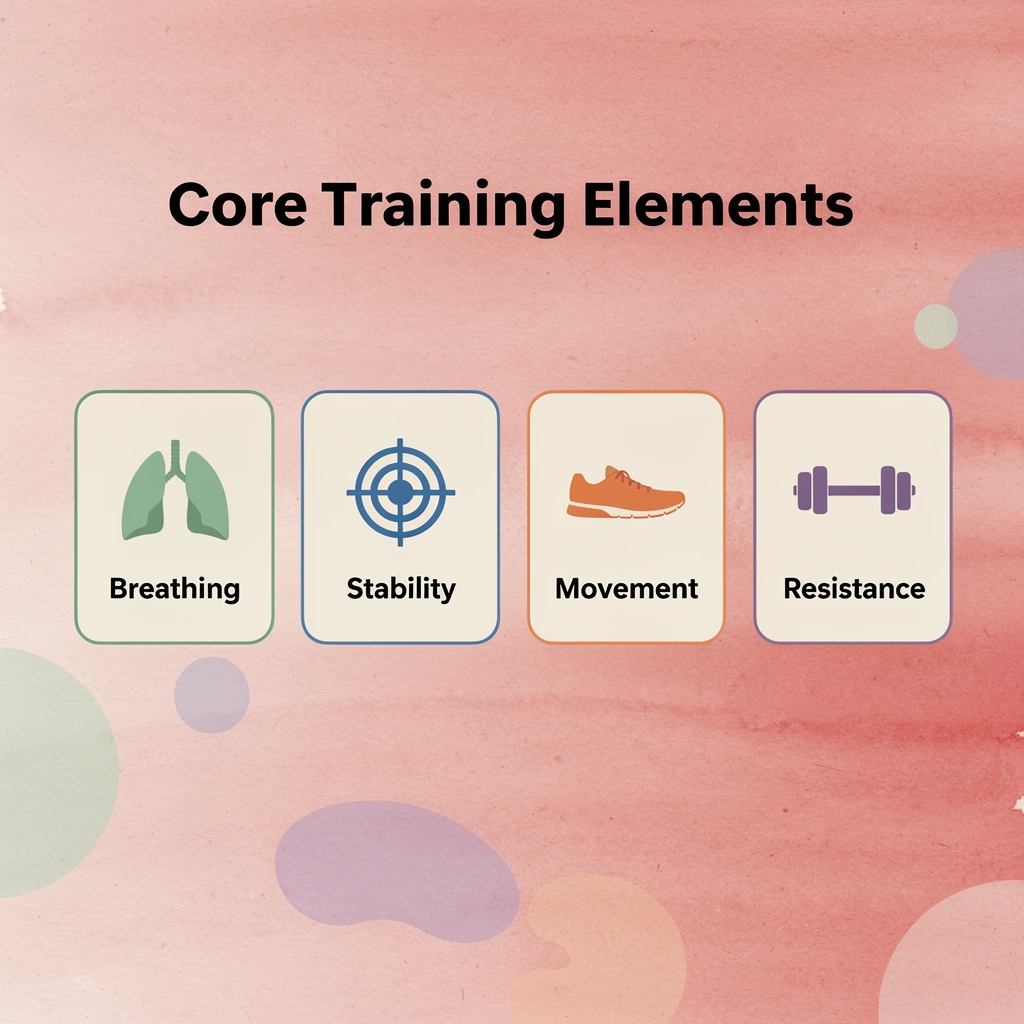
🎯 Key Point: Effective postpartum core training focuses on functional movement patterns that integrate your entire core system, not just traditional crunches or sit-ups.
“The most effective postpartum exercise programs emphasize coordinated movement patterns and progressive loading rather than isolated abdominal exercises.” — Postpartum Exercise Guidelines, 2023

💡 Tip: Look for workouts that incorporate breathing techniques, pelvic floor coordination, and multi-planar movements to ensure your core functions as an integrated system during daily activities.
What makes low-impact movement truly effective for new moms?
Low-impact doesn’t mean low-intensity. Walking and gentle stretching won’t rebuild the strength needed to carry your child up three flights of stairs or lift a car seat without strain.
How can you challenge your muscles while protecting recovering joints?
The challenge is finding training that protects healing joints while pushing your muscles to work hard. According to the American College of Obstetricians and Gynecologists (2020), postpartum exercise should include cardiovascular activity and gradual muscle strengthening.
The Lagree Method on the Megaformer provides this balance: slow, controlled resistance work under constant tension creates the demand your body needs without impact, allowing you to work hard without the joint stress of running or jumping.
Progressive Resistance and Full-Body Integration
Your core functions as part of a chain that includes your glutes, hips, back, and pelvic stabilizers. When one link weakens, the others compensate, breaking down movement patterns.
Research recommends full-body strength training at least twice per week during postpartum recovery rather than focusing solely on abdominal exercises. Weak glutes force your lower back to work harder during a squat; poor deep core engagement lets hip flexors take over when lifting. Rebuilding functional strength means training these muscle groups to work together under progressively heavier loads, not performing endless planks in isolation.
Stability, Alignment, and Control
Strength without stability is like power without steering: you can create force but cannot direct it efficiently or safely. After months of postural changes during pregnancy, many women unknowingly compensate by overusing their lower back, shoulders, or hip flexors during everyday movement.
Controlled movement patterns teach your body to distribute force properly. Slower repetitions demand more precise muscle activation and better body awareness throughout each range of motion. Without momentum, you’re forced to engage the right muscles at the right time, which is what postpartum bodies need to relearn.
What This Actually Builds
The goal isn’t stronger abs—it’s regaining confidence in how your body moves. Research shows that structured exercise after having a baby improves physical health, reduces fatigue, supports mental well-being, and is associated with reductions in low back and pelvic pain, a reduced risk of urinary incontinence, and lower postpartum depression rates.
How does this confidence translate to daily life?
That confidence translates directly into daily life. Carrying your child feels more comfortable. Maintaining good posture requires less conscious effort. You trust your body to stabilize when you reach for something or catch your balance on uneven ground. These are practical training outcomes that respect what your body has endured while demanding that it become stronger.
What makes most postpartum programs fail?
Knowing what to include in a workout is only half the answer. Understanding how much exercise is needed to see results is where most postpartum programs fail.
Why Shorter, Smarter Workouts Often Produce Better Results
The belief that longer workouts deliver better results misses what matters: whether the workout challenges your body appropriately, whether you can perform it consistently, and whether you have resources to recover and adapt. For postpartum women managing limited sleep, unpredictable schedules, and newborn care, a focused 30-minute session three times per week produces better outcomes than sporadic 90-minute workouts that leave you depleted.

🎯 Key Point: Consistency beats intensity when it comes to sustainable fitness progress, especially during the demanding postpartum period.
“A focused 30-minute session three times per week produces better outcomes than sporadic 90-minute workouts for postpartum women managing sleep deprivation and unpredictable schedules.”

💡 Tip: Focus on workout quality over workout duration – your body responds better to consistent challenge than occasional exhaustion.
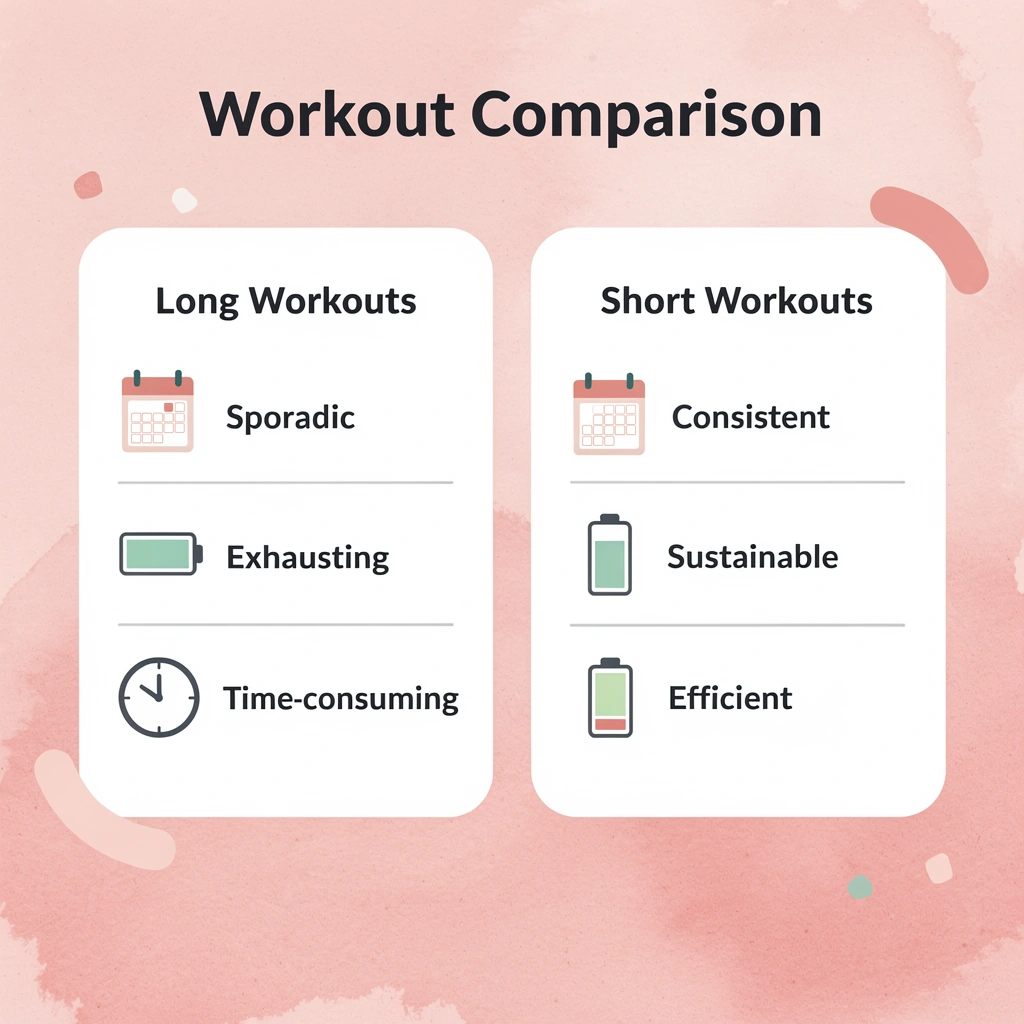
| Long Workouts (90+ min) | Shorter Workouts (30 min) |
|---|---|
| Sporadic consistency | Regular consistency |
| High recovery demands | Manageable recovery |
| Schedule conflicts | Fits busy schedules |
| Energy depletion | Sustainable energy |
Consistency Builds Adaptation
Your body responds to patterns, not single efforts. A workout done once gives a temporary boost; done regularly, it creates lasting change. According to UCLA Health, 15 minutes of mixed fast and slow running twice a day led to measurable improvements in heart and lung function. The key was consistency and intensity you could sustain. For postpartum core recovery, a 25-minute session that fits between nap time and work calls becomes a habit, while a 75-minute session that requires childcare coordination becomes an exception.
Progressive Challenge Drives Strength
Strength comes from slowly increasing the demand placed on your muscles through added resistance, increased time under tension, or more challenging movement patterns. Research published in Frontiers in Psychology involving 23 resistance-trained women found that splitting workouts into shorter sessions maintained training volume and improved affective responses. The Lagree Method on the Megaformer applies this principle through slow, controlled movements that keep muscles under constant tension, creating significant strength stimulus in compact timeframes without heavy weights or high-impact stress that postpartum joints may not yet be ready to handle.
Recovery Determines Whether Adaptation Happens
Exercise creates the stimulus for change; recovery is where adaptation occurs. Longer workouts demand more recovery resources, which becomes problematic when sleep is fragmented, nutrition is inconsistent, and stress is elevated. Shorter workouts allow the body to recover efficiently while providing enough challenge to stimulate strength gains. This matters especially for postpartum women managing the physiological demands of breastfeeding, hormonal shifts, and tissue healing. A workout that leaves you energized rather than exhausted can be repeated two days later. A draining workout may require four or five days of recovery, reducing training frequency and slowing progress.
Why is sustainability key for postpartum fitness success?
The most effective program is the one you can stick with. A workout routine requiring an hour of uninterrupted time, childcare arrangements, and significant mental energy becomes difficult to maintain when life gets unpredictable.
A focused session that fits into spaces between other responsibilities becomes part of your routine. For Lagree in London, our 40 to 50-minute classes deliver full-body strength work through high-intensity, low-impact movement patterns that challenge every major muscle group without requiring long recovery periods or creating joint stress that could set back postpartum healing.
How do you know if your workout is actually working?
Knowing that shorter workouts can work well doesn’t tell you whether your body is responding to the training.
Related Reading
- Kegel Exercises Postpartum
- Postpartum Strength Workout
- Postpartum Diastasis Recti Workout
- Easy Postpartum Workout
- Postpartum Arm Workout
- Postpartum Full Body Workout
- 6 Week Postpartum Workout Plan
- Postpartum Pelvic Floor Exercises
- Postpartum Workout Plan At Home
- Best Postpartum Core Exercises
- Pilates Exercises For Post Pregnancy
- Postpartum Diastasis Recti Workout
- Postpartum Pelvic Floor Exercises
- Postpartum Belly Exercises
Signs Your Postpartum Core Is Getting Stronger
Your core is getting stronger when you feel more stable picking up your baby, when your back doesn’t hurt after an hour of standing, when you can trust your body during movements that felt shaky weeks earlier. These functional improvements matter more than measurements because they show what core strength does: it supports the demands of your daily life.
🎯 Key Point: Functional improvements like feeling stable during daily activities are the true indicators of core recovery — not numbers on a scale or tape measure.
💡 Tip: Pay attention to how your body feels during everyday movements like lifting, standing, and carrying. These are your best progress markers.
“Functional improvements matter more than measurements because they show what core strength does: it supports the demands of your life.” — Postpartum Recovery Insight
Better Balance During Single-Leg Movements
When you can stand on one leg to put on shoes without grabbing the wall or walk up stairs with control, your deep stabilizers are firing effectively. The transverse abdominis and pelvic floor work together to create stability before movement happens. Less wobbling when shifting weight, such as while holding your child, signals returning coordination. Balance improvements often appear weeks before visible changes because the neuromuscular system adapts faster than tissue remodels.
Reduced Lower Back Tension
A stronger core spreads load evenly across your torso, reducing pressure on your lower back during everyday tasks like loading the dishwasher, folding laundry, or cooking. Many women describe this as feeling “taller” or “less compressed” as the day progresses. For postpartum training that rebuilds this foundational strength without joint stress, BST Lagree in London uses slow, controlled resistance on the Megaformer to retrain coordinated muscle firing patterns that support your spine during exercise and daily movement.
Confidence During Lifting Tasks
The moment you stop second-guessing whether your body can handle lifting your toddler out of the crib or carrying groceries up the stairs, something has shifted. That confidence comes from proprioception, your body’s awareness of its position and capability in space. When your core engages automatically before you bend, lift, or twist, you feel secure rather than vulnerable. This isn’t about ignoring caution—it’s about trusting your muscles to do their job without conscious micromanagement.
Ability to Progress Exercise Intensity
If you can add resistance, hold positions longer, or control movements with better form than you could three weeks ago, your body is adapting. Progressive overload only works when your foundation can support increased demand. When a plank that once felt impossible at 20 seconds now feels manageable at 45 seconds, or when you can perform a squat with better depth and control, your muscle recruitment patterns are becoming more efficient, and your tissue is getting stronger.
How do you create conditions for these improvements to show up?
But knowing these signs exist doesn’t explain how to create the conditions where they show up in your body.
How BST Lagree Helps Women Rebuild Core Strength After Pregnancy
After having a baby, your core strength returns through steady training that engages your deep stabilizer muscles, glutes, and pelvic floor with appropriate resistance. The Lagree Method delivers this through full-body movements on the Megaformer, where each exercise demands core activation to maintain stability against spring resistance. This approach addresses the coordination problems pregnancy causes rather than fatiguing surface muscles alone.
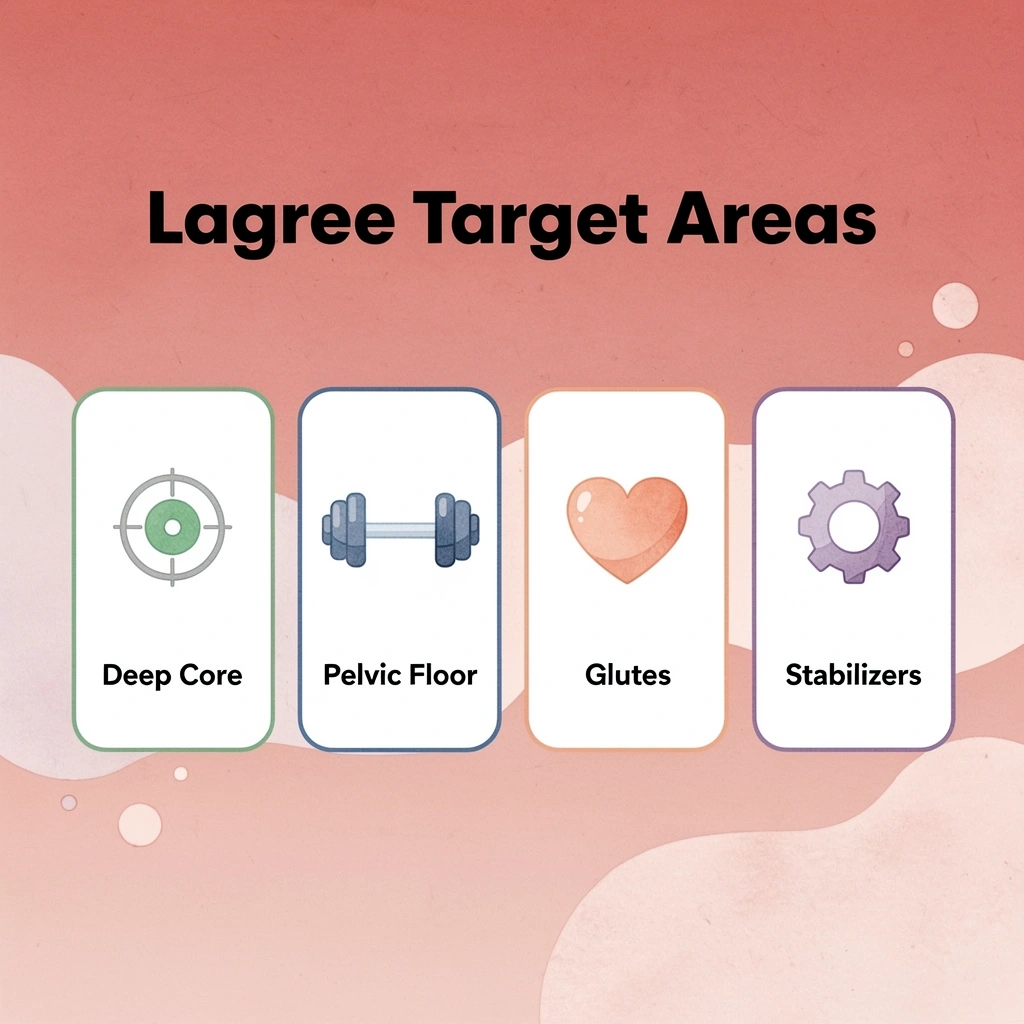
🎯 Key Point: The Lagree Method targets the exact muscle groups that pregnancy weakens – your deep stabilizers, pelvic floor, and glutes – through integrated movements that restore proper muscle coordination.
“Pregnancy and childbirth can cause significant changes to core muscle function, requiring targeted rehabilitation that addresses both strength and coordination deficits.” — American College of Obstetricians and Gynecologists
💡 Best Practice: Focus on controlled movements with spring resistance rather than high-impact exercises during your postpartum recovery – this allows your deep core muscles to rebuild safely while protecting your healing tissues.
How does low-impact training provide a mechanical challenge for postpartum recovery?
After pregnancy, bodies need physical challenge to rebuild tissue strength, but high-impact movements like running or jumping often exceed what recovering pelvic floors and abdominal walls can safely handle. According to PowerCore Studio, 60% of women experience diastasis recti after pregnancy, making traditional high-impact exercise particularly risky during early recovery.
The Lagree Method combines slow, controlled movements with significant resistance. The carriage glides on springs, eliminating impact while creating time under tension that forces muscles to work intensely. Women can train at high effort levels without the pounding forces that compromise healing tissue or overload weakened pelvic stabilizers.
Why is progressive overload important for postpartum strength building?
Getting stronger requires gradually doing more challenging exercises, which many postpartum women avoid due to concerns about injury or worsening separation. The Megaformer’s adjustable spring system lets you increase resistance in small, precise steps matched to your recovery pace. A plank becomes harder through increased spring tension or longer holds, not impact. Your body adapts when the challenge stays within what your tissues can handle.
How does BST Lagree fit into unpredictable postpartum schedules?
New mothers often stop exercising because long workout sessions don’t fit into unpredictable childcare schedules. BST Lagree solves this problem by combining strength training and cardiovascular conditioning into focused 45-minute classes.
Every movement serves multiple purposes: a lunge variation challenges leg strength, core stability, and cardiovascular endurance, while the supporting leg’s glutes help maintain pelvic alignment.
Why does this compressed format deliver measurable results?
This compression works because inefficiency gets eliminated, not intensity. Transitions between exercises take seconds, and rest periods occur only when muscles need them to maintain proper form.
Women leave having worked every major muscle group without separate cardio sessions or extended warm-ups, delivering measurable strength gains within postpartum schedules.
What makes professional guidance essential for postpartum fitness?
The biggest barrier many women face isn’t finding a workout—it’s knowing whether they’re performing exercises correctly or progressing too quickly. Without clear feedback, doubt creeps in: Is this movement safe for my pelvic floor? Should this feel this hard already? Am I compensating with my hip flexors instead of engaging my core? These questions halt progress when women train alone or follow generic programs that can’t account for individual recovery patterns.
At BST Lagree, every instructor completes rigorous certification and mentorship in the Lagree Method, enabling them to identify compensation patterns, cue proper muscle engagement, and modify exercises for individual postpartum needs.
How does real-time feedback build confidence and prevent injury?
This organized coaching builds confidence, allowing women to push hard at the right level. Instead of stopping an exercise early due to uncertainty, they receive immediate feedback confirming they’re working safely within their body’s current capacity.
The instructor observes when shoulders rise during a plank, indicating weak core engagement, or when knees turn inward during a squat, signaling poor glute activation. These corrections ensure the right muscles work in the proper sequence, retraining the coordination patterns that pregnancy disrupted.
Book a Lagree Class in London Today
You can read about coordinated core engagement and progressive resistance, or you can experience what happens when a certified instructor guides you through 45 minutes of precise, full-body movement designed for rebuilding strength after pregnancy. Feeling your body respond, your posture shift, your stability return—that’s the real transformation postpartum women need.
🎯 Key Point: Experience beats theory in postpartum recovery. Your body needs guided movement, not information alone.
Your first class at BST Lagree isn’t about perfection. It’s about learning how to engage muscles you’ve lost connection with, moving through positions that challenge stability without punishing your joints. Europe’s most experienced Lagree trainers understand postpartum bodies because they’ve worked with hundreds of women navigating exactly what you’re facing. They know when to adjust spring resistance, when to modify a position, and how to push you toward progress without crossing into injury risk.
“Europe’s most experienced Lagree trainers have guided hundreds of postpartum women through safe, effective recovery workouts.” — BST Lagree London
💡 Tip: Your instructor will modify every exercise based on your current strength level—no two postpartum journeys are identical.
Book your first session today. Walk into the studio unsure of what your core can handle, and walk out knowing you completed a structured workout that targeted every stabilizer, every coordination pattern, every muscle group, pregnancy disrupted.
✅ Best Practice: Start with one class to experience how Lagree methodology addresses specific postpartum challenges before committing to a package.
Related Reading
- Best Postpartum Exercises
- Pilates Exercises For Post Pregnancy
- Best Way To Lose Postpartum Belly Fat
- Postpartum Pilates Workout
- Beginner Postpartum Workout Plan
- How To Lose Pregnancy Belly After 2 Years
- Post Pregnancy Workout Plan
- Best Postpartum Ab Workout
- Best Postpartum Workout App
- Postpartum Gym Workout