Returning to exercise after having a baby raises real questions about what is safe, where to start, and how to rebuild without overdoing it. A beginner postpartum workout plan focuses on restoring core stability and pelvic floor function before progressing to more demanding exercises. Slow, intentional movement is the foundation, not a shortcut.
For new mothers seeking structured support during recovery, low-impact training methods allow meaningful progress without stressing healing tissue or joints. The controlled, deliberate nature of this approach builds deep muscle strength at a pace the body can handle. Those ready to take that step can explore lagree in London for a method built around exactly that kind of training.
Table of Contents
- Why Most New Moms Struggle to Return to Exercise
- When Is It Safe to Start a Postpartum Workout Plan for Beginners?
- The Three Phases of a Beginner Postpartum Workout Plan
- A Sample Beginner Postpartum Workout Plan
- Common Postpartum Workout Mistakes That Slow Progress
- How BST Lagree Helps New Moms Rebuild Strength Safely
- Book a Lagree Class in London Today
Summary
- Returning to exercise after childbirth is harder than most fitness content acknowledges, and the difficulty is biological, not motivational. The body after pregnancy has undergone fundamental structural changes, including stretched connective tissue, disrupted intra-abdominal pressure management, and a nervous system operating under significant sleep debt. These are not conditions that respond well to simply doing less than before pregnancy.
- Pelvic floor dysfunction affects up to 50% of women postpartum, yet this statistic rarely appears in the fitness content new mothers actually consume. A weakened pelvic floor does not just limit specific exercises. It changes how the entire core functions, affecting balance, posture, and the ability to generate force safely during any movement. This makes pelvic floor recovery a prerequisite for effective postpartum training, not a side concern.
- Medical clearance and physical readiness are not the same threshold. Postpartum women who return to high-intensity exercise before six weeks face an increased risk of pelvic floor dysfunction, affecting up to 30% of new mothers. Clearance confirms that incisions are healing and vitals are stable. It does not confirm that connective tissue has remodeled, core coordination has returned, or the pelvic floor can manage load safely.
- Postpartum fitness follows three non-negotiable phases: reconnection, strength rebuilding, and endurance development. Research recommends 150 minutes per week of moderate-intensity physical activity for postpartum women, but that target only becomes achievable and sustainable once the earlier phases have been completed properly. Skipping phases does not save time. It creates structural gaps that surface later as setbacks.
- Recovery is as important as the training itself, and most postpartum fitness plans underestimate this. Chronic sleep deprivation suppresses the hormones that drive tissue repair and muscle protein synthesis, so a well-designed workout performed on fragmented sleep yields a very different physiological outcome than the same session with adequate rest. Only 15% of postpartum women meet recommended physical activity guidelines in the first year after delivery, a figure that reflects inadequate guidance and unrealistic expectations more than lack of effort.
- Progressive overload in early postpartum training should be conservative and deliberate, with small additions compounding over time rather than large jumps in intensity. Warning signals, including pelvic pressure, abdominal doming, urinary leakage, or increased bleeding, indicate the body needs less load, not more willpower. Responding to these signals quickly is the fastest path to consistent, long-term progress.
- BST Lagree’s Lagree in London fits into the later phases of postpartum recovery by offering spring-based Megaformer training that delivers genuine muscular challenge through slow, controlled resistance rather than impact, addressing the gap between gentle-only options and high-intensity formats that a healing body cannot yet absorb.
Why Most New Moms Struggle to Return to Exercise
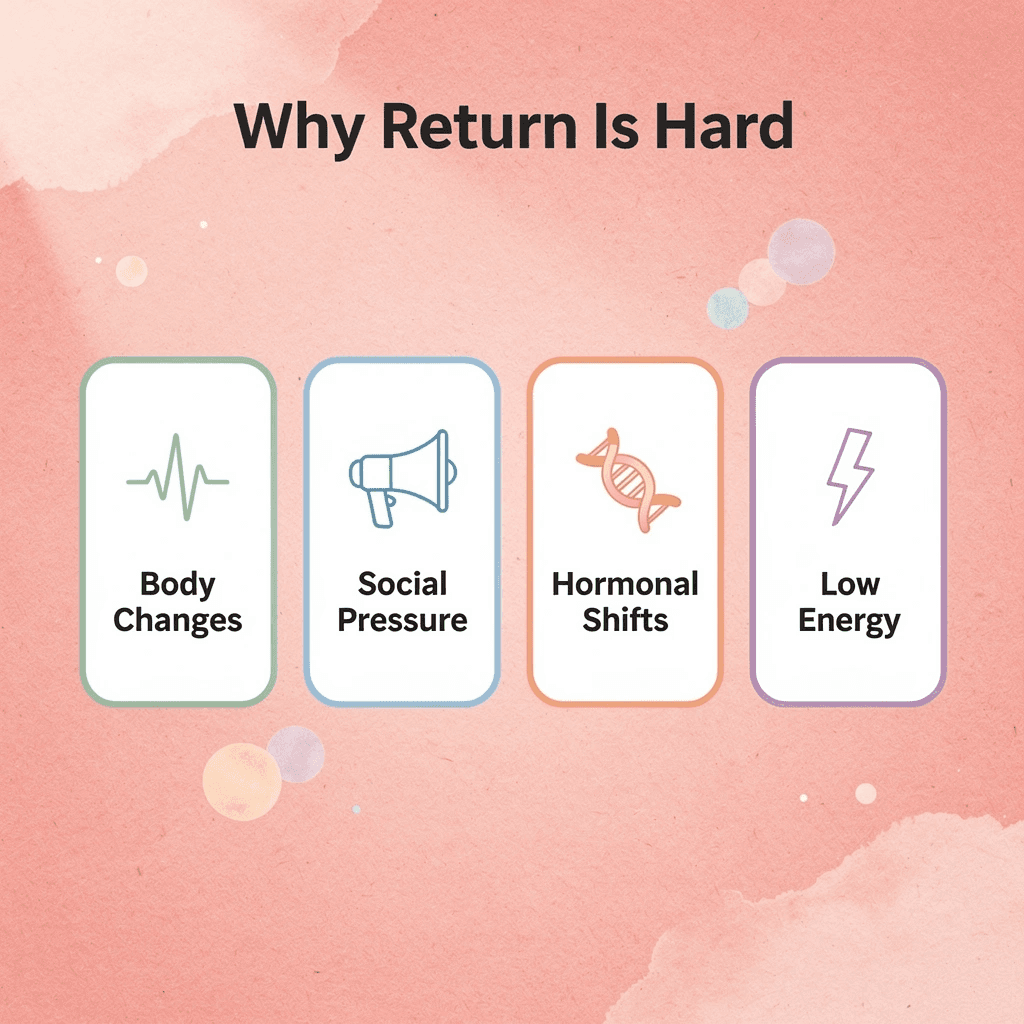
Going back to exercise after having a baby is really hard, and the difficulty usually does not come from not wanting to do it. The body that carried a pregnancy for nine months has changed in major ways, and no amount of determination changes the biology of what it needs to recover.
🎯 Key Point: The struggle to return to exercise postpartum is not a willpower problem — it’s a biology problem. Your body underwent one of the most physically demanding experiences possible, and it deserves time to heal.
“No amount of determination changes the biology of what a postpartum body needs to recover.” — A critical truth every new mother deserves to hear
| What Changed | Why It Matters for Exercise |
|---|---|
| Core and pelvic floor muscles | Weakened or stretched during pregnancy and birth |
| Hormonal levels | Affect joint stability, energy, and mood |
| Cardiovascular system | Needs time to return to pre-pregnancy baseline |
| Sleep and recovery | Chronic sleep deprivation impacts muscle repair |
| Mental load | Emotional demands reduce available energy for training |

The pressure to “bounce back” makes this harder. Social media creates a false picture where postpartum fitness looks easy and quick. When real life does not match that image, many new mothers think something is wrong with them—when the truth is that the image was wrong from the start.
⚠️ Warning: The “bounce back” narrative is not only unrealistic but actively harmful. Comparing your postpartum recovery to curated social media highlights can lead to a premature return to exercise, increasing the risk of injury and setback.
💡 Tip: If you’re a new mum struggling to get back to fitness, reframe the goal entirely. Instead of bouncing back, focus on building forward at a pace your body supports.
What physical changes make postpartum recovery more complex than expected?
Getting your body back to normal after having a baby is harder than most people think. According to the GSSI Sports Science Exchange, up to 50% of women experience pelvic floor dysfunction after childbirth, a fact rarely addressed in fitness content for new mothers. When the pelvic floor weakens, it compromises your entire core function, affecting your balance, posture, and ability to move safely and with power.
Not getting enough sleep makes everything worse. When your body contends with unpredictable broken sleep, fatigue mirrors the strain of hard work. A new mother exercising may struggle to distinguish between a good challenge and overexertion, which can lead to overtraining, slower healing, and sometimes to stopping exercise completely.
Why does a gentler version of the same workout fall short?
The common response is to find a gentler version of a familiar workout without accounting for how fundamentally different the body’s needs are now. Postpartum recovery doesn’t need less of the same thing; it needs something structurally different: a method that builds deep foundational strength without loading a healing body with impact or instability. Lagree in London addresses this through slow, controlled Megaformer training that challenges muscles through sustained tension rather than repetition or momentum—precisely the stimulus a postpartum body can use without the risks of traditional high-intensity formats.
Why do recovery timelines vary so much between new mothers?
Recovery timelines vary more than commonly acknowledged. Delivery type, sleep quality, support systems, and pre-pregnancy fitness history all shape how quickly a body is ready to progress. Comparing your six-week mark to another mother’s is like comparing two different surgeries and expecting identical healing times. Knowing that you need to start carefully is only part of the picture. The question that determines outcomes is knowing exactly when your body is ready to begin.
Related Reading
- First Postpartum Workout
- When Can I Workout Postpartum
- Is Pilates Good for Postpartum Weight Loss
- Can I Do Pilates 3 Weeks Postpartum
- Bird Dog Exercise Postpartum
- Postpartum Glute Bridge Exercise
- Postpartum HIIT Workout
- Postpartum Kettlebell Workout
- Postpartum Dumbbell Workout
When Is It Safe to Start a Postpartum Workout Plan for Beginners?
Being ready is not about a specific date. It is a condition your body communicates through specific, observable signals, and learning to read those signals is the real skill no six-week appointment teaches you.
“The six-week clearance is a starting point, not a finish line. Your body’s observable signals are the only timeline that truly matters.”
🎯 Key Point: Your postpartum readiness is determined by physical signals, not a calendar date. Waiting for your body to communicate those signals is the safest and most effective approach to returning to exercise.

According to BSW Health’s postpartum exercise guide, it can take anywhere from 6 to 16 weeks for the pelvic floor to completely heal after childbirth. That ten-week window is the difference between building lasting strength and returning too hard, too fast — only to manage unexpected symptoms for months.
⚠️ Warning: Rushing back to exercise within that 6–16-week healing window can lead to long-term pelvic floor dysfunction and setbacks that take far longer to recover from than the original wait.
| Timeline | What’s Happening | Exercise Approach |
|---|---|---|
| 0–6 weeks | Initial tissue healing | Rest and gentle movement only |
| 6–10 weeks | The pelvic floor is actively repairing | Low-impact activity with clearance |
| 10–16 weeks | Full healing possible | Gradual return to structured exercise |
🔑 Takeaway: That ten-week gap between the earliest and latest healing points is not a minor detail — it is the critical difference between a strong postpartum recovery and months of managing avoidable complications.
Is medical clearance enough to know you’re ready?
The failure point is usually this: women wait for permission instead of paying attention. Medical clearance confirms healing is progressing, but it does not check whether your deep core is activating, whether your pelvic floor is managing load, or whether your body can stabilize through a simple squat without compensation. A useful test is whether you can walk for 30 minutes at a brisk pace, feel stable through daily movements like lifting and carrying, and complete basic core activation exercises without visible abdominal doming or pelvic pressure. If those three things are true, your body is ready for structured, progressive movement.
Why do the women who progress fastest start with foundations?
The women who regain fitness fastest after having a baby are rarely those who started exercising earliest. They are the ones who built the right foundations first, then added to those foundations strategically. According to research published in Maximizing Recovery in the Postpartum Period, approximately 32% of births in the United States are via cesarean section, a surgical procedure requiring additional recovery time before exercise resumption.
Why can’t you just return to what you did before pregnancy?
Most women returning to exercise resume what they knew before pregnancy: running, high-impact classes, or heavy lifting. But postpartum bodies are not simply pre-pregnancy bodies that have rested. The connective tissue has stretched, intra-abdominal pressure management has been disrupted, and the nervous system operates under significant sleep debt. Women who choose training that delivers genuine challenge without excessive joint stress—combining slow-twitch muscle endurance, core stability, and full-body strength in a controlled environment—rebuild more completely than those who resume old habits. This is why Lagree in London draws postpartum women who are done with gentle-only options but are not ready to absorb the impact load of high-intensity formats. Our Megaformer’s spring-based resistance creates a full-body muscular challenge without the joint stress that a recovering pelvic floor and healing core cannot yet tolerate. What comes next changes how you think about all of this, because readiness is only the beginning of a much more specific story.
The Three Phases of a Beginner Postpartum Workout Plan
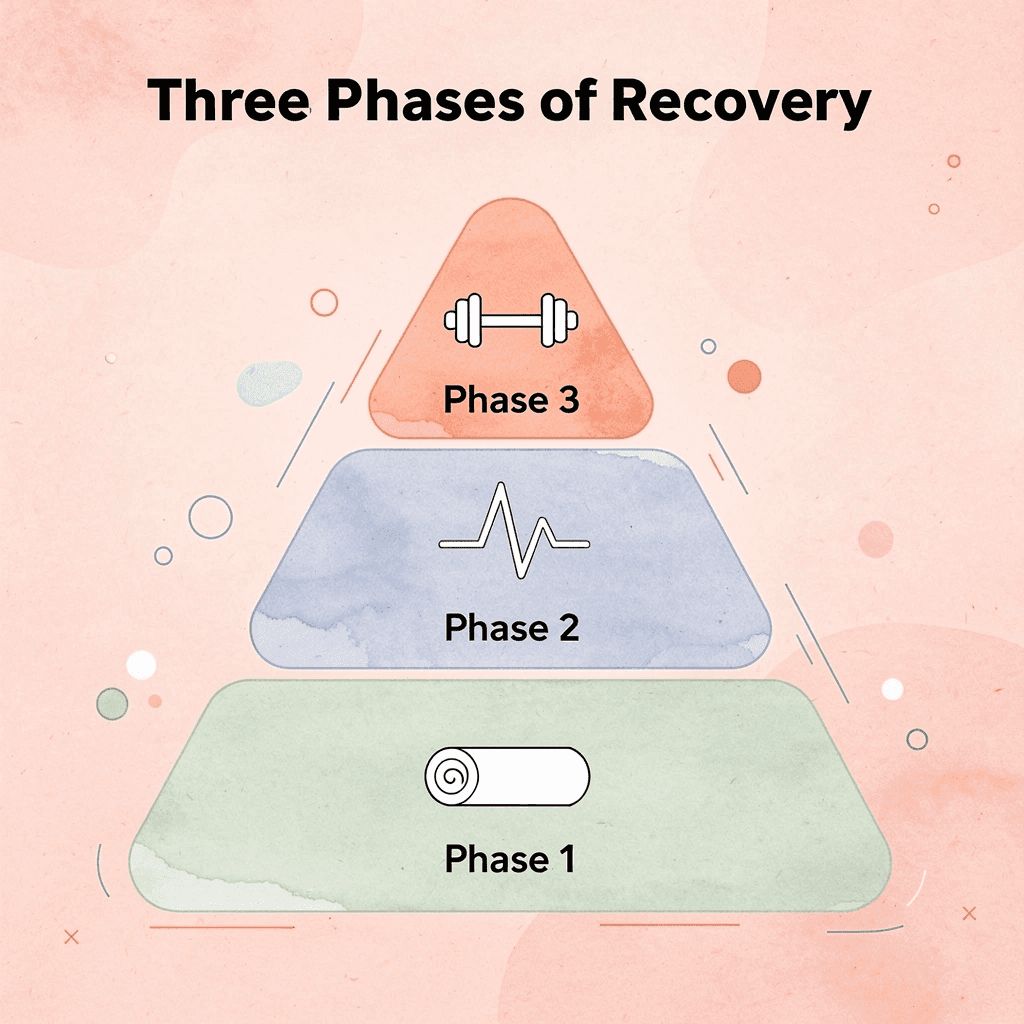
After having a baby, fitness comes back in three distinct phases — and understanding each one is essential to a safe, effective recovery. Phase 1 rebuilds the foundation: think deep core activation, pelvic floor reconnection, and gentle breath work that most new moms overlook. Phase 2 restores strength, reintroducing load-bearing movement and building the muscular resilience your body needs. Phase 3 builds endurance and broader fitness capacity, expanding into true athletic performance and long-term wellness. Skip a phase, and you are borrowing against your body’s future — setting yourself up for injury, setbacks, and frustration.
| Phase | Primary Focus | Key Goal |
|---|---|---|
| Phase 1 | Foundation rebuilding | Pelvic floor & core reconnection |
| Phase 2 | Strength restoration | Load-bearing movement & resilience |
| Phase 3 | Endurance & fitness capacity | Long-term athletic performance |
“Postpartum recovery is not a straight line — it’s a structured progression. Rushing through the phases is one of the most common mistakes new mothers make.” — Postpartum Fitness Experts
🎯 Key Point: Each phase builds directly on the last. There are no shortcuts — your body needs every step of this progression to recover safely and sustainably.
⚠️ Warning: Jumping straight into high-intensity workouts before completing Phase 1 and Phase 2 dramatically increases your risk of pelvic floor dysfunction, diastasis recti complications, and long-term injury.

Phase 1: Reconnection Before Everything Else
Healthline’s postpartum workout guidance notes that Phase 1 begins at 0 to 2 weeks after giving birth, with gentle movements such as diaphragmatic breathing and pelvic floor exercises. Breathing drills restore coordination between the diaphragm, deep abdominals, and pelvic floor: three systems pregnancy disrupts in ways motivation alone cannot fix. Walking improves circulation and restores movement without stressing healing tissue. Mobility work addresses stiffness from feeding positions, carrying a newborn, and prolonged sitting. This phase is not exercise; it is foundational recovery.
Phase 2: Rebuilding Strength With Intention
Once movement feels coordinated and symptoms are stable, strength rebuilding begins with bodyweight exercises, controlled resistance, glute activation, and functional movement patterns that mirror the demands of daily motherhood. Squats, bridges, bird dogs, and resistance band work rebuild the muscular system to support posture, pelvic stability, and the physical demands of early parenthood. Movement quality matters more than load or intensity at this stage. Women who progress too quickly often discover that heavier training later reveals the gaps they skipped.
Phase 3: Fitness and Endurance on a Rebuilt Base
Phase 3 is where training resembles regular exercise: longer workouts, more resistance, and full-body conditioning. Research published in a 2025 assessment of postpartum exercise practice recommends 150 minutes per week of moderate-intensity physical activity for postpartum women, a goal that becomes possible once the body has moved through earlier phases. Low-impact conditioning builds heart and lung fitness without stressing a still-healing pelvic floor. Women who followed the sequence feel structurally strong in ways pre-pregnancy training never required.
What kind of training is best for a post-birth body at this stage?
Lagree in London fits naturally into Phase 3 because the Megaformer’s spring-based resistance creates a full-body muscle challenge without the impact load a post-birth body isn’t ready to handle. Women who rebuilt their foundation through Phases 1 and 2 find that Lagree’s combination of strength, toning, and endurance training delivers what this stage requires: progressive challenge, controlled resistance, and results. Knowing the phases is only part of what makes a postpartum return to exercise effective.
A Sample Beginner Postpartum Workout Plan
Getting your body back after having a baby is about planning, not pushing hard. The sample plan below gives you a concrete weekly structure that honors where your body actually is — not where you think it should be.
“Postpartum recovery is a gradual process — honoring your body’s timeline is the most powerful thing you can do for long-term fitness success.” — Postpartum Fitness Experts
| Phase | Focus | Intensity |
|---|---|---|
| Week 1–2 | Rest & gentle movement | Very low |
| Week 3–4 | Breathing & core reconnection | Low |
| Week 5–6 | Light walking & mobility | Moderate-low |
| Week 6+ | Structured workouts begin | Progressive |
💡 Tip: A structured weekly plan removes the guesswork — so you can focus your limited energy on recovery, not decision-making.
⚠️ Warning: Never skip the early low-intensity phases — rushing into high-impact exercise too soon is one of the most common postpartum mistakes and can delay your recovery significantly.

What does a smart first week look like?
Day 1 focuses on basic reconnection and movement: diaphragmatic breathing (5 to 10 slow breaths), pelvic tilts (2 sets of 10), cat-cow stretches (2 sets of 8 to 10), heel slides (2 sets of 8 per side), and 10 to 20 minutes of gentle walking. You should finish feeling awake, not tired. If you could have done more, that’s exactly right.
How do days two through seven build on that foundation?
Day 2 is rest or light walking. Day 3 introduces full-body strength with glute bridges, sit-to-stands, bird dogs, wall push-ups, and supported squats (2 to 3 sets each at controlled tempo). Day 4 focuses on recovery and mobility, targeting the hips, lower back, chest, and shoulders.
Day 5 builds on Day 3 with stability work, including modified lunges, resistance-band rows, side-lying leg lifts, dead bugs, and light farmer carries. Day 6 adds 20-30 minutes of low-impact cardio at a conversational pace. Day 7 is full recovery. According to ISSA’s Post-Pregnancy Workout Plan, starting with 10 to 15 minutes of light activity per day in the early postpartum period provides the body with sufficient stimulus to adapt without creating stress it cannot absorb.
Why recovery days are part of the training, not a break from it
The failure point in most postpartum fitness plans is not the workouts: it is recovery. Your body is healing tissue, controlling hormones, managing sleep debt, and supporting another human being simultaneously. Rest days enable muscle repair, connective tissue rebuilding, and nervous system consolidation of movement patterns from training. Skipping them does not speed up progress; it slows it down. Most women who plateau in the first six weeks of postpartum exercise are not training hard enough—they are not recovering enough.
What happens when you push through fatigue too soon?
A common mistake is following a generic program and pushing through fatigue as a sign of commitment. This creates a buildup of stress in a body that hasn’t rebuilt its structural support system, leading to setbacks that erase weeks of progress. Women who train in a structured, low-impact environment like BST lagree benefit from the Megaformer’s spring-based resistance, which allows meaningful intensity while the controlled, slow-tempo format naturally prevents the overload that derails home programs.
How to progress without pushing too hard
Progressive overload after pregnancy should be careful and intentional. Ingrid and Isabel’s week-by-week postpartum exercise guide notes that ACOG recommends waiting 6 weeks after vaginal delivery and 8 weeks after C-section before resuming exercise. Early weeks focus on rebuilding movement quality, not volume. Small progressions—one extra repetition, two more minutes of walking, or a light resistance band added to a bridge—add up to measurable strength gains. Watch for pelvic pressure, abdominal doming, urinary leakage, or increased bleeding. Any of these signals means scaling back; listening is the fastest way forward.
But following the right plan and recovering well still leaves one critical variable unaddressed: the one that quietly undoes more postpartum progress than almost anything else.
Related Reading
- Kegel Exercises Postpartum
- Postpartum Strength Workout
- Postpartum Diastasis Recti Workout
- Easy Postpartum Workout
- Postpartum Arm Workout
- Postpartum Full Body Workout
- Postpartum Core Workout
- 6 Week Postpartum Workout Plan
- Postpartum Pelvic Floor Exercises
- Postpartum Workout Plan At Home
- Post Pregnancy Workout Plan
- Pilates Exercises For Post Pregnancy
- Postpartum Diastasis Recti Workout
- Postpartum Pelvic Floor Exercises
- Postpartum Belly Exercises
Common Postpartum Workout Mistakes That Slow Progress
Rushing back to exercise is the most expensive mistake a postpartum body can make. The mistakes that slow recovery are rarely dramatic — they are quiet, repeated choices that compound in the wrong direction.
“The mistakes that slow postpartum recovery are rarely dramatic — they are quiet, repeated choices that compound in the wrong direction.”
⚠️ Warning: Returning to intense exercise too soon after birth is one of the leading causes of prolonged recovery, pelvic floor dysfunction, and setbacks that can take months to undo.
💡 Tip: Before resuming any workout routine, listen to your body’s signals — pain, pressure, or leaking are never signs to push through. These are your body’s non-negotiable warning flags.
| Common Mistake | Why It Slows Progress |
|---|---|
| Returning too soon | Overloads a still-healing core and pelvic floor |
| Skipping rest days | Prevents tissue repair and hormonal recovery |
| Ignoring warning signs | Turns minor setbacks into long-term complications |

Why does medical clearance not mean you are ready for full intensity?
The most damaging pattern is treating medical clearance as a green light for full intensity. According to Rethinking Prenatal and Postpartum Exercise, Delaware Journal of Public Health, postpartum women who return to high-intensity exercise before six weeks face an increased risk of pelvic floor dysfunction, affecting up to 30% of new mothers. Clearance means healed incisions and stable vitals, not restored connective tissue, coordinated core function, or a pelvic floor ready to absorb impact. Confusing these different levels of healing is where most setbacks begin.
How does sleep debt undermine progress in postpartum training?
The second mistake is training without accounting for sleep debt. Chronic sleep deprivation reduces the hormones that help your body repair tissue and muscle protein synthesis. A 45-minute strength session on four hours of broken sleep produces a different physiological response than the same session on seven hours of sleep. When cortisol remains elevated and recovery hormones remain suppressed, even a well-designed plan stops working.
Which exercise formats create joint stress a postpartum body cannot yet absorb?
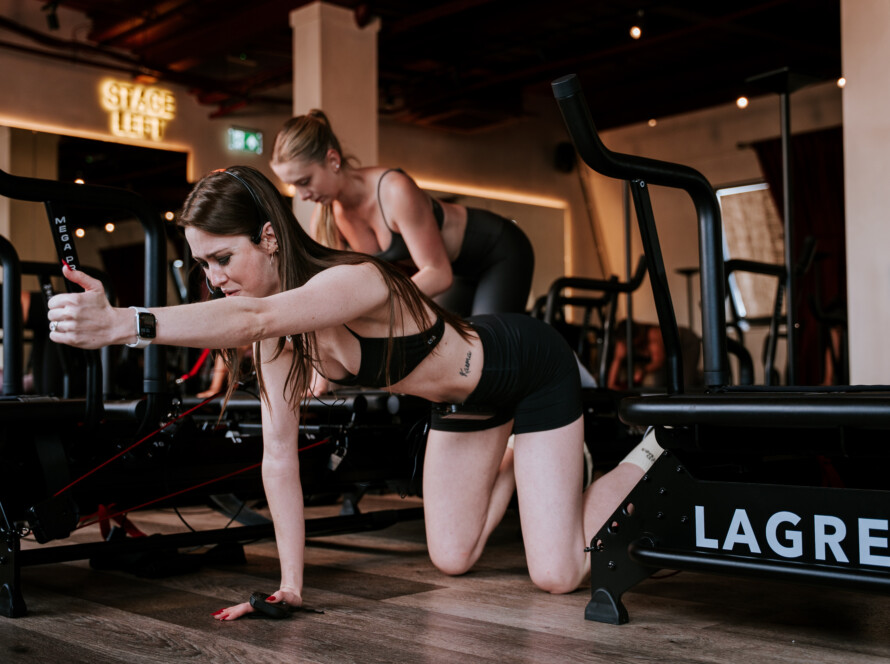
The third mistake is choosing exercise formats that create joint stress the postpartum body cannot yet handle. Running, jumping, and heavy bilateral loading place significant demands on structures that are still rebuilding collagen and regaining neuromuscular coordination. Many new mothers find themselves stuck between walking and high-impact training. The Lagree Method, offered at BST Lagree in London, addresses this gap. Our Megaformer delivers high-intensity, full-body training through slow, controlled resistance rather than impact: genuine cardiovascular and muscular demands without the joint loading that postpartum connective tissue struggles to handle.
Why do misaligned expectations and psychological pressure stall recovery?
The fourth mistake is neglecting the psychological dimension of recovery. According to Rethinking Prenatal and Postpartum Exercise, Delaware Journal of Public Health, only 15% of postpartum women meet recommended physical activity guidelines in the first year after delivery. This reflects insufficient guidance and unrealistic expectations, not laziness. What’s missing is a realistic plan that respects the body’s needs.
The failure point usually occurs when expectations don’t match what the body can do. When a postpartum woman works hard at the wrong things too soon, she creates a problem where discomfort feels like danger, confidence declines, and exercise feels like rejection instead of rebuilding. The way back requires better planning, honest signals from the body, and a plan that builds the body’s trust before asking it to perform at its best. The right environment enables trust to develop faster than expected.
How BST Lagree Helps New Moms Rebuild Strength Safely
Many women eventually look for structured strength training beyond basic postpartum exercises. The challenge is finding a workout that helps you make progress without putting stress on a recovering body. BST Lagree offers controlled, full-body strength training that builds strength, stability, and endurance safely—providing a practical bridge between early recovery and long-term fitness.
💡 Tip: If basic postpartum movements feel too easy but traditional gym workouts feel too intense, BST Lagree is designed to fill exactly that gap—safely and effectively.
“The biggest postpartum fitness challenge isn’t motivation—it’s finding a method that rebuilds strength progressively without overwhelming a body that is still healing.” — BST Lagree
⚠️ Warning: Jumping into high-impact or heavy-load training too soon after birth can strain healing tissues. Always prioritize controlled, low-impact methods like BST Lagree before advancing intensity.
| Training Type | Impact Level | Safe for Early Postpartum? | Builds Long-Term Strength? |
|---|---|---|---|
| BST Lagree | Low | ✅ Yes | ✅ Yes |
| Traditional Weightlifting | High | ⚠️ Caution | ✅ Yes |
| Basic Postpartum Exercises | Very Low | ✅ Yes | ⚠️ Limited |
| High-Intensity Cardio | Very High | ❌ No | ⚠️ Limited |
🔑 Takeaway: BST Lagree is uniquely positioned as the safest and most effective structured workout for new moms—bridging the gap between gentle recovery and real, lasting fitness progress.

Why is low-impact training important for postpartum recovery?
Women after giving birth often struggle with traditional fitness programs because many workouts stress joints and connective tissues. Pregnancy hormones affect joint stability, and the body continues adjusting months after delivery. Our low-impact training at BST Lagree reduces stress while delivering a challenging workout. Slow, controlled exercises build muscle strength without excessive impact on the knees, hips, ankles, or lower back, lowering the risk of worsening common postpartum discomforts. Finding time to exercise is a significant challenge for new mums. Our BST Lagree classes deliver a full-body workout in approximately 45 minutes, engaging multiple muscle groups and combining strength, stability, endurance, and core work in a single session.
How does controlled movement support postpartum strength and stability?
After pregnancy, how you move matters as much as how hard you work. Many women experience changes in balance, posture, and core function. Our BST Lagree classes focus on slow, controlled movements that encourage proper alignment and body awareness, building stability and reinforcing healthy movement patterns for everyday activities. The core plays a central role in postpartum recovery. Pregnancy affects the abdominal muscles, pelvic floor, breathing mechanics, and trunk stability. Lagree training naturally incorporates significant core engagement throughout each workout rather than isolating it at the end, making it effective for women with an established recovery foundation.
How does BST Lagree accommodate individual recovery needs?
No two postpartum journeys are the same. Our BST Lagree classes accommodate individual fitness levels and recovery needs, allowing women to work at an appropriate intensity while progressing safely as strength improves. Returning to exercise after childbirth can feel daunting. Our BST Lagree-certified instructors provide guidance on form, movement quality, and modifications while creating a supportive environment for women rebuilding confidence in their bodies.
Many postpartum women are rebuilding trust in their bodies, not just strength. Our BST Lagree community is women-focused, where participants focus on their own progress without pressure to keep up with others. The emphasis is on becoming stronger, healthier, and more capable over time rather than on appearance or weight loss.
How does structured programming remove the guesswork from postpartum fitness?
One of the biggest barriers to postpartum fitness is uncertainty about how often to exercise, which exercises to do, and how hard to work. Our structured classes at BST Lagree remove this guesswork. A professionally designed program balances challenge and progression, eliminating the need to create your own workouts or second-guess your exercise choices. This structure enables consistency and lets you focus on execution rather than planning.
The postpartum period bridges recovery and long-term fitness goals. Many women want to return to regular exercise, improve their fitness levels, and build lasting strength. Our BST lagree program provides this bridge through low-impact training, full-body strength work, core engagement, professional guidance, and progressive modifications. Rather than rushing into demanding workouts, women can build strength gradually while developing the stability and confidence needed for continued progress.
Book a Lagree Class in London Today
BST Lagree in London’s Angel studio offers high-intensity, low-impact training on the Megaformer that builds postpartum strength, toning, and endurance without the joint stress that can slow down early recovery — matching where your body actually is, not where you think it should be.
“High intensity, low impact training meets you where your body is — building strength and endurance without the joint stress that derails early postpartum recovery.” — BST Lagree
🎯 Key Point: The Megaformer delivers a full-body workout that is specifically designed to protect vulnerable postpartum joints while still driving real, measurable results.
| Training Feature | Why It Matters Postpartum |
|---|---|
| High Intensity | Maximizes calorie burn and muscle activation |
| Low Impact | Protects joints and pelvic floor during recovery |
| Megaformer Machine | Provides controlled resistance for safe progression |
| Women-Focused Studio | Environment built around your specific needs |

Book your first class at BST lagree and experience a structured, women-focused approach to postpartum fitness. Your body has done something extraordinary: the next step is giving it a plan that respects that.
💡 Tip: Your first class is the most important step. A structured program tailored to postpartum recovery is more effective than returning to generic fitness routines too soon.
✅ Best Practice: Choose a studio like BST Lagree that combines expert coaching, a supportive community, and low-impact methodology to ensure your postpartum comeback is safe, sustainable, and empowering.
Related Reading
- How To Lose Pregnancy Belly After 2 Years
- Pilates Exercises For Post Pregnancy
- Best Postpartum Exercises
- Postpartum Gym Workout
- Best Way To Lose Postpartum Belly Fat
- Best Postpartum Ab Workout
- Postpartum Pilates Workout
- Post Pregnancy Workout Plan
- Best Postpartum Workout App