After childbirth, the body needs deliberate, structured recovery, yet pelvic floor rehabilitation is one of the most commonly skipped steps. Kegel exercises postpartum rebuild the muscles responsible for bladder control, core stability, and overall pelvic health, making them a smarter first postpartum workout than most new mothers realize. Rushing past them or skipping them entirely can undermine progress for months.
Treating pelvic floor work as a foundation rather than an afterthought sets new mothers up for stronger, safer progress as training intensity increases over time. For those ready to take a structured approach to postpartum recovery, Lagree in London offers training that integrates pelvic floor rehabilitation with full-body conditioning from the start.
Summary
- Kegel exercises are genuinely useful for postpartum recovery, but the advice surrounding them leaves significant gaps. A 2021 study published in PMC found that 31% of women still reported urinary incontinence at six weeks postpartum despite having done Kegels during pregnancy. The problem is not effort. It is that the instructions most women receive are incomplete.
- Instruction quality is a bigger barrier than most providers acknowledge. The same study found that only 38% of women received adequate guidance on how to perform Kegel exercises correctly from their prenatal care provider. Common errors like holding the breath or clenching the glutes during the movement actively undermine the exercise, shifting load away from the target muscles entirely.
- Even women performing Kegels correctly face a ceiling that isolated pelvic floor work cannot break through. Up to 50% of women perform Kegels incorrectly, according to Kind Health Group, but even those doing them precisely still leave the rest of the system, including the abdominals, glutes, diaphragm, and spinal stabilizers, unaddressed. Pregnancy reorganizes the entire movement system over nine months, and no single exercise can reverse it.
- Some postpartum women are not dealing with a weak pelvic floor at all. A hypertonic pelvic floor, where the muscles are chronically over-tensed rather than under-active, requires the opposite intervention. Without a proper assessment from a pelvic floor physiotherapist, doing more Kegels in this case does not help. It makes things worse.
- The structural consequences of pregnancy are more widespread than most recovery conversations reflect. Research published in the British Journal of Sports Medicine found that approximately 60% of women had diastasis recti at six weeks postpartum, and research from Care New England notes that 1 in 3 women experience pelvic floor dysfunction. Meanwhile, 40% of women do not attend their postpartum visit at all, meaning nearly half of new mothers are making recovery decisions without any professional baseline assessment.
- Recovery timelines are not one-size-fits-all, and generic programs routinely miss this. Research published in PMC found that women who underwent cesarean section had return-to-normal-activity timelines delayed by up to six weeks compared to vaginal delivery. A program designed without accounting for delivery type, healing stage, or symptom profile can actively slow progress rather than support it.
- BST Lagree in London addresses this gap by offering structured, progressive, full-body training on the Megaformer that builds on pelvic floor foundations rather than treating them as the finish line.
Why So Many New Moms Still Struggle After Doing Kegels
Kegel exercises are not failing new moms. The advice surrounding them is.
Most women are told to do Kegels and assume repetition will fix what pregnancy changed. However, a 2021 study published in PMC/Journal of Women’s Health found that 31% of women reported urinary incontinence at six weeks postpartum despite performing Kegel exercises during pregnancy, suggesting these instructions alone are insufficient.
Why the standard advice leaves so much out
Only 38% of women received adequate instruction on how to correctly perform Kegel exercises from their prenatal care provider. More than half were sent home to practice a technique they were never properly taught. Holding your breath during a Kegel increases abdominal pressure and forces the pelvic floor to work against itself. Clenching the glutes shifts the load entirely away from the target muscles. These mistakes are common when guidance is generic and rushed.
Why does pregnancy change more than just the pelvic floor?
Pregnancy affects much more than the pelvic floor. Over nine months, the abdominal wall stretches, the diaphragm shifts, posture changes, and the hips and glutes reorganize how they carry weight. Strengthening a single muscle group cannot undo that widespread change.
Many new mums focus on pelvic floor exercises while neglecting the rest of the system. Studios like BST Lagree approach this differently, building postpartum programming around the Megaformer to address deep core activation, hip and glute strength, and breathing mechanics in tandem, treating pelvic floor recovery as a single layer of a full-body rebuild rather than a standalone fix.
When can Kegel exercises actually make things worse?
Some women have a hypertonic pelvic floor: muscles that are chronically over-tensed rather than under-active. For them, Kegel exercises worsen symptoms. Without proper assessment from a pelvic floor physiotherapist, there is no way to know which category applies.
Understanding what Kegels do well and where their role ends changes the entire shape of a recovery plan.
What Kegel Exercises Postpartum Actually Help With
Kegel exercises help retrain pelvic floor muscles that get stretched or weakened during pregnancy and childbirth. They work really well for this specific purpose, but they also have important limits worth understanding.
“The pelvic floor is a group of muscles and connective tissues that support the bladder, bowel, and uterus — and postpartum recovery depends heavily on retraining them.” — Pelvic Health Research
| What Kegels Help With | Why It Matters Postpartum |
|---|---|
| Urinary incontinence | Reduces leaking when sneezing or laughing |
| Pelvic organ support | Helps lift and stabilize weakened structures |
| Sexual function recovery | Restores sensation and muscle tone |
| Core stability foundation | Reconnects deep core after delivery |
💡 Tip: Start Kegel exercises as early as 24–48 hours after a vaginal birth — gentle contractions can begin rebuilding strength almost immediately.
⚠️ Warning: Kegels are not a one-size-fits-all fix. If you have pelvic floor tension or prolapse, performing Kegels incorrectly can make symptoms worse — always consult a pelvic floor specialist first.

What changes inside the pelvic floor after birth
The pelvic floor supports the bladder, bowel, and uterus while working with the diaphragm and deep abdominals to manage pressure during movement. After childbirth, this coordination is often disrupted: some women lose the ability to tighten effectively, while others lose the ability to fully relax. Kegel exercises rebuild intentional muscle activation, improving strength, endurance, and the brain-to-muscle connection that pregnancy weakens.
How much can Kegel exercises reduce postpartum symptoms?
When done correctly and at the right time, the results can be significant. According to BabyCenter, Kegel exercises can reduce urinary incontinence by up to 70% in women after giving birth, a meaningful result for leakage during coughing, sneezing, or exercise. Research published in a 2026 study on postpartum pelvic floor health education found measurable reductions in pelvic floor dysfunction scores at six weeks postpartum among women who received structured Kegel guidance, suggesting that education and consistency drive better outcomes than isolated effort.
How do Kegels build the foundation for full postpartum recovery?
The pelvic floor creates a stable foundation for the entire core system, allowing the abdominals, diaphragm, and spinal stabilizers to work together efficiently. Kegel exercises restore muscle tone and coordination in this critical layer. Like repairing a building’s base before rebuilding the floors above, the foundation matters, but it does not replace what still needs to happen higher up.
Why is pelvic floor work alone not enough to rebuild the whole body?
Most postpartum recovery plans treat Kegels as the complete solution rather than one component of a larger process. Women who return to physical training with only pelvic floor work often find their core unstable, their hips weak, and their body unresponsive. This gap signals that the surrounding system—glutes, abdominals, postural muscles, and movement patterns—still needs rebuilding. Studios like BST Lagree in London address this gap by offering high-intensity, low-impact, full-body training on the Megaformer that progressively rebuilds strength, stability, and endurance throughout the body once the pelvic floor foundation is in place.
The difference between recovery and restoration
Kegels can help a woman recover pelvic floor function, but cannot restore the full physical capacity that pregnancy changes. Recovery and restoration are not the same thing. Pelvic floor training is the beginning of a physical evolution, not the destination. Women who progress most confidently treat Kegel work as rebuilding the foundation, then deliberately build on top of it.
Even when women understand this correctly, one piece of the picture quietly undermines their progress in less visible ways.
Related Reading
- First Postpartum Workout
- When Can I Workout Postpartum
- Is Pilates Good for Postpartum Weight Loss
- Can I Do Pilates 3 Weeks Postpartum
- Bird Dog Exercise Postpartum
- Postpartum Glute Bridge Exercise
- Postpartum HIIT Workout
- Postpartum Kettlebell Workout
- Postpartum Dumbbell Workout
Why Kegels Alone Often Aren’t Enough
Kegel exercises rebuild the pelvic floor, but not a body that spent nine months reorganizing itself from the inside out. That critical difference matters more than postpartum recovery plans typically recognize.
“Kegel exercises rebuild the pelvic floor — but not a body that spent nine months reorganizing itself from the inside out.”
⚠️ Warning: Focusing exclusively on Kegel exercises after birth addresses one piece of a much larger recovery puzzle, leaving the rest of your body behind.
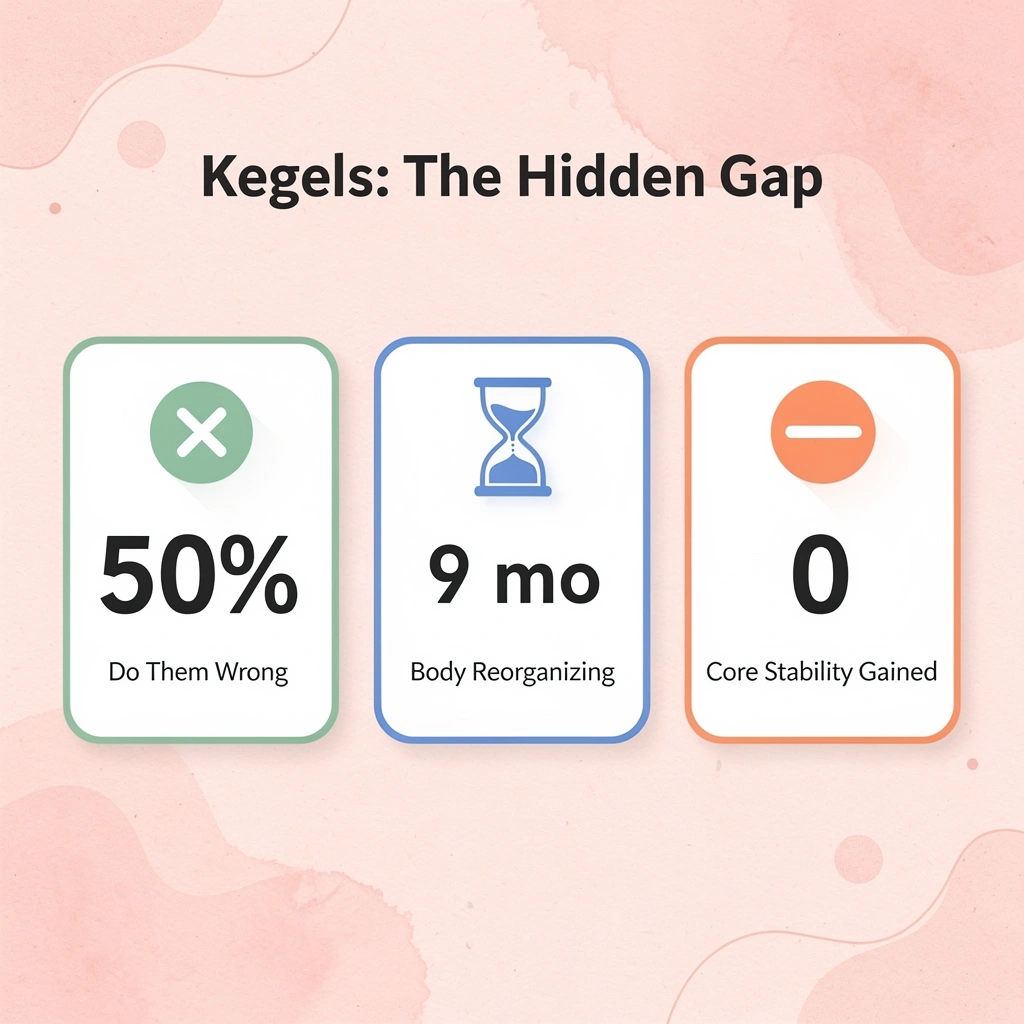
According to Kind Health Group, up to 50% of women who do Kegel exercises do them incorrectly. Even when done perfectly, a stronger pelvic floor doesn’t automatically mean a stable core, responsive hips, or the full-body strength needed for daily life with a newborn.
| What Kegels Address | What Kegels Miss |
|---|---|
| Pelvic floor muscle contraction | Core stability and deep abdominal function |
| Urinary control | Hip strength and glute activation |
| Isolated pelvic strength | Full-body functional movement |
🔑 Takeaway: When up to half of all women are performing Kegels incorrectly, the exercise most postpartum plans rely on is already working at a significant disadvantage — before accounting for everything it doesn’t target.
💡 Tip: A complete postpartum recovery plan should address pelvic floor function, core reconnection, hip mobility, and total-body strength — not just one isolated muscle group.
What the body actually loses during pregnancy
The abdominal wall stretches and loses tension. The glutes weaken due to altered movement patterns. Spinal alignment shifts. Breathing mechanics change as the diaphragm adapts to less space. These system-wide changes do not reverse simply because the baby has arrived. A woman can complete her Kegel routine daily and still feel unstable when she picks up her child, because the instability was never a pelvic floor problem alone.
Why does focusing only on Kegels leave recovery incomplete?
The failure point is usually a recovery plan that treats one piece of the system as if it were the whole. Most women default to Kegels, but when glute weakness, shallow breathing, and core disconnection remain unaddressed, progress stalls. Care New England notes that 1 in 3 women experience pelvic floor dysfunction, yet the broader physical consequences of pregnancy rarely receive equal attention in standard recovery conversations.
How does treating the pelvic floor as a starting point change outcomes?
Women who move through recovery most effectively treat pelvic floor work as the starting point for rebuilding the whole body, not the finish line. BST Lagree offers high-intensity, low-impact, full-body training on the Megaformer that simultaneously challenges the core, glutes, hips, and stabilizers, providing a natural next step for women ready to move beyond isolated recovery exercises.
Recovery is about restoring how the entire movement system communicates under load, fatigue, and the physical demands of motherhood. Women who understand this earliest tend to progress fastest, not because they worked harder, but because they worked in the right direction from the start.
But knowing what to add to your recovery is only half the equation. What you avoid in those early weeks matters equally.
7 Postpartum Recovery Mistakes That Slow Progress
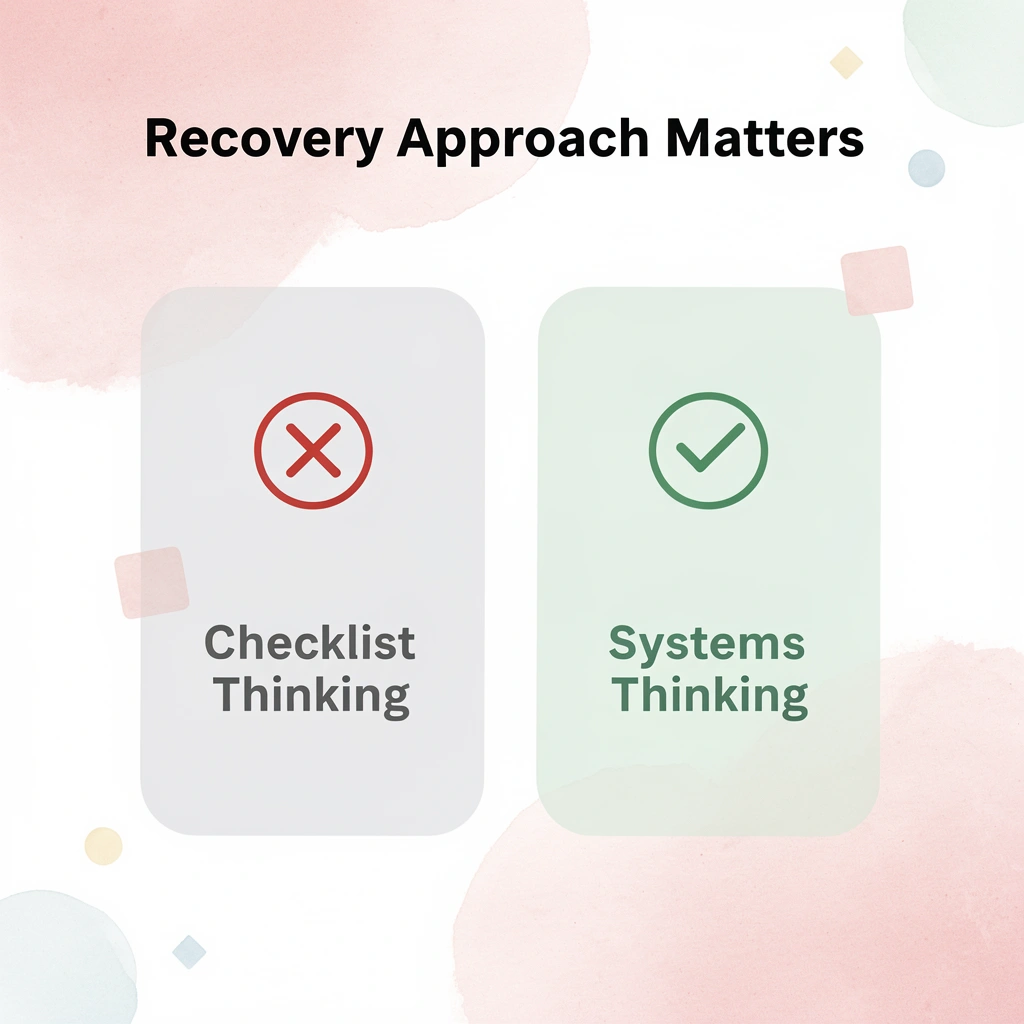
Most problems after having a baby come from treating recovery like a checklist instead of a system. The mistakes that take the most time are usually not the dramatic ones.
“Recovery is not a checklist — it’s a system that requires consistency, patience, and the right approach from day one.” — Postpartum Health Insight
⚠️ Warning: Treating postpartum recovery as a one-and-done checklist is one of the most common — and most costly — mistakes new mothers make. Small, repeated missteps compound into long-term setbacks.
💡 Tip: Shift your mindset from “Am I done yet?” to “Am I building the right habits?” — this single mental shift can dramatically speed up your postpartum progress.
| Checklist Mindset | Systems Mindset |
|---|---|
| Focuses on completing tasks | Focuses on building habits |
| Short-term thinking | Long-term consistency |
| Leads to burnout and stalls | Leads to sustainable recovery |
| Ignores root causes | Addresses underlying patterns |
1. Relying Only on Kegels
Kegel exercises are important, but treating them as the only answer leaves many women stuck. Pregnancy reshapes the abdominal wall, alters hip mechanics, shifts spinal alignment, and changes how the diaphragm functions under pressure. Focusing solely on the pelvic floor leaves everything else unaddressed.
2. Returning to Exercise Too Quickly
The pressure to “bounce back” is real, but returning to high-impact training before foundational strength has been rebuilt stresses tissues that are still healing. This often worsens symptoms like pelvic heaviness or urinary leakage. Recovery is not a competition with someone else’s timeline.
3. Ignoring Core Strength
The pelvic floor and core are not separate systems. Weak core coordination after birth makes everyday demands—lifting a baby, carrying a car seat, bending repeatedly—significantly harder. Research in the British Journal of Sports Medicine found that approximately 60% of women had diastasis recti six weeks postpartum, demonstrating how common abdominal changes are and how often they go unaddressed.
4. Neglecting Breathing Mechanics
During pregnancy, breathing patterns change as the diaphragm adjusts to a growing uterus. These changes often persist postpartum, unnoticed. When the diaphragm, deep abdominal muscles, and pelvic floor cannot work together effectively, core pressure management breaks down. This means that even well-designed exercises produce diminished benefits.
5. Avoiding Strength Training
Many women stick with gentle rehabilitation exercises for months because they worry that anything harder will cause harm. Motherhood is physically demanding from day one, and a body that never gradually takes on more weight will not build the strength needed to handle those demands. Strength training, started at the right point in recovery, rebuilds the ability that pregnancy depleted.
Most women who stay stuck in the rehabilitation phase are missing the bridge between recovery and real physical capability.
Why do generic online programs fall short for women rebuilding after birth?
The same pattern shows up in how women choose their postpartum fitness environment. Many are drawn to generic online programs because they feel accessible and low-commitment. A program designed for no one in particular rarely works well for any individual. Progression that doesn’t match someone’s actual recovery stage either moves too quickly or progresses too slowly. Women rebuilding after birth need training that responds to their body, not a fixed script.
How does Lagree close the gap between rehabilitation and transformation?
This is where BST Lagree in London offers a different path. Our Megaformer’s high-intensity, low-impact design allows women to rebuild full-body strength, endurance, and stability without the joint stress of traditional high-impact exercise. For women transitioning out of early postpartum recovery, it bridges rehabilitation and transformation.
6. Skipping Postpartum Care Visits
According to Medbridge, 40% of women do not attend their postpartum visit, meaning nearly half of new mothers make recovery decisions without medical evaluation of their healing.
Without a postpartum assessment, problems like pelvic organ prolapse, abdominal separation, or pelvic floor hypertension often go undetected until they become difficult to treat. The six-week check is the foundation for informed recovery decisions.
7. Following Generic Online Workouts
Women often follow programs not designed for their specific delivery experience, healing timeline, or symptom profile. A workout for someone eight months postpartum differs fundamentally from one suited to someone six weeks postpartum after a cesarean birth.
Research published in PMC shows cesarean recovery timelines are delayed by up to six weeks compared to vaginal delivery. Generic progression that ignores delivery type can slow recovery rather than support it.
Prioritizing Weight Loss Over Recovery
Trying to lose weight immediately after having a baby creates an energy deficit that slows healing. Insufficient calorie intake during a period when your body needs energy for tissue repair, hormone regulation, and often breastfeeding impairs recovery. Physical change follows function: as your body becomes stronger and more capable, your body composition shifts naturally.
What does a better approach to postpartum recovery actually look like?
Women who recover most completely treat the postpartum period not as a setback to overcome, but as a starting point for something more capable than what came before. That reframe changes how they train, fuel, and measure progress.
The more interesting question is what effective postpartum fitness looks like when built correctly from the ground up.
What Effective Postpartum Fitness Looks Like
Good postpartum fitness is a step-by-step plan that rebuilds your whole body from the inside out. It starts with deep internal coordination — targeting your pelvic floor, diaphragm, and core stabilizers — and works progressively outward into full-body strength and function.
“Postpartum recovery isn’t about bouncing back — it’s about building forward, one layer of strength at a time.” — Postpartum Fitness Principle
| Phase | Focus Area | Goal |
|---|---|---|
| Phase 1 | Deep internal coordination | Restore pelvic floor & core connection |
| Phase 2 | Stability & alignment | Build foundational movement patterns |
| Phase 3 | Full-body strength | Return to functional fitness |
💡 Tip: Always start with internal coordination before progressing to high-impact exercise — skipping this step is the most common postpartum fitness mistake.
⚠️ Warning: Jumping straight into intense workouts without rebuilding deep core function can worsen conditions like diastasis recti or pelvic floor dysfunction. Progression matters.

Where the real work begins
Pelvic floor awareness is the starting point, not the end goal. Once you can coordinate that deep muscle activation with your breath and movement, your body is ready for more challenging work. This layering is where most recovery programs either succeed or fail. According to a systematic review of clinical guidelines published in 2026, health organizations recommend at least 150 minutes per week of moderate-intensity aerobic activity postpartum, alongside muscle-strengthening work on at least 2 days per week. These numbers reveal what most women are not told: recovery is neither passive nor minimal.
Why does the body need to be trained as a connected system?
The failure point in most postpartum programs is treating the body as separate parts rather than a connected system. Your diaphragm, deep abdominals, spinal stabilizers, glutes, and pelvic floor do not work independently during a squat, a lunge, or picking up a 10-pound car seat. Exercises that train these systems together under controlled load and progressive challenge produce results that isolated rehabilitation work cannot match. Low-impact resistance training builds muscular strength without excessive stress on joints or connective tissue healing.
What does an effective postpartum training approach actually look like?
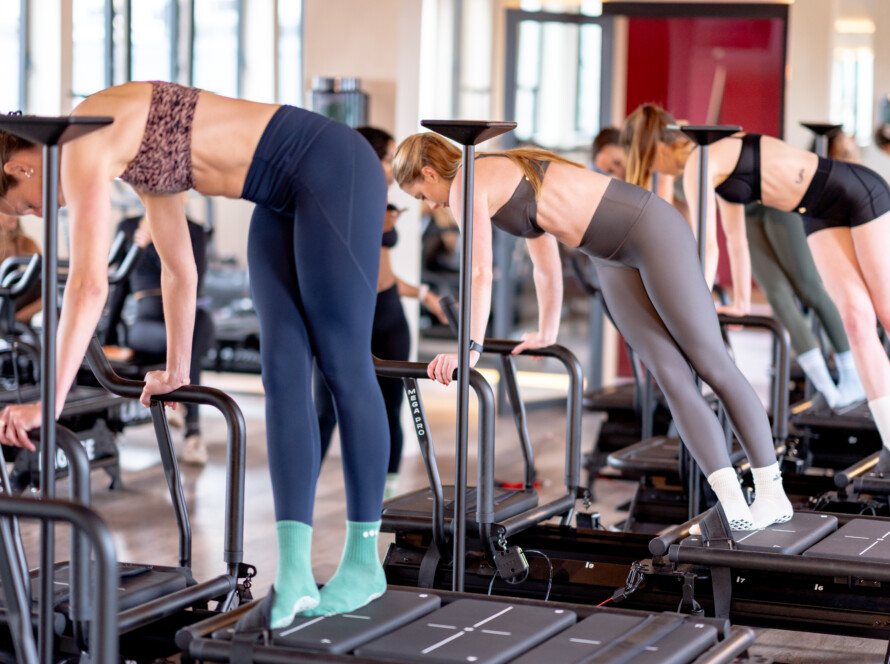
Most postpartum fitness approaches ask women to choose between gentle rehab and intense training. The most effective path sits between them: structured, progressive, full-body movement that respects the body’s current state while consistently challenging it to do more. Studios like BST Lagree in London use the Megaformer to deliver high-intensity, low-impact workouts that strengthen the entire body through controlled resistance and sustained muscle engagement, without the joint stress that derails early postpartum recovery.
Why progression beats intensity every time
The women who recover fastest train consistently and increase the challenge at the right pace. Progression allows your body to adapt, coordination to improve, and confidence to build alongside strength. Without it, the body either stagnates from insufficient stimulus or breaks down from excess.
What does real-life strength actually look like for a new mother?
Being a mother requires whole-body strength. Carrying a baby, pushing a stroller on uneven sidewalks, and repeatedly rising from the floor demand strength, balance, and endurance working in concert. Postpartum fitness aims to build a body that handles daily life more effectively than before pregnancy.
The next question is which environment provides this training in a way that works for a new mother’s life.
Related Reading
- Postpartum Strength Workout
- Postpartum Diastasis Recti Workout
- Easy Postpartum Workout
- Postpartum Arm Workout
- Postpartum Full Body Workout
- Postpartum Core Workout
- 6 Week Postpartum Workout Plan
- Postpartum Pelvic Floor Exercises
- Postpartum Workout Plan At Home
- Best Postpartum Core Exercises
- Pilates Exercises For Post Pregnancy
- Postpartum Diastasis Recti Workout
- Postpartum Pelvic Floor Exercises
- Postpartum Belly Exercises
How BST Lagree Supports Postpartum Strength and Recovery
BST Lagree is a women-focused studio in London built around the Lagree Method, which combines strength, cardio, and endurance in 45-minute low-impact sessions on the Megaformer. For postpartum women, this combination challenges the whole body without the joint stress that makes high-impact training feel too soon. Our certified instructors guide you carefully as you progress, making sure movements are right for your recovery stage. The result is a training environment that treats postpartum fitness as the start of real physical change — not careful rehabilitation.
💡 Tip: If you’re unsure whether you’re ready for group classes, BST Lagree’s certified instructors can assess your recovery stage and tailor your first session to match exactly where you are.
“The Lagree Method combines strength, cardio, and endurance in a single low-impact session — making it one of the most complete training formats available for postpartum recovery.” — BST Lagree
| Training Type | Joint Impact | Full-Body Challenge | Postpartum Suitable |
|---|---|---|---|
| Lagree / Megaformer | Low | ✅ Yes | ✅ Yes |
| High-Impact Cardio | High | ✅ Yes | ⚠️ Often Too Soon |
| Traditional Rehab | Low | ❌ Limited | ✅ Yes |
| Weight Training | Medium–High | ✅ Yes | ⚠️ Requires Clearance |

Recovery ends when you feel strong, capable, and confident in a body that handles real life with ease: that is exactly what BST Lagree is designed to deliver.
🎯 Key Point: Postpartum fitness isn’t about getting back to who you were; it’s about building a stronger, more capable version of yourself. BST Lagree treats every session as a step toward that goal.
⚠️ Warning: Don’t mistake low-impact for low results. The Megaformer creates constant muscular tension that drives strength gains without the recovery setbacks that high-impact training can cause postpartum.
Book a Lagree Class in London Today.
If you’re doing Kegel exercises after giving birth but still don’t feel as strong, stable, or confident as you’d like, BST Lagree can help you move beyond isolated recovery exercises and rebuild full-body strength.
“BST Lagree helps postpartum women move beyond isolated recovery and rebuild full-body strength, stability, and confidence — one class at a time.” — BST Lagree
🎯 Key Point: Kegel exercises alone target only isolated muscle groups; BST Lagree delivers complete, full-body recovery designed for postpartum women.
Book a class today and experience a supportive, low-impact workout designed to help women regain strength and feel more capable in everyday life. With expert guidance in 45-minute classes, you may notice significant improvements in strength, stability, and confidence within two weeks of consistent training.
💡 Tip: Commit to consistent training: results in strength and stability can appear in as little as two weeks.
✅ Best Practice: Choose a low-impact, expert-led class like BST Lagree to safely rebuild postpartum strength without risking injury or overexertion.
Related Reading
- Best Postpartum Exercises
- Pilates Exercises For Post Pregnancy
- Best Way To Lose Postpartum Belly Fat
- Postpartum Pilates Workout
- Beginner Postpartum Workout Plan
- How To Lose Pregnancy Belly After 2 Years
- Post Pregnancy Workout Plan
- Best Postpartum Ab Workout
- Best Postpartum Workout App
- Postpartum Gym Workout