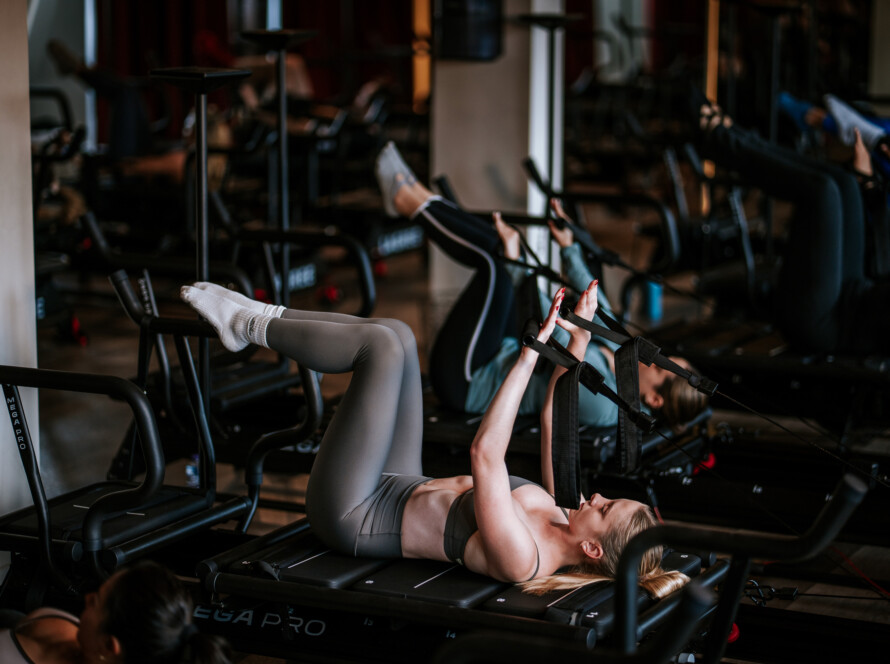
Club Pilates runs on Balanced Body reformers, standardised across every franchise location. Here is what that machine is built to do, and exactly where it stops delivering.
Balanced Body reformers are the confirmed equipment across all Club Pilates franchise locations, standardised so that a member stepping into a studio in London gets the same machine as one in Los Angeles. Club Pilates, founded in 2007, built its entire franchise model around a carefully selected equipment suite. Studios use multiple equipment brands alongside the Reformer, including TriggerPoint, TRX® springboard, and EXO-chair, rather than naming a single exclusive equipment partner.
That choice was the architectural decision that made a global franchise possible. The reformers in Club Pilates studios come from Balanced Body’s commercial range, engineered for daily multi-user use, consistent spring tension calibration, and the kind of frame durability that survives back-to-back class schedules. This is a formal supply partnership, not a loose convention where individual franchise owners browse equipment catalogues and pick their preference.
Club Pilates standardises its equipment suite at the franchise level, so the reformer brand is locked in as part of the franchise agreement, not left to each studio owner’s discretion. The result is operational consistency: instructors trained on Balanced Body reformers at one location can walk into any other Club Pilates studio and teach without relearning the equipment. That transferability matters enormously at scale.
Equipment standardisation becomes a structural requirement. Uniform machines mean uniform class formats, uniform instructor training pathways, and a member experience that travels. That consistency is the product, as much as the class itself.
See our Lagree London for how this works in practice. Knowing the brand name is the starting point. The more useful question is what Balanced Body’s commercial reformers are engineered to do, and where that engineering stops.
That’s what the next section unpacks.
“Club Pilates classes (even at Level 1.5 and 2) feel insufficiently intense compared to other reformer-based or Lagree studios, leaving frequent members feeling underprepared when they try outside studios.”
— what we hear from pilates & fitness enthusiasts
Key takeaways
- Club Pilates studios run Balanced Body reformers, commercial-grade machines engineered for classical Pilates, high-throughput scheduling, and instructor-led precision across hundreds of sessions a week.
- The Balanced Body reformer is built for movement quality and postural correction, not progressive overload, which is why consistent reformer practitioners hit a ceiling that more sessions and better instructors cannot break.
- The Megaformer uses the same sliding-carriage format as a reformer and then re-engineers it entirely: continuous spring tension held under slow, deliberate tempo recruits slow-twitch and fast-twitch muscle fibres simultaneously in a way the reformer’s repertoire was never designed to reach.
- Strength building and cardio in one 45-minute workout is not a marketing claim, it is a mechanical outcome of how the Megaformer loads the body, which is why Lagree became Hollywood’s most popular workout before it spread globally.
- The two machines look related at a glance; they are not interchangeable, women who assume the Megaformer is simply a harder reformer class consistently report it demands more than anything they encountered in a Pilates studio.
- BST Lagree in Angel, Islington, London runs 45-minute group Lagree classes on the Megaformer, alongside a health-focused café and official Lagree instructor certification courses, the full method, not a reformer class with a different name.
Balanced Body Reformer Features That Make It the Studio Standard
Fifty years of studio use is not an accident. The Balanced Body Studio Reformer earned its place in commercial studios because it was engineered to solve a specific set of problems: high-throughput use, instructor-led pacing, and the demands of teaching classical Pilates consistently across hundreds of sessions a week. The core of the machine is a spring-resistance system paired with a sliding carriage, foot bar, shoulder blocks, and adjustable straps.
The carriage glides on the frame, creating the resistance-and-release dynamic that defines reformer movement. The spring system allows an instructor to dial resistance up or down between clients without tools, which matters enormously in a class format where transitions need to be fast. The attached tower expands exercise variety within the footprint of a single unit, removing the need for separate Cadillac equipment and making the machine space-efficient for a commercial studio floor.
That footprint efficiency comes with a real-world caveat worth naming here. Taller clients frequently find that the Balanced Body Studio Reformer’s fixed carriage travel creates awkward positioning during strap work, where combined leg and torso length pushes the geometry of certain movements outside a comfortable range. This is a consistent hardware limitation that surfaces whenever the machine is used across a genuinely diverse client population.
A studio that attracts clients mid-routine on a work trip, or who are returning to training after time away, cannot afford equipment that quietly sidelines a portion of the room.
Why Commercial Grade Build Specs Matter Inside a Busy Studio
Commercial classification means the frame, carriage rails, and upholstery are built to sustain multi-user throughput across back-to-back sessions, day after day, without the maintenance cycle a lightly used home unit would require. Even so, durability on the frame is one thing; the upholstery is another. Studio owners consistently find that both dark and light upholstery colours show soiling faster than expected under back-to-back commercial use, which creates a maintenance pressure that compounds with client volume.
For a client who has chosen a studio because the environment feels elevated, clean, and designed for focused training, a machine that looks worn undermines the entire promise of the space. It is a small detail operationally but a significant one experientially, and it is the kind of friction that a premium Angel studio like BST Lagree works deliberately to eliminate.
Method Fidelity and How the Machine Locks In Classical Pilates
The Balanced Body Studio Reformer with Tower has been in continuous commercial studio use for over 50 years, and that longevity is about method fidelity as much as build quality. The machine’s geometry, spring labelling (heavy, medium, light), and carriage travel are calibrated to deliver the classical Pilates repertoire as Joseph Pilates conceived it. Franchise operators choosing equipment at scale need every location to feel identical to clients, and a machine with a 50-year track record in professional studios removes that variable reliably.
For the client who travels frequently and wants to step into a studio that feels familiar and high-quality without losing progress, that standardisation is valuable. It is the reason the reformer became the default across so many cities and formats. That same design logic carries a consequence worth naming.
The spring system uses qualitative resistance labels rather than precise load measurements. Once a practitioner’s body adapts to the available resistance, the machine has no structured mechanism to introduce a new neuromuscular stimulus. This is a hardware reality baked into any fixed-spring commercial unit.
It is also why clients who arrive at a Lagree studio in London, whether through the free intro workshop class available to new clients, a single £25 Speakeasy drop-in, or a 10 Class Speakeasy Pack at £199, often describe the method as categorically different from what they expected based on reformer experience alone. The stimulus is different, and so is the machine. For the London studio in Angel, that sits at the centre of everything, because the Megaformer was built from the ground up to answer it.
The Balanced Body Studio Reformer is, by every commercial measure, the right tool for the job it was built to do. The next section asks a harder question: what happens when the job itself stops producing results?
50 years
Balanced Body in continuous commercial studio use
Related Reading
- Lagree Before and After 3 Months
- What To Bring To Pilates Reformer Class
- How Many Times A Week Should You Do Pilates Reformer
- Can You Do Reformer Pilates While Pregnant
- What To Wear To Pilates Reformer Class
Why the Classical Reformer Method Creates a Progression Ceiling
If your results on the reformer have stalled, the instinct is usually to push harder or find a more demanding instructor. But the machine itself may be the limiting factor, and understanding why starts with what the classical reformer was actually designed to do. This section breaks down how the method’s original purpose creates a structural ceiling on physical progress, and why that ceiling has nothing to do with effort.
Classical Pilates Was Engineered for Precision, Not Progressive Overload
Joseph Pilates developed his original reformer repertoire as a system for movement quality, postural alignment, and neuromuscular control. That design intent works well until you have achieved it, and the problem surfaces once you have. Both a load-progression group and a repetition-progression group produced significant gains in muscle hypertrophy and strength over the study period; without a structured mechanism for progressive overload, the neuromuscular system reaches homeostasis and stops generating new muscular adaptations regardless of continued effort or instructor quality.
The classical reformer method provides neither mechanism in any systematic way. Spring resistance is fixed within narrow grades, rep counts are standardised by the repertoire, and the goal of each exercise is precision, not escalating demand. You can attend five classes a week and still be training inside a stimulus your body already adapted to months ago.
What makes this harder to catch early is that the classical reformer is often positioned as complementary to strength training, yet practitioners who commit to it fully, reducing or dropping their lifting alongside it, can find themselves experiencing unexpected strength regression rather than the compounding gains they expected. The method’s identity and its physiological ceiling are not always the same thing.
The Repertoire Has a Ceiling Once You Have Mastered the Movement Library
You can attend five classes a week and still be training inside a stimulus your body already adapted to months ago.

The classical reformer system contains a finite library of exercises. Once a practitioner can perform that repertoire with competence and control, the novelty stimulus disappears and the precision stimulus plateaus. Long-term practitioners who have logged many classes over months or years often find that visible toning results have stalled, because the training demand has not materially changed in months.
The effort feels real. The stimulus is not growing. Industry research states it plainly: the body only changes in response to demands that exceed what it has already adapted to.
A fixed repertoire with fixed spring loads cannot structurally supply that escalating demand. The ceiling is not a flaw. It is an honest outcome of a system optimised for something other than strength adaptation.
Why the Reformer’s Design Cannot Deliver Progressive Overload
The Balanced Body reformer is doing exactly what it was built to do. The plateau is not the machine’s failure, and it is not yours. The friction arrives when your goal shifts toward building real strength, sustaining cardiovascular demand, or continuing to see physical change after mastery.
That is a different goal, and it calls for a different engineering brief entirely. Consistent practitioners who have outgrown the classical method’s ceiling often find that switching to a modality built around slow-twitch endurance loading and simultaneous muscular and cardiovascular demand breaks the plateau immediately. BST Lagree’s 45-minute group classes at their Angel, Islington studio are built around exactly that stimulus, the kind the classical reformer method cannot replicate.
Transformation-focused training here materialises with consistent class attendance over time, across a member’s ongoing fitness journey. The goal is to get you back in shape with a method that works, without having to figure it out alone. For anyone wanting to experience that difference before committing, BST Lagree offers a free introductory Lagree workshop class, claimed via the on-site form, with a complimentary coffee included on your first visit.
From there, single drop-in credits and class packs (3, 5, or 10 classes) let you build attendance at a pace that suits you, at a premium London studio built for exactly the kind of progressive demand the classical reformer cannot provide.
How the Megaformer Compares to the Reformers Used in Pilates Studios
Two machines. Same sliding carriage. Completely different ceiling.
The Megaformer and the Balanced Body reformer look related at a glance, and that visual similarity is exactly what causes the confusion. Treating the two machines as interchangeable is a mistake. As FOLD Reformer’s March 2025 spring comparison confirms, different reformer spring systems produce structurally different resistance profiles, so two machines sharing the same sliding-carriage format can deliver fundamentally different training stimuli.
The machine itself sets the parameters. The instructor and effort level work within them.
The Shared DNA and Where the Engineering Diverges
Both machines use a spring-loaded sliding carriage on a horizontal track. That is where the overlap ends. The Balanced Body reformer is built around a single carriage platform, with springs graded qualitatively as heavy, medium, light, and very light, without specific force measurements attached to each setting.
The Megaformer adds a fixed front platform and a rear platform, extending the total usable surface area and creating loading positions that a single-carriage layout cannot replicate. Sebastian Lagree’s design intent was to engineer a machine capable of delivering strength, cardio, and endurance within a single unbroken movement, something the classical reformer format was never asked to do. That distinction matters enormously for anyone who wants to keep the low-impact feel of Pilates while building visible strength and tone.
Why Dual Platforms and Extended Spring Ranges Change What Your Muscles Do
The spring range matters more than most people recognise. FOLD Reformer’s analysis shows that spring extension distance alone can shift resistance dramatically across a wide range on a single spring, depending on carriage travel. The Megaformer’s dual-platform layout allows full-body loading at tension levels a single-carriage reformer never reaches in standard repertoire, with multiple large muscle groups under continuous load simultaneously.
That is a structural outcome of the machine’s geometry, not a coaching style or a programming choice. One question that trips people up at this point: if strength feels harder after switching to Lagree Fitness, is the Megaformer the cause, or is the added training volume catching up with you? The honest answer is that it is almost always the latter.
The Megaformer recruits muscle fibres differently and more completely, which creates more acute fatigue than the reformer ever did. Misreading that fatigue as regression can cause people to abandon a method that is working. At BST Lagree in Angel, the 45-minute class structure is deliberately scoped so that accumulated fatigue across sessions translates into visible strength and tone over time, transformation that materialises with consistent attendance, not as an overnight event.
Slow-Twitch Fibre Recruitment, the Mechanical Reason the Megaformer Hits Differently
Slow-twitch muscle fibres respond to sustained, low-velocity tension held over time, not to explosive or fast-tempo loading. The Megaformer’s design enforces slow tempo under continuous spring resistance, which is the mechanical condition that recruits and fatigues slow-twitch fibres. Fibre recruitment is determined by spring tension range and configuration.
The Balanced Body spring system’s qualitative grading limits how precisely that tension can be sustained across a full movement arc. Switching to the Megaformer changes the mechanical conditions your muscles are working under. The Megaformer is the right choice when the outcome you want is strength building and cardio in one session, with a resistance architecture that keeps adapting as you do.
At BST Lagree’s premium studio in Angel, London, every 45-minute class is built around that extended platform and spring system. One structural reality worth naming plainly: Lagree classes do not include dedicated stretching time, whereas classical Pilates often does. Two methods doing different things well, with no rule against using both.
If you are based in or near Angel and want to experience the machine difference before committing to a pack, BST Lagree offers a free intro workshop class for new clients via the on-site form. Your first class also comes with a complimentary coffee.
- A single drop-in class
- Multi-class packs that reduce the per-class cost meaningfully as your attendance becomes more consistent
The machine difference is real and measurable, but it only matters if the method built around it is designed to exploit what it can do.
Related Reading
- Is Reformer Pilates Strength Training
- Is A Pilates Reformer Worth It
- Pilates Reformer Footwork
- Tower Vs Reformer Pilates
- Pilates Reformer Moves Names
- Does Pilates Reformer Build Muscle
What Lagree Training on the Megaformer Delivers That the Reformer Cannot
Knowing which reformer Club Pilates uses is straightforward enough, but the more useful question is what that equipment actually cannot do and why it matters to your results. The Megaformer is built around a different mechanical principle entirely, one that changes which muscle fibres get recruited, how cardiovascular demand is generated, and what your body is actually forced to adapt to. Understanding that mechanical difference is what makes the plateau problem legible.
The Megaformer’s defining feature is continuous spring tension held under a slow, deliberate tempo, and that combination targets muscle fibres the classical reformer’s movement geometry rarely reaches. As research published in the Journal of Applied Physiology confirms, slow-twitch and fast-twitch muscle fibres respond to fundamentally different mechanical stimuli; training that does not specifically recruit fast-twitch fibres will not stimulate them, regardless of effort level. Classical reformer movements are rhythmic and spring-assisted through much of their range, which keeps the demand within a fibre-recruitment profile the body adapts to relatively quickly.
By contrast, the Megaformer removes that assistance entirely. Held positions and slow transitions force the body to sustain load across multiple fibre types simultaneously, including intermediate fibres the reformer’s movement geometry rarely touches. What most exercise physiologists consistently observe is that muscle fibre type transitions occur only when a novel mechanical stimulus is applied; a habituated modality stops driving those transitions regardless of how hard the effort feels.
How Lagree Delivers Strength and Cardio Simultaneously
A 45-minute Megaformer session is not strength followed by a cardio finisher. The cardiovascular load is embedded in the resistance work itself, because holding slow compound movements under continuous tension keeps heart rate elevated throughout without a single sprint or jump. The result is simultaneous strength and cardio adaptation in one session, not stacked, not alternating. The Megaformer’s constant-tension architecture recruits slow-twitch endurance pathways and sustained-load strength pathways at the same time, producing a dual adaptation the classical reformer’s spring-and-pulley system is structurally unable to generate. Women who have been separating their cardio and strength sessions to compensate for what the reformer does not deliver often find that a single Lagree class covers both.
Why Switching Training Modalities, Not Just Studios, Is What Breaks a Real Plateau
A harder reformer class applies more effort to the same stimulus. As is broadly understood across the field, the body does not respond to effort in isolation, it responds to a novel mechanical stimulus. Increasing class intensity within a habituated movement pattern does not meet that threshold.
The broader pattern seen across training populations makes clear that a change in training modality, not just intensity, is required to drive new adaptation when fibre-type recruitment has plateaued. Lagree is a different training modality, not a premium reformer class. The switch that breaks a genuine plateau is a modality switch, and that means a different machine, a different movement architecture, and a different fibre-recruitment profile from the first session.
It is worth naming the honest trade-off: Lagree classes cost more per session than most reformer memberships, and the learning curve in the first few sessions is real. A Lagree studio in London like BST Lagree in Angel, Islington structures those 45-minute Megaformer sessions around exactly this simultaneous strength-and-cardio stimulus, in an instructor-led format designed to make the modality switch feel like a discovery rather than starting over.
Related Reading
- Best Pilates Reformer App
- Pilates Reformer Glute Exercises
- Pilates Reformer Leg Exercises
- Pilates Reformer Springs Explained
- Pilates Reformer Ab Exercises
Next steps
If your results have plateaued despite consistent classes and real effort, the path forward starts with recognising that the ceiling belongs to the machine, not to you. The Balanced Body reformer’s spring system uses qualitative resistance grades rather than precise load measurements, and once your body adapts to the available stimulus, the machine has no structured mechanism to push further. That is a hardware limit, not a motivation problem. Start with our Lagree classes in London.
The reformer’s fixed spring architecture means it cannot reliably recruit the muscle fibres that sit beyond its movement geometry. Switching to the Megaformer is not a preference choice, it is a fibre-recruitment event the reformer is physically incapable of producing. And because the Megaformer delivers simultaneous strength and cardiovascular adaptation in a single 45-minute session, rather than stacking separate workouts, the dual adaptation it produces is structurally absent from anything a classical reformer class can offer. Together, those two realities point to one conclusion: a different machine, not more effort on the same one.
Start with Lagree classes in London at BST Lagree’s Angel studio, where new clients can claim a free intro workshop class through the on-site form, complimentary coffee included. From there, single drop-in credits and class packs let you build a rhythm at your own pace.
Frequently Asked Questions
What equipment does Club Pilates use besides the Reformer?
Club Pilates studios use multiple equipment brands alongside the Reformer, including TriggerPoint, TRX® springboard, and EXO-chair. The full equipment suite is standardised at the franchise level as part of the franchise agreement, not chosen individually by each studio owner.
Is the Balanced Body Reformer the same machine you’d find at a home studio?
No, a home reformer and a commercial reformer are not the same machine. Commercial classification means the frame, carriage rails, and upholstery are built to sustain multi-user throughput across back-to-back sessions day after day, which is a different engineering brief from a lightly used home unit.
Why does the classical Reformer stop producing visible results after a while?
The classical Reformer uses fixed spring grades and a standardised repertoire, which means there is no structured mechanism for progressive overload once your body has adapted. Without a demand that exceeds what the body has already adjusted to, the neuromuscular system reaches homeostasis and stops generating new muscular adaptations, regardless of how frequently you attend class.
What actually makes the Megaformer different from the Balanced Body Reformer?
The Megaformer adds a fixed front platform and a rear platform to the sliding-carriage format, extending the total usable surface area and enabling loading positions a single-carriage layout cannot replicate. Sebastian Lagree’s design intent was to engineer a machine capable of delivering strength, cardio, and endurance within a single unbroken movement, something the classical Reformer was never built to do.
Does Club Pilates let individual franchise owners choose their own Reformer brand?
No. The Reformer brand is locked in as part of the franchise agreement, meaning individual studio owners cannot browse equipment catalogues and pick their own preference. This standardisation ensures that instructors trained on Balanced Body Reformers at one location can walk into any other Club Pilates studio and teach without relearning the equipment.