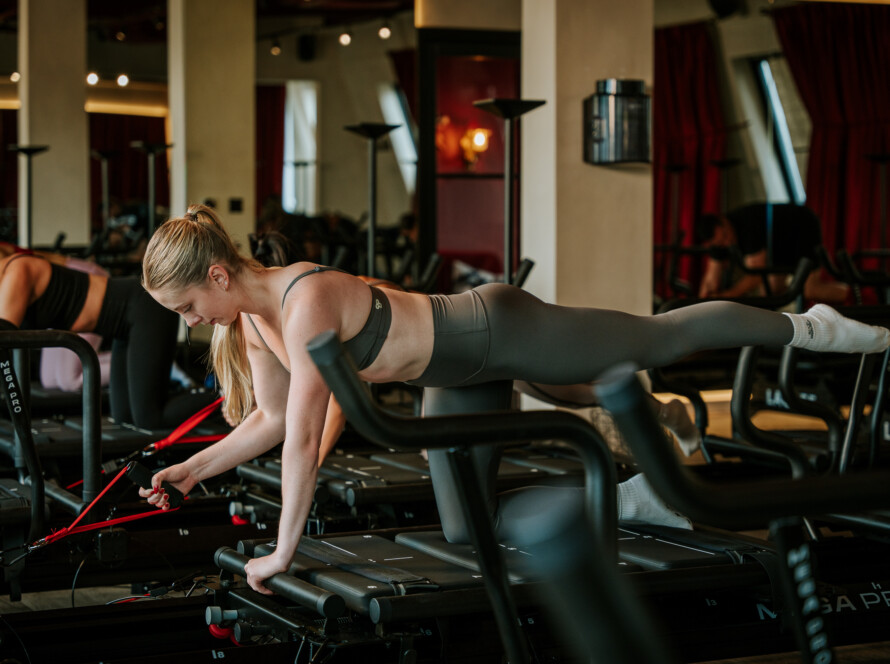
Reformer Pilates exercise names are chaotic by design, not your fault. Learn the classical sequence behind the confusion and every move finally has a place on a map you can actually follow.
Three classes in, and you still freeze when the instructor calls out “Elephant.” Most reformer regulars and wellness explorers assume that if progress stalls, the answer is more classes or more effort, that the repertoire must have more to give them. But the confusion you feel has nothing to do with effort or volume.
It is baked into the method’s history. Understanding why takes about two minutes, and it changes everything. Online Pilates Classes notes that the same exercises are frequently known by multiple names across studios and lineages, with labels shifting depending on whether a teacher trained in a classical, contemporary, or studio-specific tradition.
A student hears “Elephant” in one studio and “Standing Plank Compression” in another. Same move, same springs, zero consistency. That is not a quirk of one bad studio.
See our Lagree London for how this works in practice. It is the predictable output of a method that was never governed by a single certifying body with binding terminology rules. Gratz Pilates confirms it plainly: the original Pilates sequence was transmitted as an oral tradition, with no single authoritative written text for beginners to consult.
When Joseph Pilates died in 1967, his method splintered across the handful of instructors he had personally trained, each of whom preserved, adapted, and renamed exercises according to their own interpretation. Each handoff introduced variation. The result is that the 34 classical mat exercises exist more as an apprenticeship canon than a published curriculum.
A beginner searching for the definitive Pilates reformer moves names list is chasing something the method never produced. That barrier is a structural feature of how the method was transmitted, not a reflection of individual learner failure. Underneath the naming chaos, there is a logical sequence that Joseph Pilates himself laid out.
Once you see it, the whole system clicks into place.
34
Classical Pilates exercises in the full repertoire
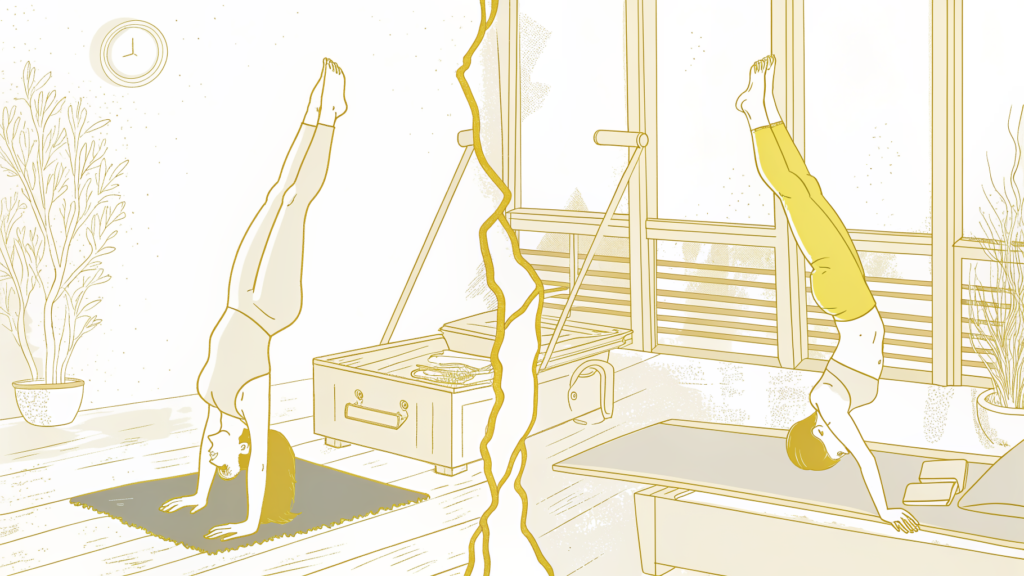
Key takeaways
- The classical reformer repertoire is a fixed list, 34 mat exercises, eight beginner, five intermediate, five advanced, not a rotating menu your instructor curates each session.
- Freezing when an instructor calls ‘Elephant’ is not a focus problem; it is a naming-system problem baked into how Joseph Pilates originally documented the method.
- Knowing a move’s name covers one-third of what you need, the target body zone and at least one precise cue are what separate training from going through the motions.
- The advanced tier (Snake and Twist, Star, Control Balance, Tendon Stretch, Horseback) is not a reward for attendance; it is the terminus of a finite list, and most practitioners hit it faster than they expect.
- A July 2025 randomised controlled trial in Scientific Reports found no significant change in body fat percentage after eight weeks of reformer Pilates, the method has a ceiling, and it is structural, not personal.
- Three variables the classical reformer never touches, time under tension, instability, and load, are exactly what the Megaformer controls, and controls differently every session.
- Once reformer form is clean across the full classical list, BST Lagree in Angel, Islington is the logical next step: 45-minute group Lagree classes that combine strength building and cardio in one, with a health-focused café on-site and official Lagree instructor certification courses for those who want to teach it.
The Classical Order of Reformer Pilates Exercises Beginners Should Follow
34 named exercises. That number, established by Joseph Pilates and documented by Online Pilates Classes, is the entire classical mat repertoire, the logical sequence hiding beneath all that naming chaos. Not a rotating menu. Not a curated shortlist your instructor assembles each morning. A fixed, deliberate sequence where every exercise earns its position by preparing your body for the one that follows. Most reformer regulars think: “If I’m not progressing, I need to try harder or add more classes; the repertoire must have more to give me.”
That assumption is understandable, but it points in the wrong direction. The problem is rarely effort or volume. It is that most beginners treat a reformer class the way they treat a playlist: individual tracks to learn, in whatever order they play.
That framing feels manageable, but it costs you something real. Without the sequence, you cannot locate yourself on the map. You cannot see what comes next, or why.
Every class feels like starting over, and the visible strength and tone you came for keeps feeling just out of reach, no matter how consistently you show up. This is exactly the confusion we see in beginners at our Angel studio. The sequence itself is the solution, and understanding it before your first session changes everything.
Why Sequence Removes Overwhelm
The critical insight from Online Pilates Classes is this: understanding the classical order lets a practitioner locate exactly where they sit in the progression and identify precisely what comes next, removing the guesswork from advancement. That is the map’s real value. Not memorisation.
Orientation. When you know the sequence is finite and codified, the overwhelm lifts. You stop treating every new exercise name as an isolated fact to memorise and start reading it as a coordinate on a route you are already walking.
And crucially, that route is one that keeps the low-impact feel of Pilates intact while systematically building the visible strength and tone that materialises with consistent attendance over time, across your ongoing class journey at our Angel studio, not in a single session. Classes are structured to support that continuity. Transformation at this level is not a matter of trying harder in isolation; it is a matter of returning to the same intelligible map, session after session, until the route becomes second nature.
Now that you can see the full map, where the sequence starts, how the tiers stack, and why the order exists, the next step is to zoom in on the foundation itself. The following section names every essential beginner move, tells you exactly which part of the body it trains, and gives you one concrete cue to make it click from your very first session.
When you know the sequence is finite and codified, the overwhelm lifts.
1. Footwork Series – The Non-Negotiable First Stop in Every Reformer Session
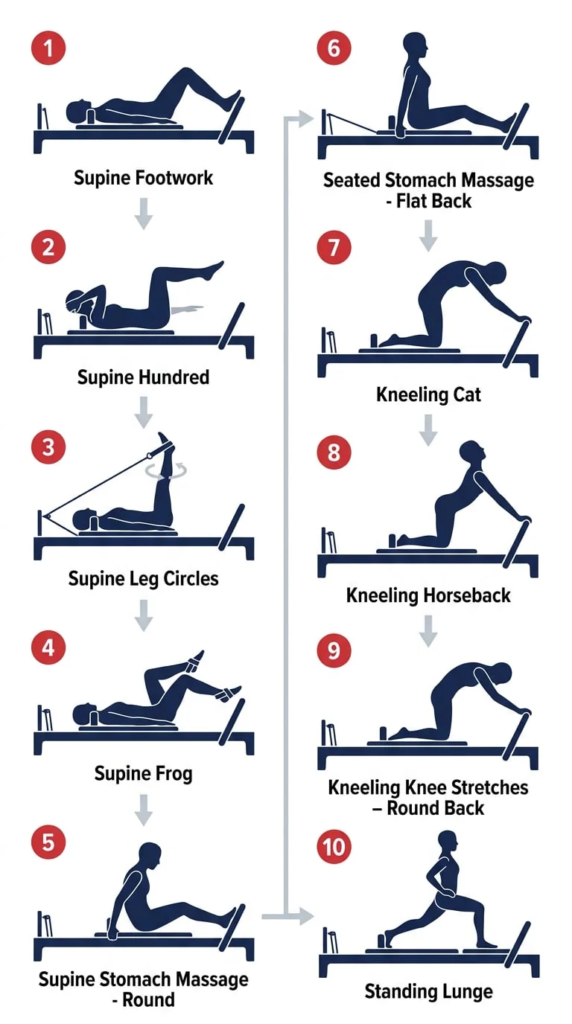
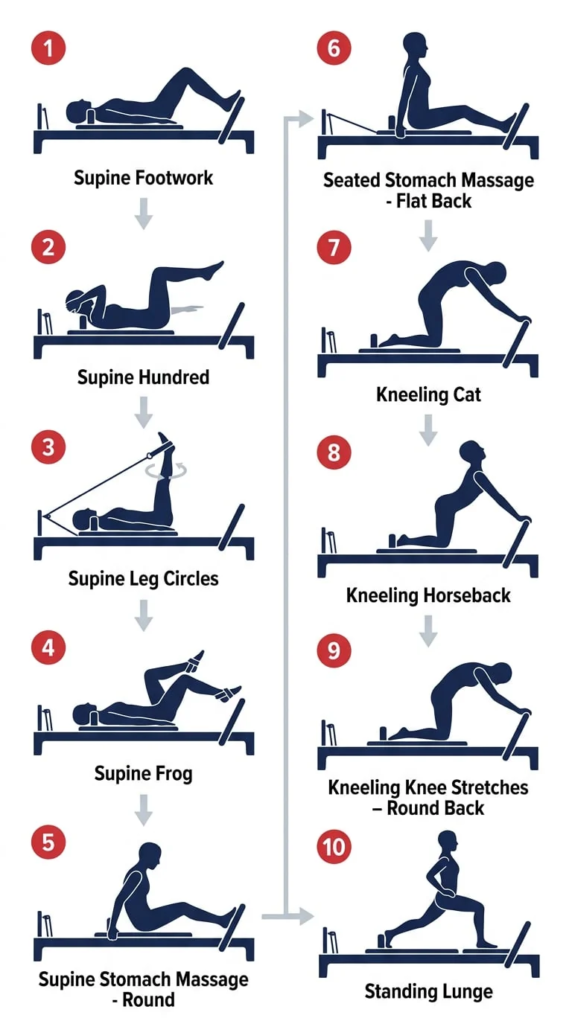
The Footwork Series opens every classical reformer order because it warms the legs, establishes spinal alignment, and teaches the foundational push-pull relationship with the springs before any other demand is placed on the body. Beginners learn heel, arch, and toe positions here. The tradeoff: it looks deceptively simple, so students rush it, missing the core-activation cues that make every subsequent pilates reformer move names sequence more effective.
2. The Hundred – Breathing Drill That Anchors the Entire Classical Sequence
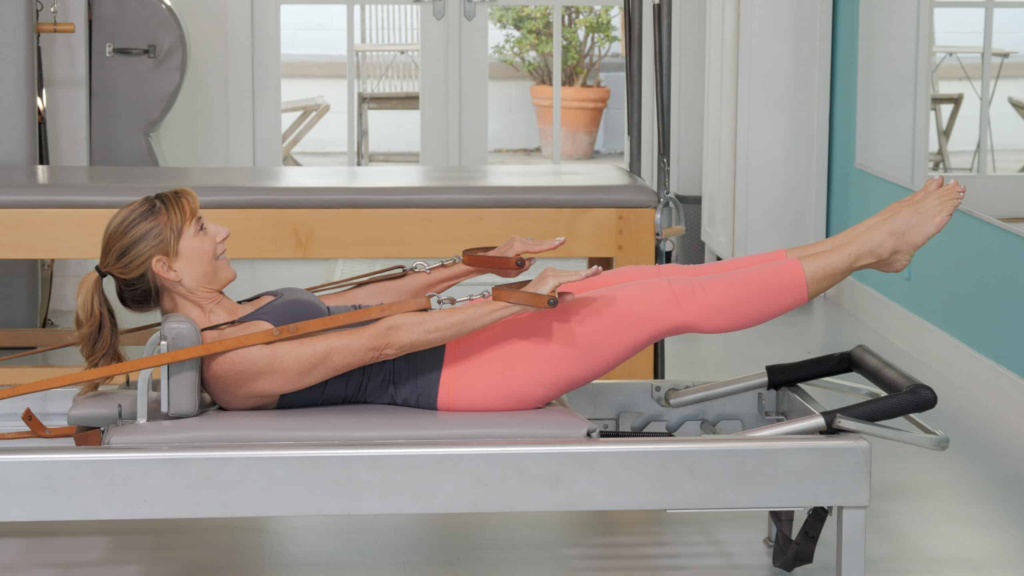
Appearing near the top of the classical reformer repertoire, The Hundred synchronizes percussive breath with sustained abdominal contraction and leg hold. It is the sequence’s cardiovascular ignition point and teaches beginners how breath drives movement, a concept that underpins every named exercise that follows. The limitation for true beginners is neck strain; a headrest modification is essential until deep flexor strength develops.
3. Footwork to Leg Circles – How the Beginner Tier Transitions Into Hip Mobility Work
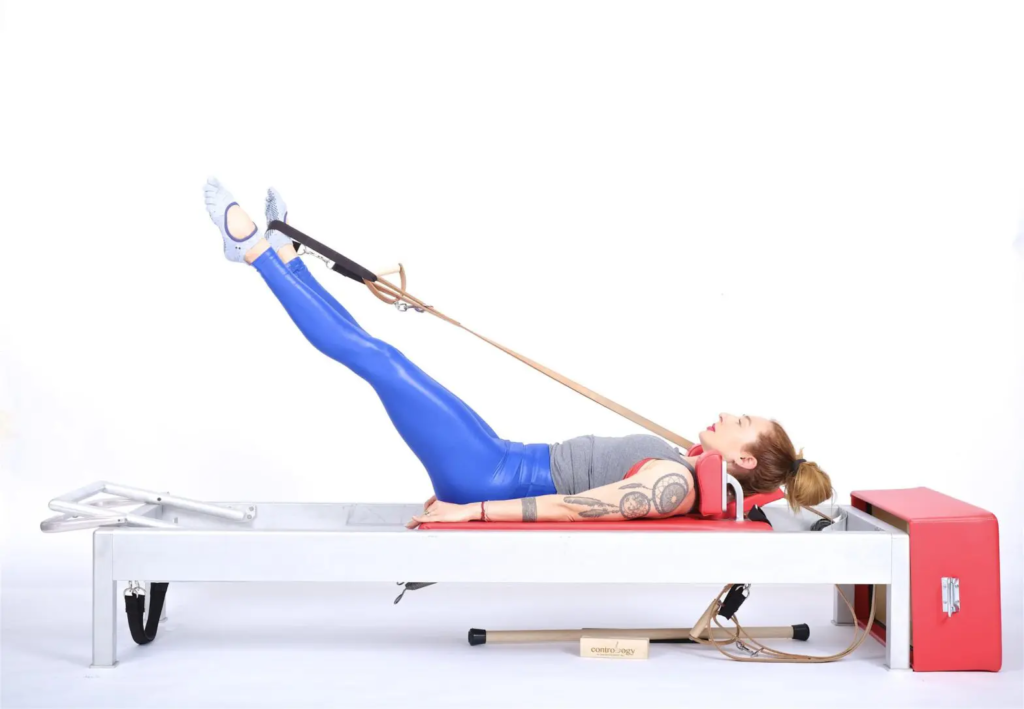
After Footwork, the classical order moves into Leg Circles in straps, shifting focus from linear pushing to rotational hip-socket mobility. This transition marks the first tier boundary beginners encounter and signals that the sequence is intentionally building complexity. Understanding this step prevents students from skipping ahead. The tradeoff is that strap setup takes time, and rushing the transition sacrifices the hip-flexor lengthening the exercise is designed to deliver.
4. Stomach Massage Series – The Mid-Sequence Spinal Flexion Cluster Beginners Often Skip
The Stomach Massage Series sits in the middle of the classical beginner order and combines seated spinal flexion with active leg pumping against spring resistance. It bridges supine work and upright exercises, making it a critical sequencing landmark. Beginners who skip it lose the spinal articulation prep needed for later moves. The limitation is that tight hip flexors make the rounded-back position uncomfortable, requiring prop support initially.
5. Short Box Series – Named Exercises That Introduce Spinal Extension Into the Order
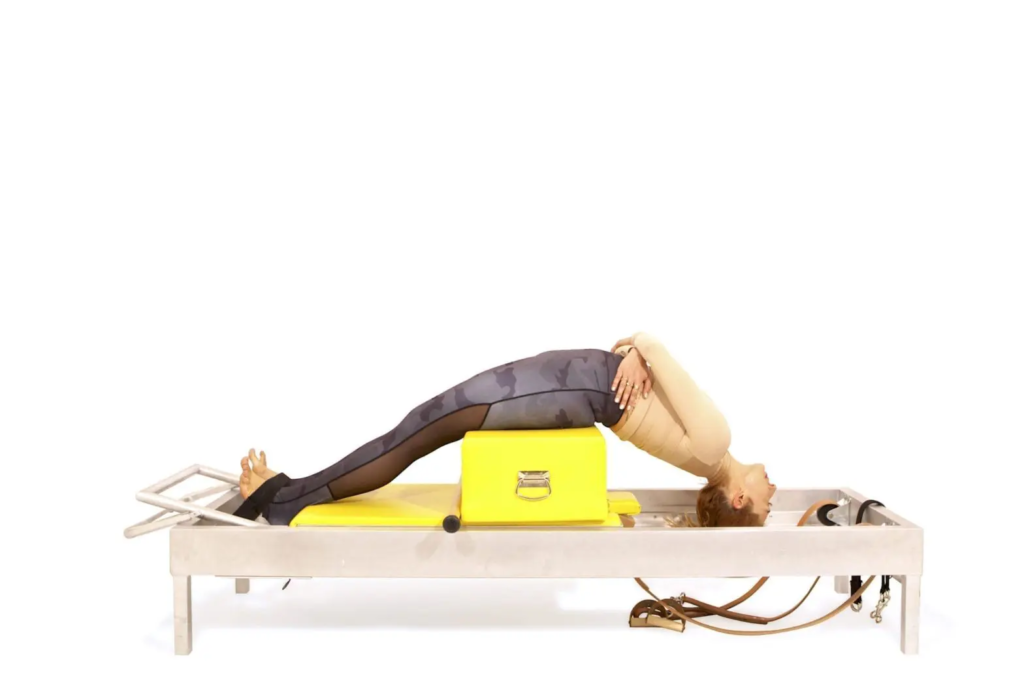
The Short Box Series is a named cluster of exercises, Round, Flat, Side-to-Side, Twist, and Tree, performed seated on the box placed on the reformer carriage. It is the sequence’s primary introduction to spinal extension and lateral flexion for beginners. Knowing these names helps students locate themselves in the progression. The tradeoff: without a teacher cue, beginners collapse into lumbar hyperextension rather than achieving true thoracic extension.
6. Elephant – The Standing Footbar Move That Marks the Intermediate Tier Entry
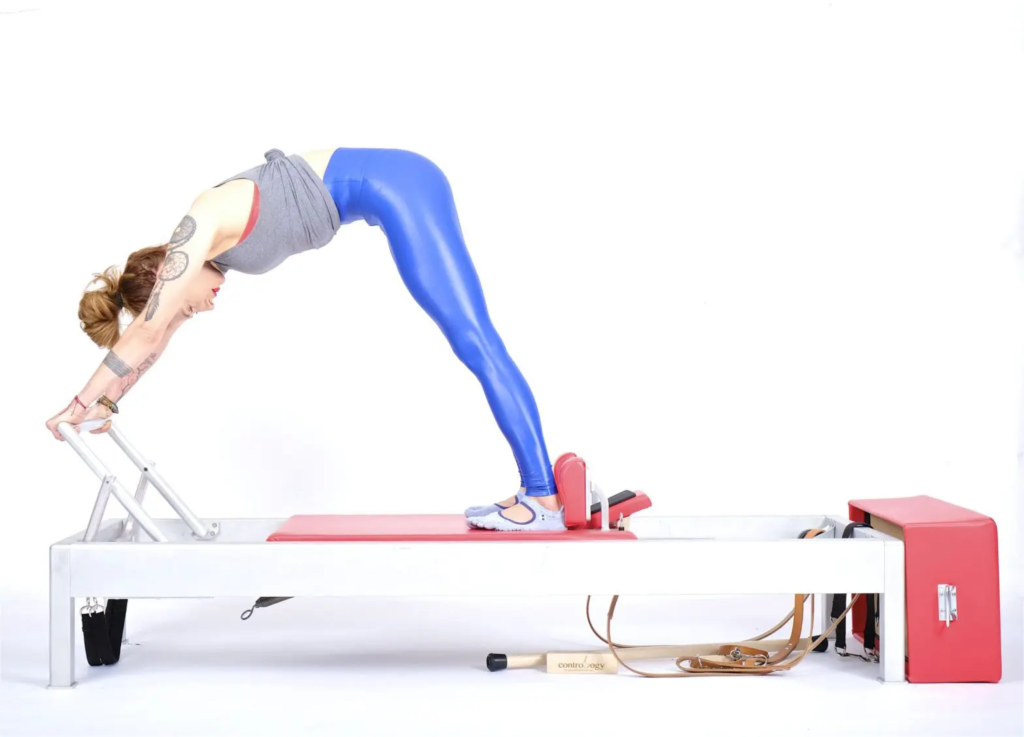
Elephant is the first standing-on-the-reformer exercise in the classical order, placing the student upright on the carriage with hands on the footbar. Its position in the sequence signals the transition from beginner to intermediate tier. Recognizing this landmark tells practitioners exactly where they sit in the progression. The limitation is that students with tight hamstrings cannot achieve the required hip hinge, making a bent-knee modification mandatory before advancing.
7. The Classical Repertoire Spans 34-Plus Named Exercises Across Three Tiers – Not a Random Pick-and-Mix
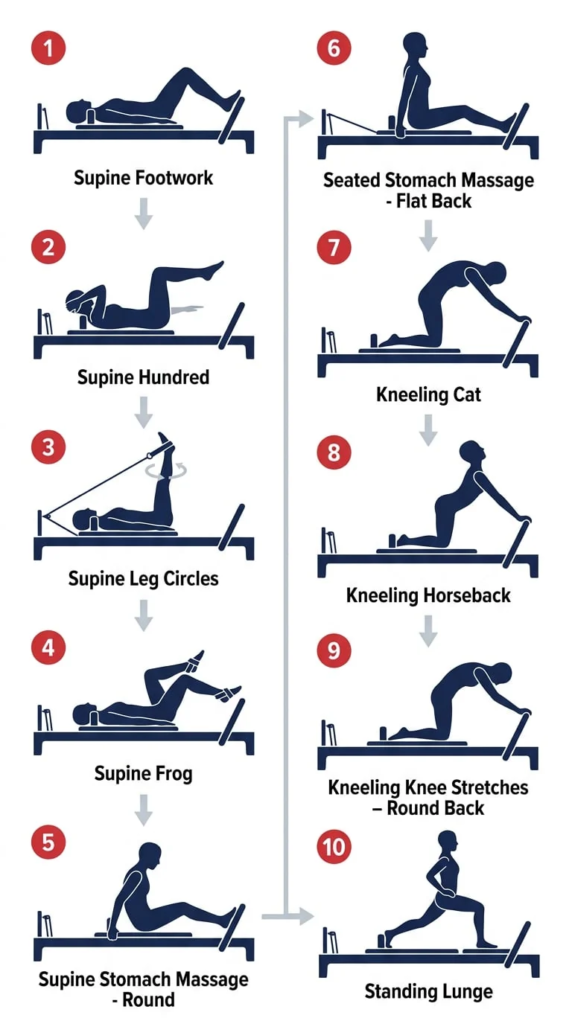
The classical Pilates reformer repertoire, the answer to the common question ‘what are the 34 Pilates moves?’, comprises dozens of named exercises organized across beginner, intermediate, and advanced tiers. The reformer version mirrors and extends the original mat sequence Joseph Pilates codified. Understanding this scope removes overwhelm: beginners work roughly the first third of the full list. The limitation is that different lineages number and name exercises slightly differently, causing confusion without a qualified instructor.
8. Beginner Tier Overview – The First Eight Named Reformer Moves Every New Student Learns
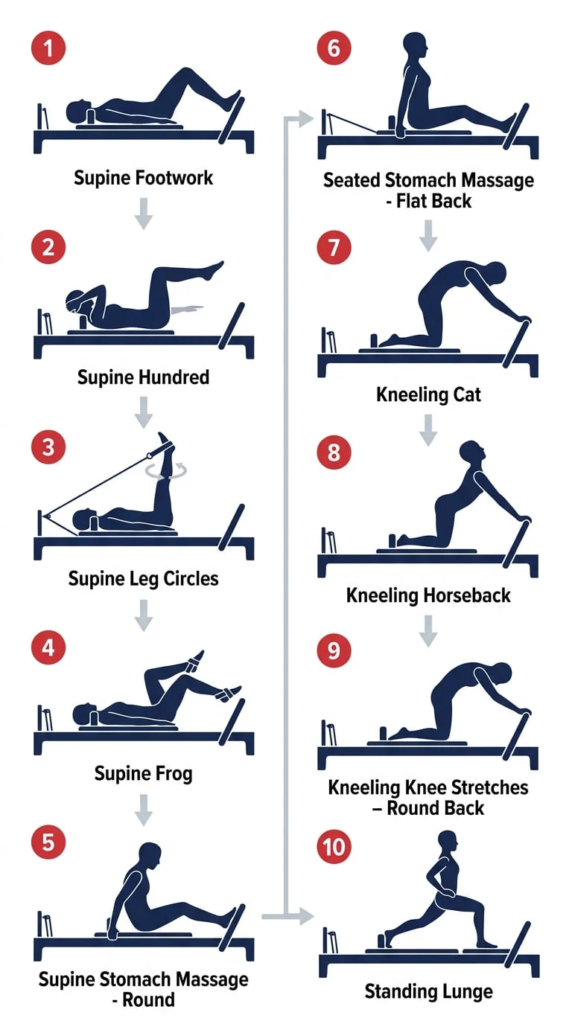
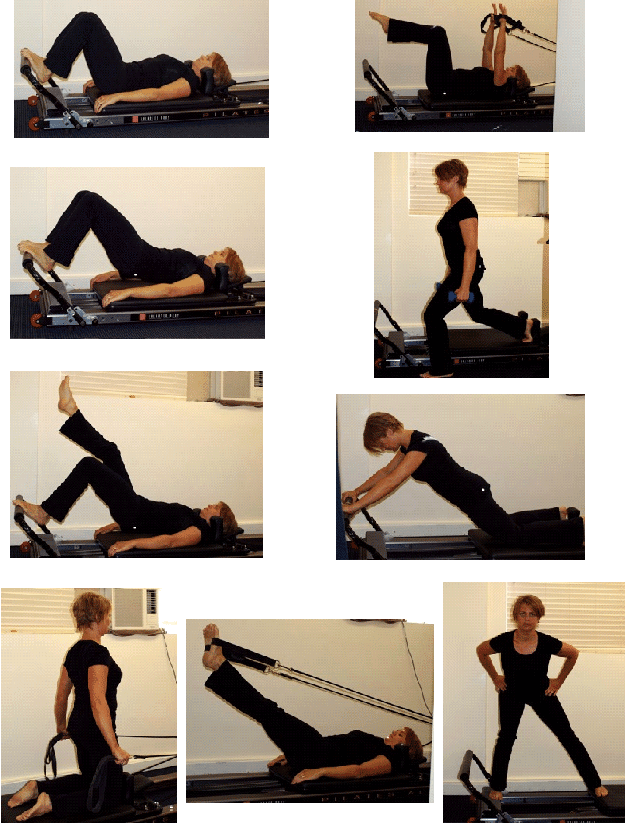
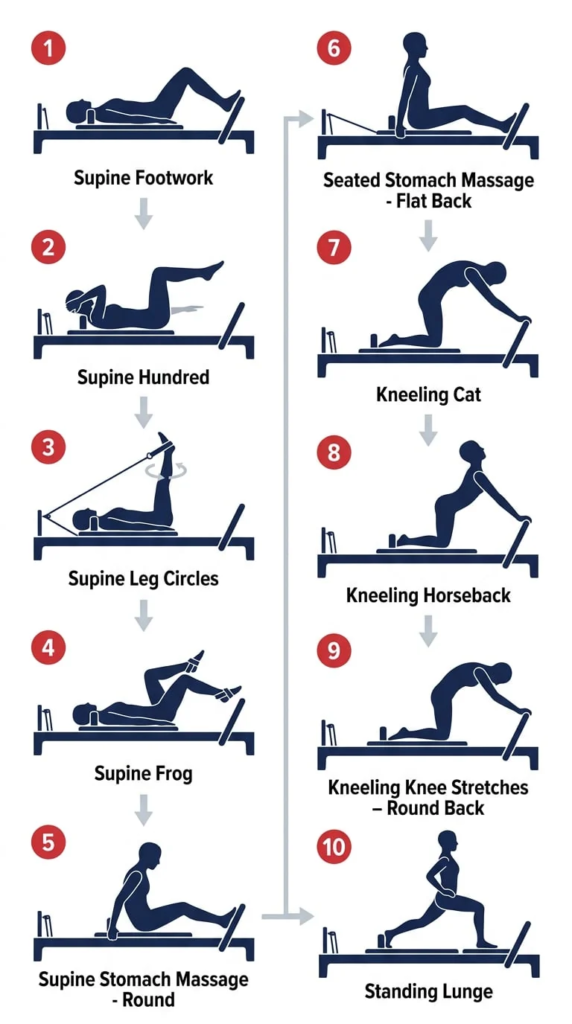
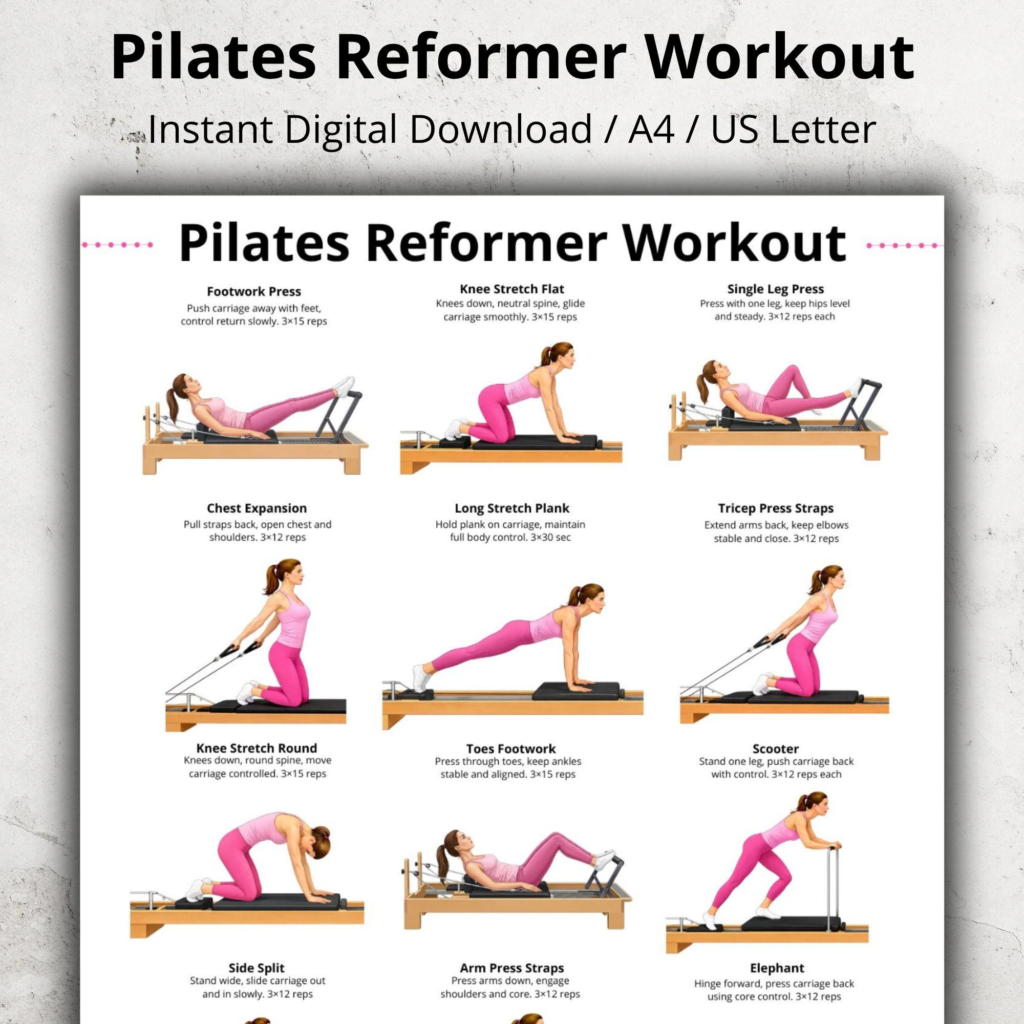
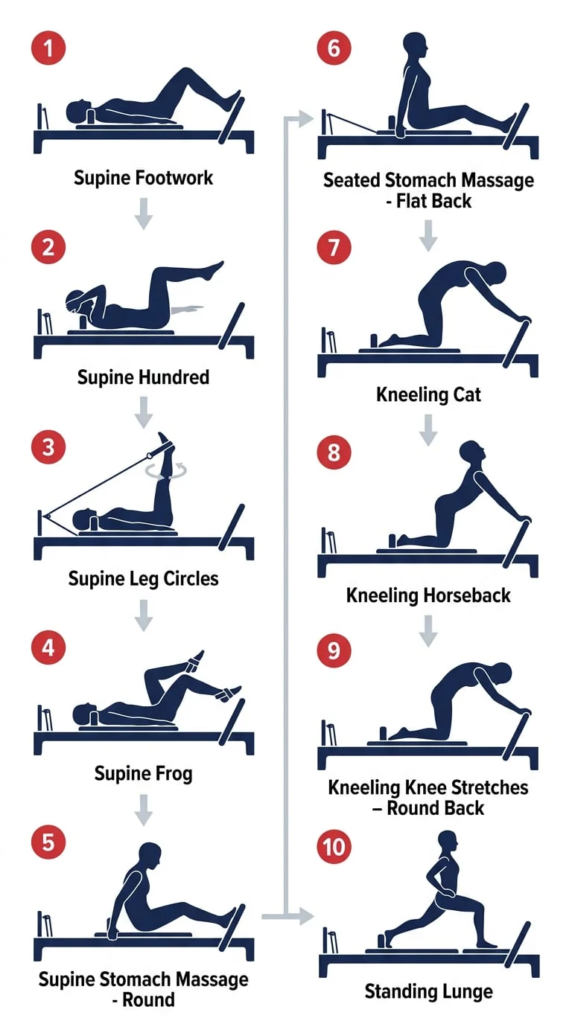
The beginner tier of the classical reformer order typically encompasses Footwork, The Hundred, Frog, Leg Circles, Stomach Massage, Short Box, Elephant, and Long Stretch, eight foundational pilates reformer moves names that build the neuromuscular patterns required for everything above them. Knowing this cluster as a defined group lets beginners set realistic session goals. The tradeoff is that ‘beginner’ does not mean easy; each move demands precise spring tension and alignment that takes weeks to internalize.
9. Long Stretch Series – Four Named Plank Variations That Close the Beginner Order
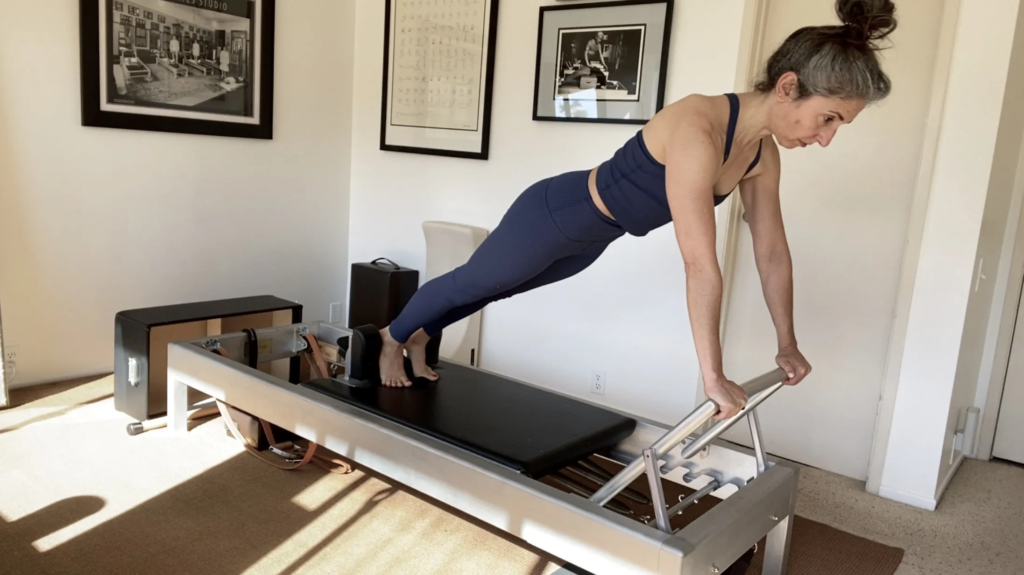
The Long Stretch Series, comprising Long Stretch, Down Stretch, Up Stretch, and Elephant, forms a plank-based cluster near the end of the beginner tier. These four named exercises demand full-body integration of the core stability built in earlier moves, making them a natural progression checkpoint. Beginners who can execute all four with control are ready to enter intermediate work. The limitation is wrist load; students with wrist issues need fist or forearm modifications.
10. Intermediate Tier Named Moves – Where Kneeling and Arm Work Enter the Sequence
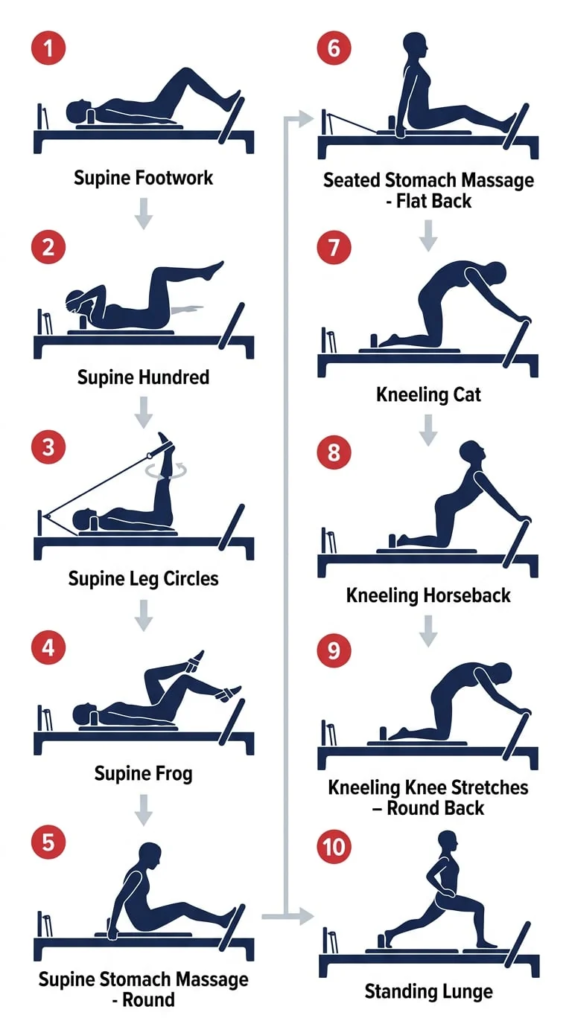
The intermediate tier introduces named exercises like Knee Stretch Series, Running, and Pelvic Lift, shifting the body into kneeling positions and adding arm-spring work. These moves assume the spinal stability and spring-resistance awareness built in the beginner tier. Recognizing the intermediate cluster by name allows self-directed practitioners to audit their readiness. The tradeoff is that intermediate exercises expose asymmetries hidden during supine beginner work, often revealing hip and shoulder imbalances that need targeted correction.
11. Advanced Tier Named Moves – Snake, Twist, and Control Balance Mark the Sequence’s Peak
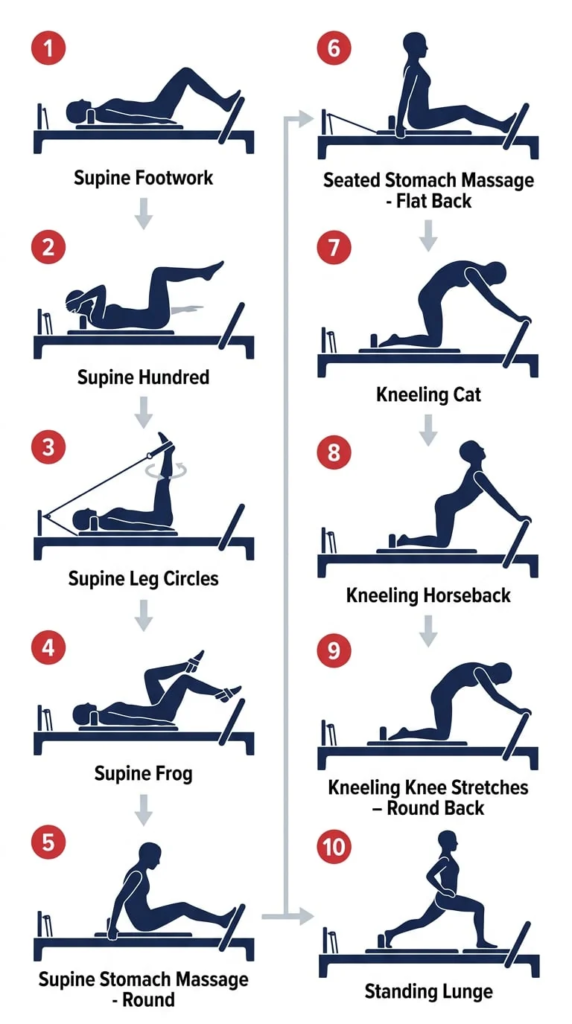
The advanced tier of the classical reformer order includes named exercises such as Snake, Twist, Semi-Circle, and Control Balance, movements requiring full spinal articulation, rotational strength, and balance on a moving carriage. These names represent the sequence’s ceiling and are typically introduced only after consistent intermediate practice. The limitation is that attempting advanced pilates reformer moves names without the prerequisite tier foundation dramatically increases injury risk, particularly to the lumbar spine and shoulders.
12. Understanding Sequence Order Removes Overwhelm – You Can Locate Exactly Where You Are
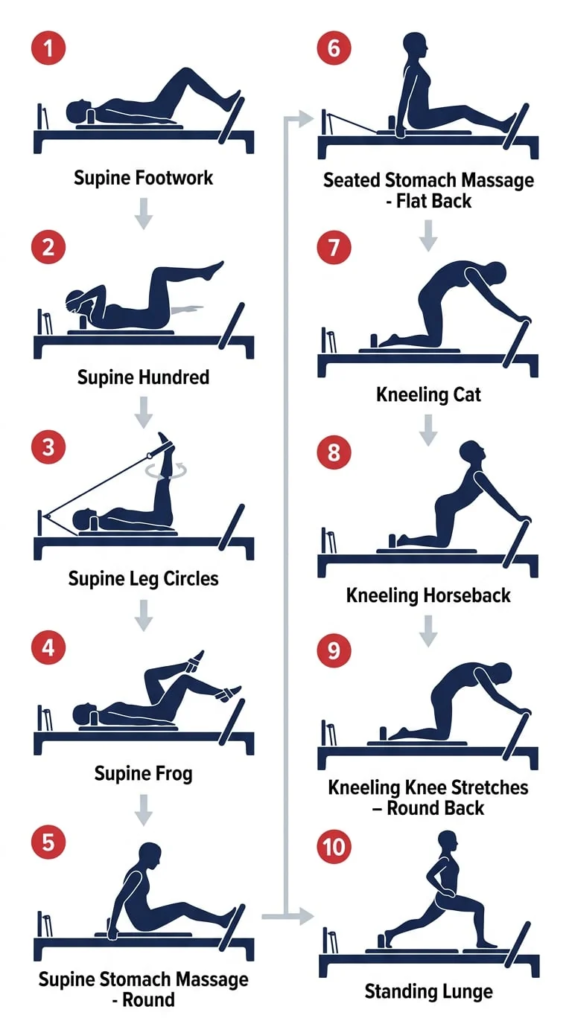
One of the most practical benefits of learning the classical reformer order is that it functions as a personal GPS: once you know the named exercises and their tier placement, you can identify precisely where you are in the progression and what comes next. This eliminates the anxiety of open-ended ‘what should I do today?’ decisions. The tradeoff is that the classical order is rigid by design, creative sequencing preferred by contemporary studios can feel jarring to students trained classically.
13. Knee Stretch Series – The Named Kneeling Cluster That Bridges Intermediate to Advanced
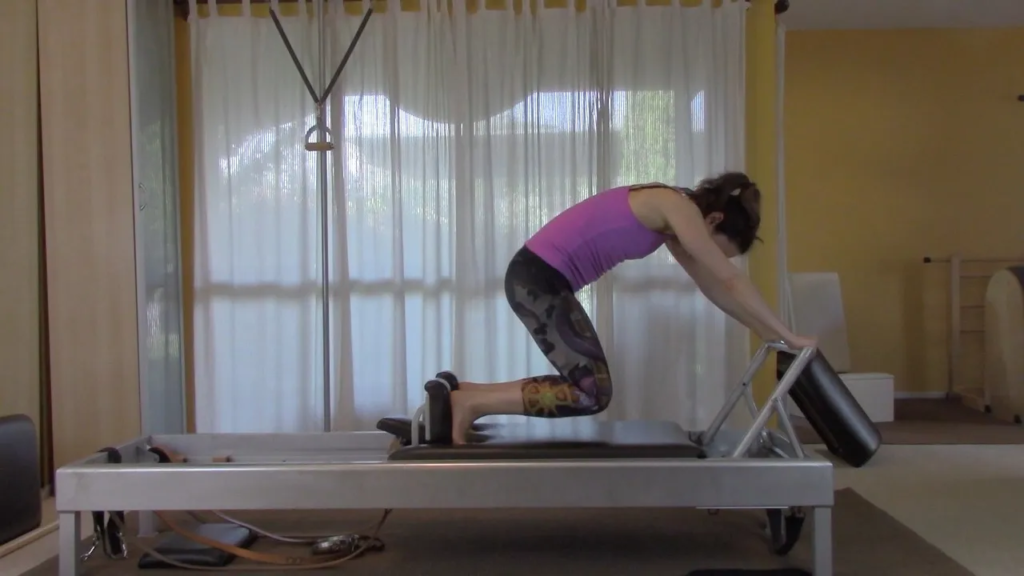
The Knee Stretch Series, Round Back, Flat Back, and Knees Off, is a named three-part cluster in the intermediate tier that demands kneeling stability on a moving carriage while maintaining spinal shape under spring load. It is the clearest bridge exercise between intermediate and advanced tiers in the classical order. Beginners attempting it prematurely typically collapse the lumbar spine. Mastering all three variations by name signals genuine intermediate competency.
14. Exercise Order and Sequencing Logic – Why Each Named Move Prepares the Body for the Next
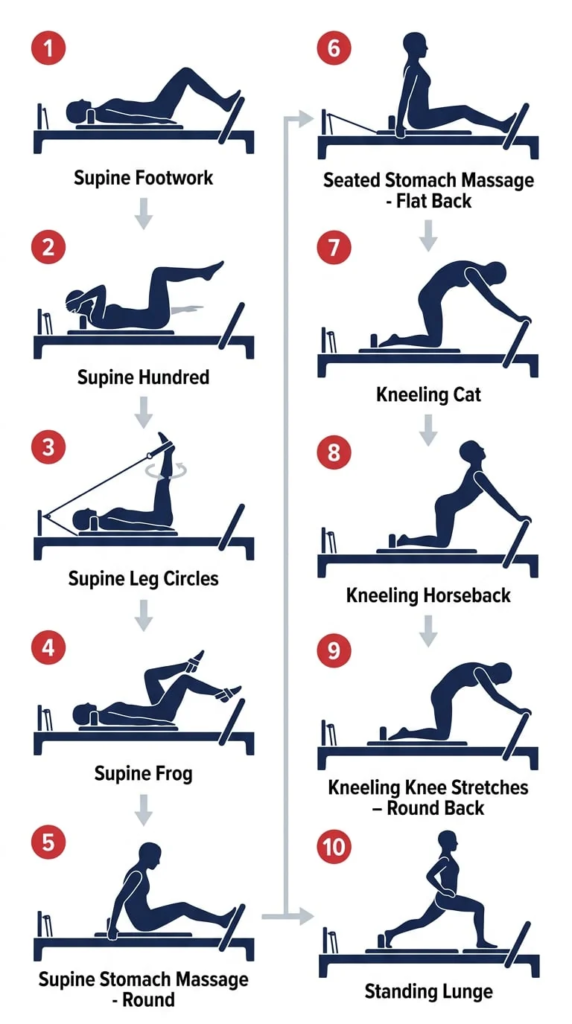
The classical reformer sequence is not arbitrary: each named exercise is positioned to warm, challenge, and recover specific muscle groups in a deliberate chain. Supine moves establish core control before seated moves demand it upright; kneeling moves build shoulder stability before standing moves require it on a moving surface. Understanding this cause-and-effect logic helps beginners respect the order rather than cherry-pick favorite pilates reformer moves names, which is the single most common self-programming mistake.
Related Reading
- Lagree Before and After 3 Months
- What To Bring To Pilates Reformer Class
- How Many Times A Week Should You Do Pilates Reformer
- Can You Do Reformer Pilates While Pregnant
- What To Wear To Pilates Reformer Class
- What Reformer Does Club Pilates Use
The Essential Beginner Reformer Pilates Moves Names You Need to Learn First
Eight beginner reformer moves form the agreed entry layer of classical Pilates practice. Knowing their names is only a third of the picture. Each exercise has a target body zone and at least one cue that determines whether you are actually training or simply going through the motions.
Without that three-part reference, the list is decorative, not functional. One of the most consistent gaps we see among beginners entering this space is not a lack of effort; it is the absence of a clear map. When you don’t know which moves to prioritise or what correct execution feels like from the inside, the learning curve feels arbitrary rather than progressive.
That ambiguity is exactly what this reference is built to close.
- Footwork
- The Hundred
- Coordination
- Elephant
- Knee Stretches
- Leg Circles
- Running
- The Reformer Move Target Zones grouping that ties them together
1. Footwork – The Non-Negotiable First Move of Every Reformer Session
“As someone transitioning to reformer Pilates, I don’t always know which specific moves or exercises to prioritize first, making the learning curve feel unclear.”
— what we hear from beginner reformer Pilates students
Footwork is performed lying on the carriage facing the footbar, cycling through foot positions:
- Toes
- Arches
- Heels
- Parallel
- V-position
It establishes foundational alignment before any other movement begins. Target zone: legs and postural chain. Beginner cue: press the footbar away without letting your lower back arch off the carriage. Most studios recommend starting on two to three springs; dropping to one spring too early removes the feedback the move depends on.
2. The Hundred – Classic Abdominal Warm-Up with Rhythmic Arm Pumps
The Hundred is the primary abdominal strengthening exercise for beginners, using rhythmic arm pumps to coordinate breath with core activation. Target zone: deep abdominals and breath control. Beginner cue: if your neck strains within the first twenty pumps, your head goes down, not your chin further in.
Neck strain during this move is one of the most commonly reported beginner discomforts in reformer Pilates, almost always caused by insufficient abdominal strength rather than poor effort. This is also where the pace of a standard group class can work against you. When the instructor moves on before the cue has landed, you file it away as a shape rather than a sensation, and that gap compounds over time.
Beginners with hypermobility in particular can find that their range looks correct while their stability is absent, because the body finds workarounds that a fast-moving class never flags. Coordination trains neuromuscular timing as much as raw strength, requiring the arms and legs to extend and return in precise sequence while the core holds still. Target zone: full-body timing, deep stabilisers.
Beginner cue: the arms open after the legs extend, not simultaneously. Research into neuromuscular coordination training consistently shows that timing-focused drills build motor control that isolated strength work cannot replicate. Most beginners rush the sequence; slowing it down by thirty percent reveals exactly where their coordination breaks.
Elephant is a standing reformer exercise where the heels press into the footbar while the hands hold the carriage platform, creating a pike position that compresses the core and lengthens the posterior chain. Online Pilates Classes describes it as deceptively demanding for beginners who encounter it early in the order. Target zone: hamstrings, calves, and spinal decompression.
Beginner cue: push the carriage away with your heels, not your toes. Tight hamstrings make this feel impossible at first; that tightness is exactly what the move is there to address.
3. Coordination – Upper and Lower Body Synchronisation Drill for Timing and Strength
Coordination challenges beginners to extend the legs while opening and closing them, simultaneously curling the head and extending the arms, all in a precise sequence. It trains neuromuscular timing as much as raw strength, making it one of the most cognitively demanding beginner moves. Those who struggle with body awareness find it revelatory. The tradeoff: the sequencing is easy to rush, which defeats the coordination purpose entirely.
4. Elephant – Standing Full-Posterior-Chain Move with Heels on the Footbar
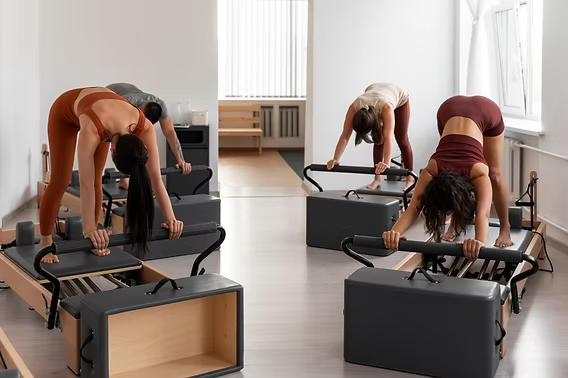
In Elephant, the practitioner stands on the carriage with heels pressing into the footbar, hinging forward into a flat-back position and using core compression to push and pull the carriage. It looks deceptively gentle but delivers a demanding stretch and strengthening stimulus across the hamstrings, calves, and spinal extensors. Beginners with tight hamstrings will find the posterior chain demand humbling. Wrist and shoulder load is a real consideration for those with upper-body limitations.
5. Knee Stretches – Kneeling Carriage Series for Spinal Stability and Hip Flexor Control
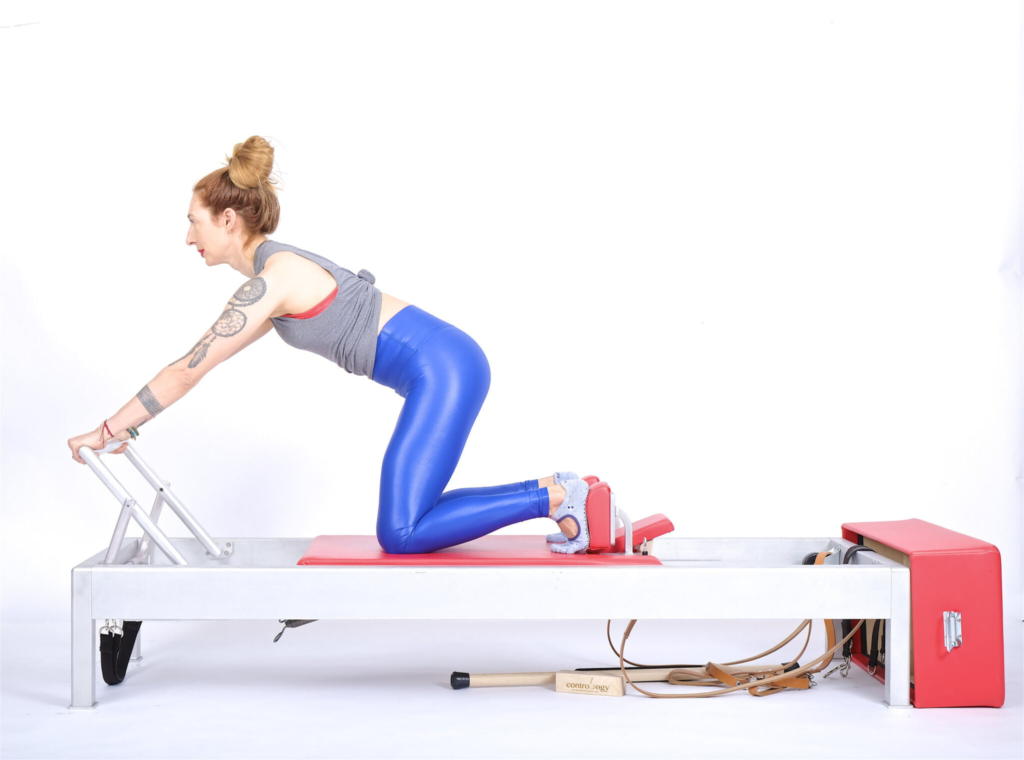
Knee Stretches are performed kneeling on the carriage, hands on the footbar, driving the knees back and forward in two variations: round-back and flat-back. Target zone: hip flexors, spinal stability, and knee tracking. Beginner cue: in the round-back variation, the spine stays in a consistent C-curve throughout; the moment it collapses to flat, the exercise becomes a hip-flexor yank rather than a stability drill.
The flat-back variation demands a neutral spine held under load, a different challenge that should not be skipped in favour of the easier-feeling option. This is one of the moves that beginners who have tried to self-assess their readiness for independent practice most commonly misjudge; it looks simpler than it is, and the distinction between the two variations only becomes clear once an instructor has called it out in real time.
6. Know Your Target Zone – Which Reformer Moves Work Core, Legs, or Upper Body
Before beginners memorise exercise names, they need a mental map of which moves target which body zone. Core-dominant moves include The Hundred and Coordination; leg-dominant moves include Footwork and Running; upper-body moves include Elephant and Rowing. Understanding this framework helps beginners communicate with instructors, self-assess fatigue, and build balanced sessions. The tradeoff: oversimplifying zones can cause beginners to underestimate how many reformer exercises are genuinely full-body in nature.
7. Leg Circles – Supine Hip Mobility Drill with Feet in Straps
Leg Circles are performed lying on the back with both feet in the reformer straps, drawing controlled circles to train hip mobility and hamstring length. Online Pilates Classes lists them as a named staple of the foundational reformer order. Target zone: hip joint mobility and lower-back decompression.
Beginner cue: keep the pelvis completely still; if the hip rocks with each circle, the range is too large. Practitioners who work this move consistently over several weeks typically notice a meaningful reduction in lower-back tightness, because the hip and lumbar spine share load, and freeing one relieves the other. Running closes the foundational sequence by mimicking a running gait on the carriage, alternating heel presses to release calf tension accumulated during Footwork.
Target zone: calves, Achilles, and ankle mobility. Beginner cue: keep the movement small and deliberate; this is decompression, not cardio. Rushing Running because it feels easy is the equivalent of skipping a cooldown stretch.
Its position at the end of the beginner sequence is intentional: it returns the body to the same alignment conversation that Footwork opened. As Pilates Andrea notes, the order of reformer exercises is not arbitrary; each move prepares the body for what follows, which is precisely why understanding the names, zones, and cues as a connected sequence matters more than learning any single exercise in isolation. These eight moves are finite by design.
The reformer’s classical spring resistance and fixed sequence mean that once Footwork and The Hundred feel second nature, the machine has limited new stimulus to offer. That is the method working exactly as intended. The beginner catalogue runs out of surprise before most practitioners realise it, and adding more reformer classes at that point produces diminishing returns rather than new adaptation.
That ceiling is where a structurally different approach becomes the logical next chapter, and it is also where being among the first in your circle to discover something new starts to feel relevant. The Lagree method, practised on the Megaformer at BST Lagree’s Angel studio, targets slow-twitch muscle fibres through continuous time under tension and shifting instability simultaneously. Those are variables the classical reformer sequence does not offer.
For a Londoner who already speaks reformer fluently, a 45-minute Lagree class represents a different physical conversation. Transformation-focused results materialise with consistent attendance over time, and the pack structure is designed to support exactly that kind of sustained commitment. These 8 moves are your reformer foundation, the vocabulary every instructor assumes you speak before the session advances.
Once they feel familiar rather than foreign, you are ready for the reformer’s next tier, which has a very different set of names waiting for you.
8. Running – Alternating Heel-Press Cool-Down That Releases Calf Tension
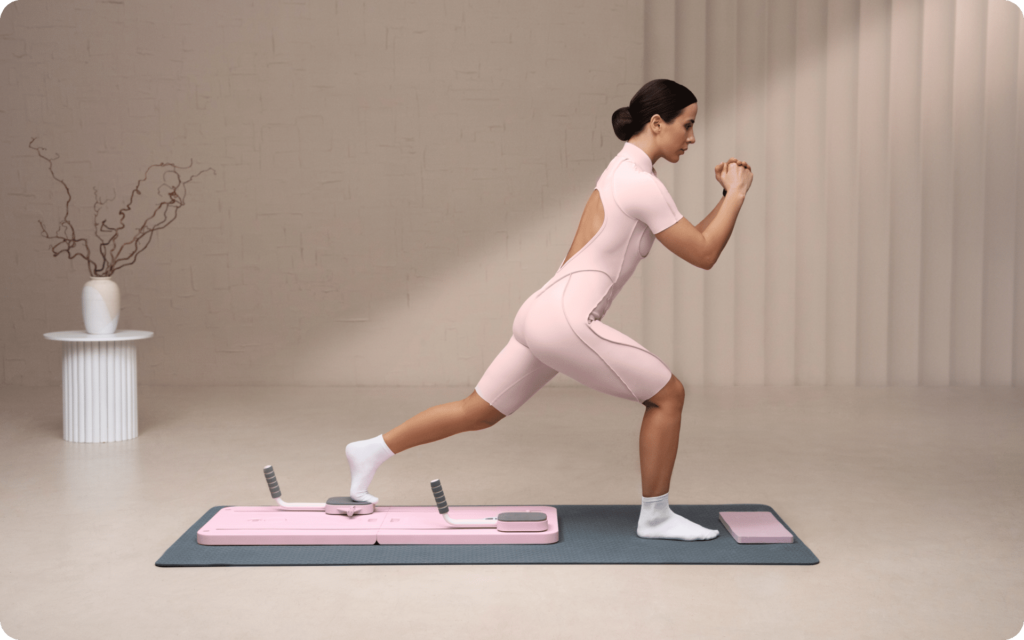
Running is performed at the end of footwork, with feet on the footbar in parallel position, alternately bending one knee while the other leg presses long, mimicking a running gait rhythm. It systematically releases calf and Achilles tension built up during the footwork series and gently mobilises the ankle joint. It is the ideal session closer for beginners. The one limitation: its simplicity leads many beginners to rush it, losing the decompressive benefit it is specifically designed to deliver.
What Are the Intermediate Pilates Reformer Exercise Names Worth Adding Next
Five intermediate reformer exercises mark the second tier of the classical repertoire. They are not a natural continuation of beginner work; they are a distinct layer that most practitioners only access when an instructor decides they are ready and cues them precisely through each new demand. That readiness question is one of the most common points of friction at this stage: practitioners who feel intermediate, competent on the carriage, comfortable with the breath, often find themselves genuinely uncertain about which exercises to add next, and whether they are adding them in the right order. That uncertainty is worth naming, because it shapes the quality of everything that follows.
1. Short Box Series – Spinal Articulation and Hip Flexor Endurance Off the Mat
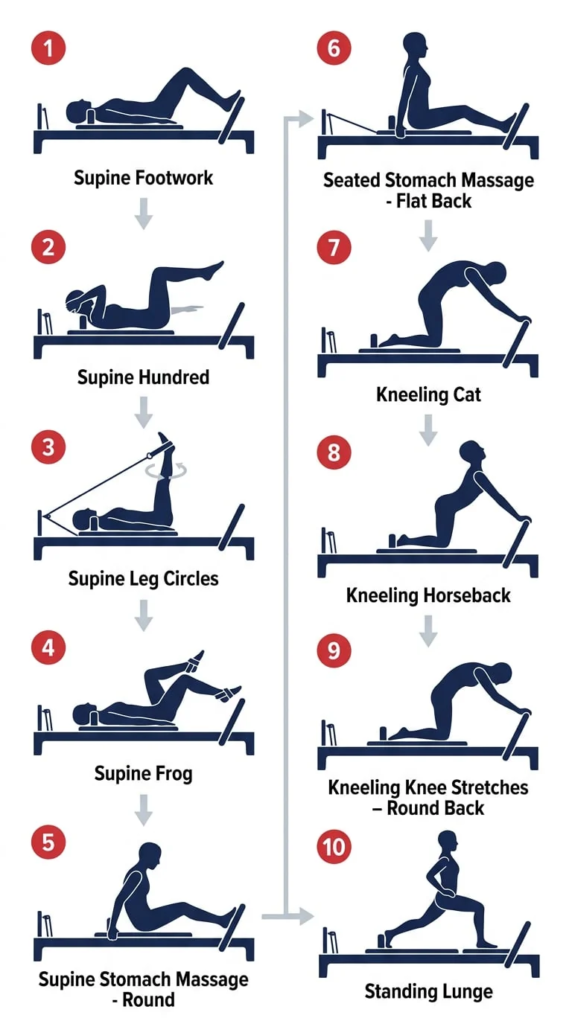
The Short Box Series moves you off the carriage and onto a box, so it becomes the first real test of core endurance outside the supine position in the reformer repertoire. The seated position immediately exposes hip flexor dominance: most practitioners grip through the front of the hip rather than articulating through the spine, which is exactly why an instructor’s eye matters here far more than additional repetitions. This is precisely where low-impact movement starts to carry real intensity.
The demand on postural endurance is sharply higher the moment the fixed surface disappears beneath you. A static floor plank and a Long Stretch Series plank are categorically different challenges. The moving carriage removes the fixed base, so the full-core integration demand rises sharply with every push and pull.
Wrist load increases significantly in this position, and practitioners with any existing wrist sensitivity should discuss spring tension adjustments with their instructor before progressing here. At BST Lagree’s studio in Angel, that conversation happens in real time. Instructors read the carriage movement and adjust tension mid-set rather than leaving you to troubleshoot between sessions.
Seated facing the footbar with the spine in a C-curve and legs pumping, the Stomach Massage Series is the move that surprises almost everyone. The cardiovascular demand is real, and thoracic mobility restrictions surface immediately in the seated flexion position. If your upper back resists rounding, the series will tell you within the first four counts.
This is the point in the repertoire where low-impact training stops feeling low-intensity. The heart rate climbs, the compression demand is sustained, and the gap between knowing the exercise name and executing it cleanly becomes impossible to hide. Broader industry trends confirm that practitioner retention is strongly linked to perceived progression, and the Stomach Massage Series is often the first move that makes intermediate students feel genuinely challenged again.
Research confirms that membership withdrawal and exercise dropout rates reach 40-65% within the first six months, so keeping practitioners challenged and progressing is critical. Short Spine Massage returns you to the supine position but adds a rolling articulation through each vertebra as the legs lower from the straps. The hamstring length requirement catches many intermediate practitioners off guard: the move looks passive from the outside and feels intensely demanding from the inside.
It is not a move to self-direct; the breath timing and spinal sequencing need to be cued in real time to avoid substituting lumbar flexion for genuine thoracic articulation. Bridging variations share some of this quality. Practitioners often arrive at sessions having practised the shape at home and finding it harder to appreciate rather than easier, which is a reliable sign that the movement is doing real work and that instructor feedback is the variable that unlocks it rather than additional solo repetitions.
2. Long Stretch Series – Plank-Based Push and Pull on a Moving Carriage
Starting in a full plank with hands on the footbar and toes on the shoulder rests, the Long Stretch Series challenges practitioners to stabilize the entire body while the carriage travels. Variations including Down Stretch and Up Stretch shift the spinal position and load distribution, integrating upper-body pressing strength with deep abdominal control. The real limitation is wrist load, practitioners with wrist sensitivity must modify grip or spring tension carefully before progressing.
3. Stomach Massage Series – Core Compression and Cardiovascular Demand Combined
Seated facing the footbar with a deeply flexed spine and feet pressed against it, the Stomach Massage Series drives the carriage in and out through rhythmic leg pumping while the abdominals stay compressed. Four progressive variations add arm reaches and spinal extension, steadily increasing demand. It is ideal for practitioners ready to layer cardiovascular challenge onto core work, but the seated C-curve position exposes any weakness in thoracic mobility or hip flexor length immediately.
4. Short Spine Massage – Supine Spinal Articulation Requiring Hamstring Control
Lying supine with feet in the long loops, the carriage is drawn in and the spine peels off the mat vertebra by vertebra into a supported bridge, then rolls back down with equal precision. The movement simultaneously demands hamstring length, abdominal strength, and spinal mobility in a single fluid sequence, making it one of the most diagnostic pilates reformer moves names instructors use to assess overall body integration. Tight hamstrings are the most common limiter and must be addressed before the exercise can be performed safely.
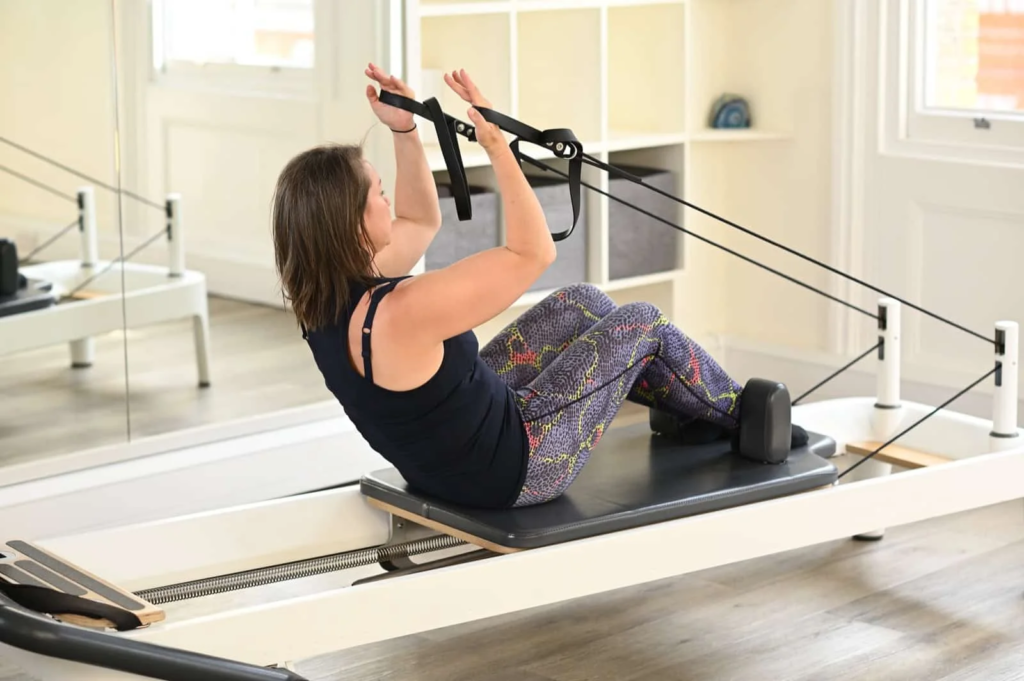
5. Rowing Series – Seated Arm-and-Spine Combinations for Upper-Back Strength
Facing the back of the reformer, the Rowing Series trains upper-back strength and shoulder girdle stability through arm-and-spine combinations that require simultaneous control of the carriage, the breath, and the spinal position. It is the move that makes the reformer feel like a coherent system for the first time. That feeling is real.
The moment these five exercises stop requiring conscious effort is not a sign to keep cycling through them. Most studio practitioners stall here not because they lack strength, but because the system offers no self-directed signal for what comes next. Studios observe this dynamic as one of the primary reasons Pilates members disengage: progress becomes invisible at the intermediate stage, the training stimulus stops changing, and without structured load progression built into each session, motivation erodes before the practitioner recognises it as a progression problem rather than a personal one.
That stall is where a structurally different training system becomes the logical next tool. A 45-minute Megaformer class at BST Lagree operates on different mechanics entirely, with continuous time under tension and instructor-led load progression built into every session, so the training stimulus keeps changing long after a fixed named-exercise repertoire has run out of road. That progression is not theoretical: it materialises with consistent class attendance over time, across a member’s ongoing fitness journey, in a way that self-directed reformer practice cannot replicate.
If you are at the stage where the five intermediate exercises above feel familiar but no longer feel like they are moving you forward, the most concrete next step is a single class with an instructor who can read the carriage and adjust the demand in real time. BST Lagree’s free intro workshop class, claimed via the on-site form, with a complimentary coffee included, is designed for exactly that moment: familiar enough to feel like a continuation of reformer work, different enough in its mechanics to make the next level of strength accessible again. Mastering these five intermediate exercise names is a genuine milestone.
It means the reformer has finally started to function as the integrated system it was designed to be. But fluency at the intermediate level is also where most studio practitioners quietly stop progressing, because the method has run out of road. The advanced moves waiting in the next section reveal exactly how steep and finite that final climb really is.
Related Reading
- Is Reformer Pilates Strength Training
- Is A Pilates Reformer Worth It
- Pilates Reformer Footwork
- Tower Vs Reformer Pilates
- Does Pilates Reformer Build Muscle
What Are the Advanced Reformer Pilates Move Names That Mark the Method’s Ceiling
The advanced reformer Pilates move names are Snake and Twist, Star, Control Balance, Tendon Stretch, and Horseback. These five, identified by The Pilates Journal as the canonical ceiling of the classical repertoire, are not waypoints. They are the terminus of a finite list.
Most practitioners assume the advanced tier is simply the reward for consistent attendance. Keep showing up, keep trying harder, and eventually you will work through the whole sequence. In practice, when clients plateau at this level, the expert response is regression into preparatory exercises, not more classes.
The advanced moves do not extend the reformer’s ceiling for a stuck practitioner; they reveal exactly why she has already hit it. That distinction matters. Reaching Snake and Twist or Control Balance and still feeling stuck is not a personal failure.
It is the method doing precisely what it was designed to do. The named-move library is fixed. Spring resistance tweaks and tempo adjustments extend the reformer’s life briefly, but no new named exercise appears at the end of the list.
For anyone who has spent months working toward these moves, that realisation carries a real cost: the reformer offers no structured path beyond its own repertoire. No progressive overload protocol, no coach-led intensity scaling. The machine finishes teaching, and then it waits.
The Megaformer operates on a structurally different training model, variable resistance combined with slow-twitch time-under-tension, delivering a genuinely distinct physical challenge rather than a harder iteration of the same machine. One of the most common struggles beginners in this space face is trying to figure it all out alone, reading move names, watching videos, then arriving in a studio unsure whether their body is positioned correctly or whether the springs are even set appropriately for their level. That is precisely what BST Lagree at its Angel studio is designed to remove.
New clients can claim a free intro workshop class via the on-site form, a guided Lagree session, at no cost, that comes with a complimentary coffee. The point is not a taster. It is a structured entry point so that the method is explained, not assumed.
You get back in shape with a method that works, without figuring it out alone.
1. Snake and Twist – Side-Plank Rotation on the Moving Carriage
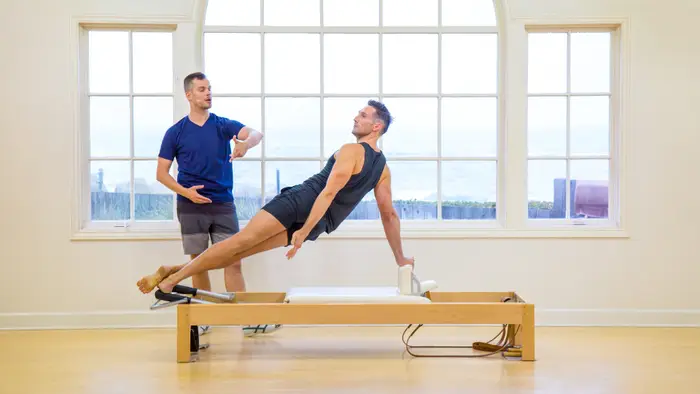
Widely regarded as one of the hardest reformer moves, Snake and Twist demands full-body coordination, rotational control, and stability on an unstable surface simultaneously. The Pilates Journal classifies it as a genuine advanced tier exercise requiring dedicated preparatory sequencing before any attempt, and Pilates Anytime documents its full technical demands in detail. Most studio beginners never reach it in a group class setting.
Wrist and shoulder load is significant, making it unsuitable for anyone with upper-limb instability. Star requires the practitioner to hold a single-arm, single-leg lateral plank on a moving carriage while the machine shifts beneath her. The proprioceptive demand is extreme.
It sits at the top of the classical repertoire alongside Snake and Twist; it functions as a diagnostic: if you cannot hold it cleanly, the gap is in foundational stability, not effort. Control Balance, Supine Legs-Overhead Spinal Articulation and Hamstring Control: Control Balance combines a full spinal rollover with precise hamstring-length control under spring load. The Pilates Journal groups it with Snake and Twist and Star as part of the canonical hardest reformer Pilates moves.
2. Star – Single-Arm, Single-Leg Lateral Balance on the Carriage Side Rail
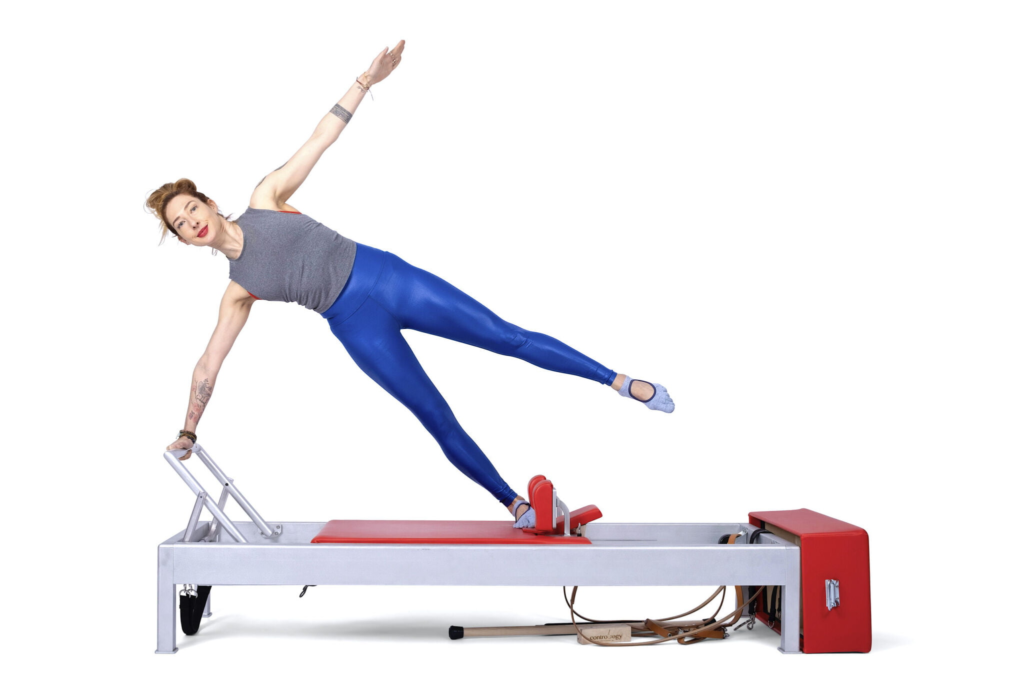
Star takes the reformer’s side-lying position to its extreme by requiring the practitioner to balance on one hand and one foot along the carriage rail while the carriage moves. The resulting lateral chain demand, glutes, obliques, shoulder girdle, is unmatched among reformer Pilates moves names at the advanced tier. It suits practitioners who have mastered Side Splits and Side Plank variations. The real limitation is that even minor spring miscalibration makes it unsafe.
3. Control Balance – Supine Legs-Overhead Spinal Articulation and Hamstring Control
Control Balance places the practitioner supine with legs overhead, demanding precise spinal articulation through every vertebra while maintaining extreme hamstring flexibility and deep abdominal control simultaneously. Among advanced reformer Pilates moves names, it is the one that most ruthlessly exposes any asymmetry in the posterior chain. It is the right choice for practitioners preparing for teacher certification or elite performance. The tradeoff is significant cervical spine load, making it contraindicated for anyone with neck issues.
4. Tendon Stretch – Footbar-Edge Seated Hip Flexor and Core Extreme
Tendon Stretch positions the practitioner balanced on the footbar edge, demanding extreme hip flexor length and deep core compression simultaneously. It is a move that exposes every gap in the intermediate tier. Attempting it without adequate hip flexor mobility typically shifts load into the lumbar spine, which is the most common reason instructors regress clients back rather than pushing forward.
5. Horseback – Kneeling Proprioceptive Balance with Arm-Circle Coordination
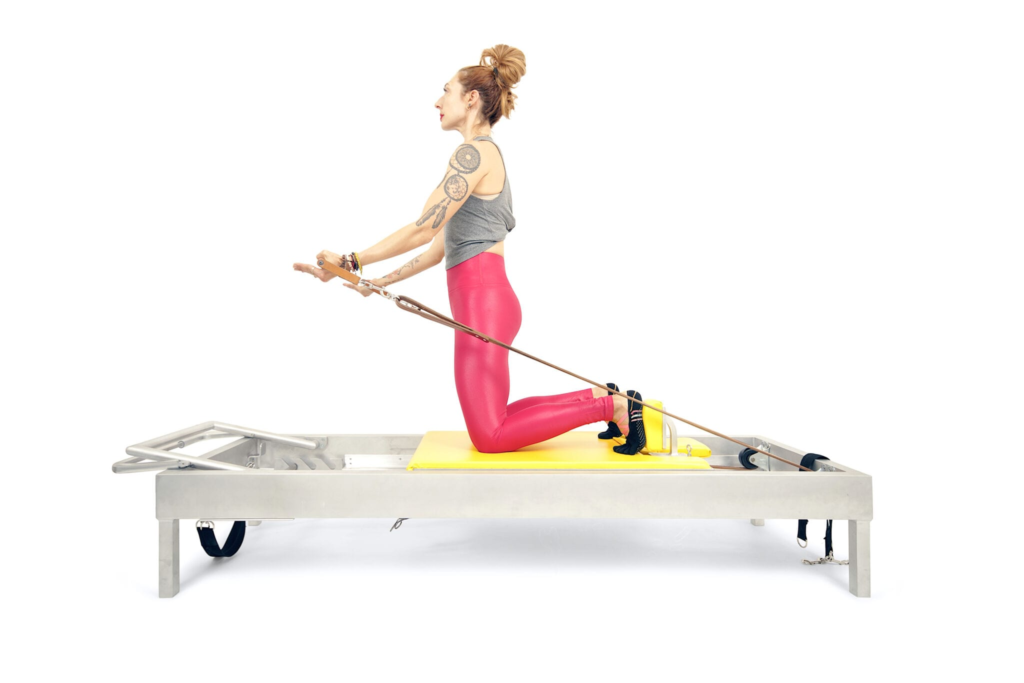
Horseback requires kneeling balance on the moving carriage while coordinating arm circles, training proprioception and multi-planar stability in a single movement. It is the advanced tier’s coordination test. The tradeoff is that it offers almost no progressive overload pathway once mastered: the move is either controlled or it is not, leaving practitioners with nowhere to go once they own it cleanly.
6. Long Spine Massage – Full Posterior Chain Articulation Under Spring Load
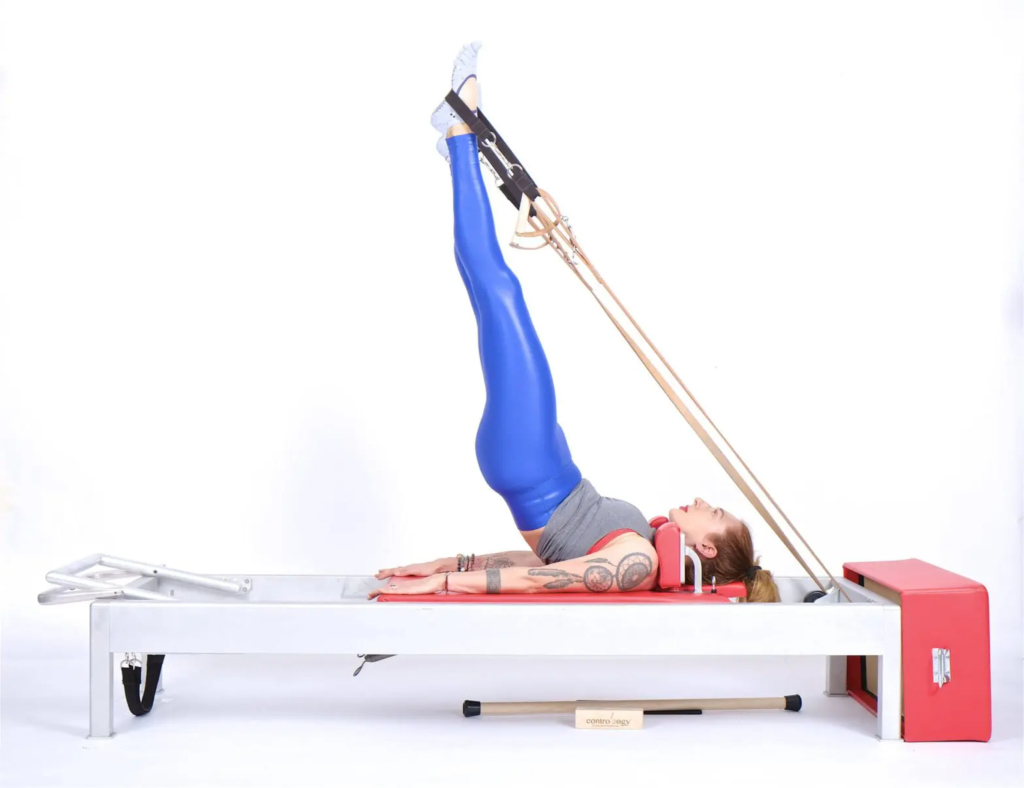
Long Spine Massage is a supine spinal articulation with feet in straps, rolling the spine sequentially under spring resistance. It bridges the intermediate and advanced tiers by demanding hamstring length and spinal mobility in combination. Beginners frequently underestimate the hip flexor demand. It is most beneficial when the practitioner already has clean control in Short Spine Massage and can maintain neutral pelvis through the full range.
7. Short Spine Massage – Controlled Spinal Roll-Down with Strap Resistance
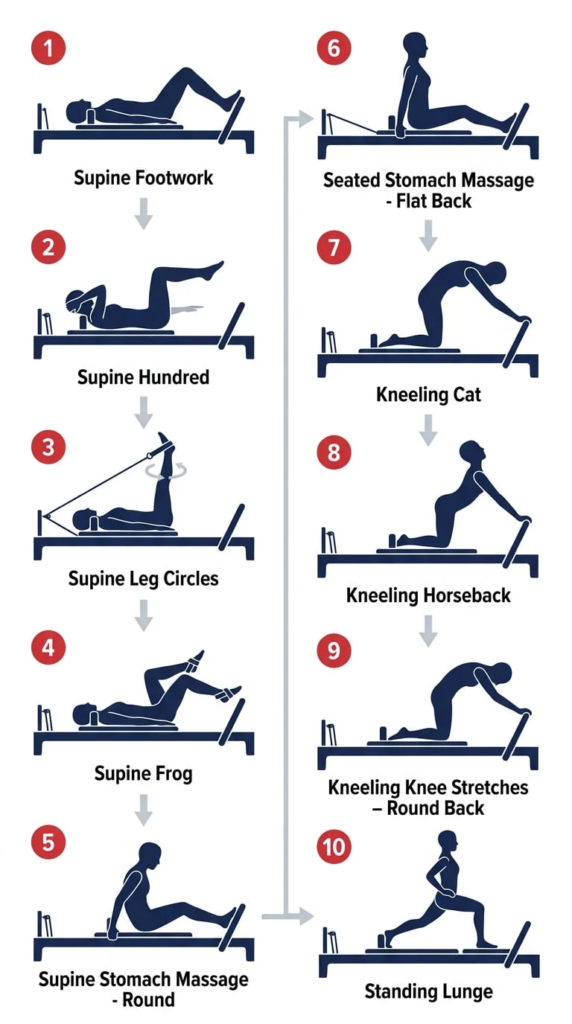
Short Spine Massage uses strap resistance to guide a controlled spinal roll-down from a supine position with feet in the straps. It trains sequential vertebral articulation and hamstring control. The move sits at the upper edge of the intermediate tier and is the most common exercise where practitioners discover they have been substituting lumbar flexion for genuine thoracic mobility, a gap that blocks progress into the true advanced tier.
8. Knee Stretch Round – Spinal Flexion Endurance on a Moving Carriage
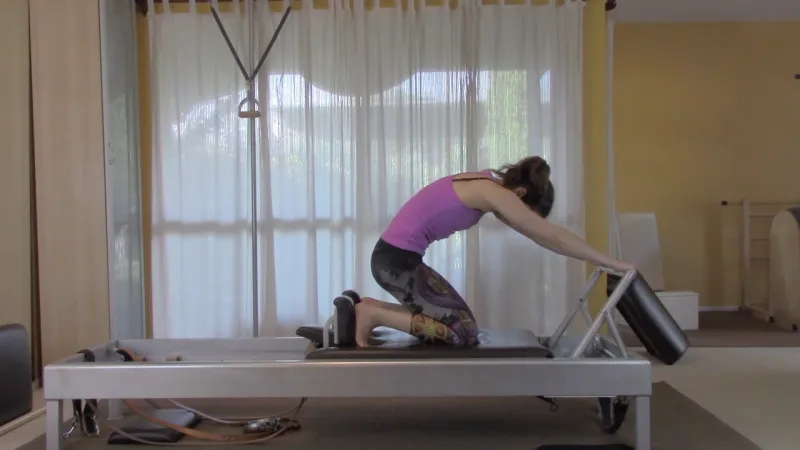
Knee Stretch Round trains spinal flexion endurance in a kneeling position while the carriage moves. It is a deceptively demanding intermediate exercise that most practitioners underestimate because the range of motion looks small. The real challenge is sustaining deep abdominal compression through repeated carriage travel without losing the rounded spine position. Losing that position turns it into a hip flexor exercise rather than a core one.
9. Up Stretch – Pike Transition Demanding Hamstring Length and Shoulder Stability
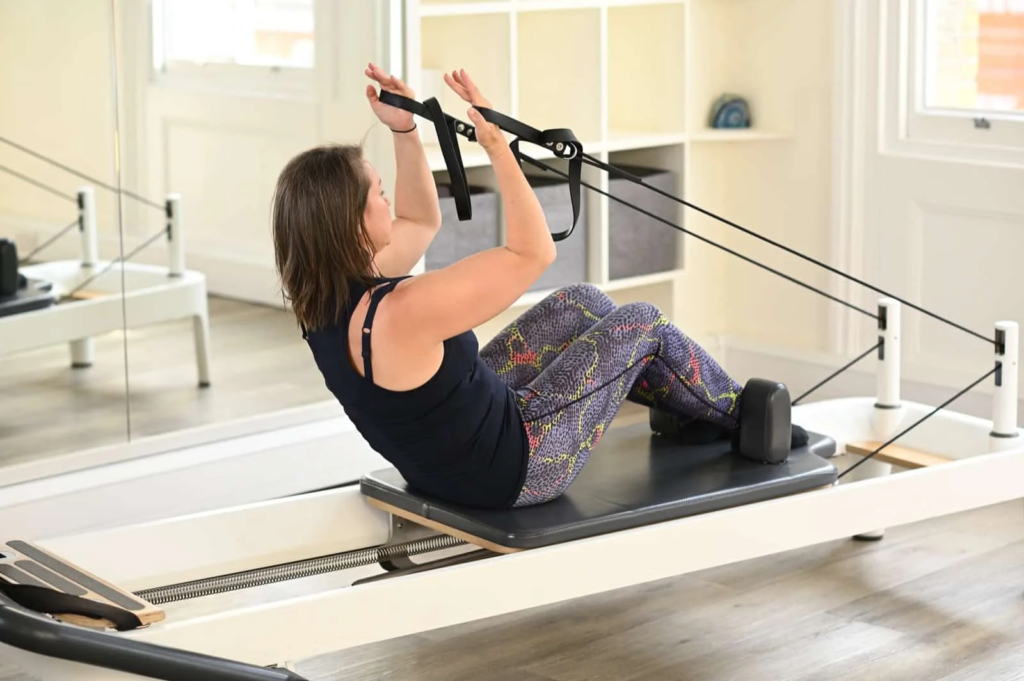
Up Stretch is a pike-to-plank transition on the moving carriage, requiring hamstring length and shoulder stability to work simultaneously. It is one of the clearest diagnostic moves in the repertoire: tight hamstrings produce a compensated lumbar curve that is immediately visible. Practitioners who can perform it cleanly have typically already developed the posterior chain length needed to attempt the advanced tier without injury risk.
10. Elephant – Heel-Lowering Hamstring and Calf Stretch with Carriage Control
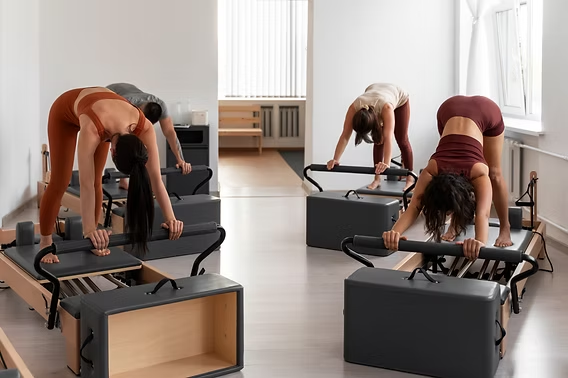
Elephant is a standing forward fold on the carriage with heels pressing into the footbar, training hamstring length and posterior chain control through carriage movement. It appears early in the sequence but remains relevant across all levels because the depth of the stretch scales with flexibility. The tradeoff is that it requires foot and ankle stability that beginners often lack, making the first few attempts feel unstable rather than productive.
11. Arabesque – Single-Leg Standing Balance with Contralateral Extension
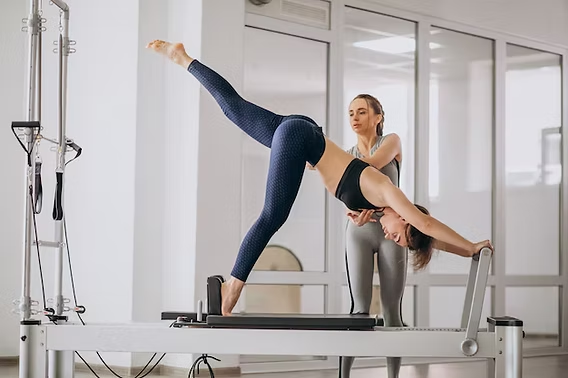
Arabesque demands single-leg standing balance on the moving carriage with the opposite leg extending behind, training hip stability and contralateral coordination. It sits in the upper-intermediate range and is the move where balance deficits from earlier in the repertoire become impossible to disguise. Most group class participants never attempt it with full extension because the studio pace does not allow the preparation time it requires.
Backbend on the Reformer trains spinal extension mobility under spring load, requiring thoracic flexibility and shoulder girdle stability in combination. It is one of the more accessible advanced-adjacent moves for practitioners with dance or gymnastics backgrounds, and one of the most contraindicated for those with lumbar compression history. Spinal extension under load is productive when mobility is genuine and risky when it is compensated.
Splits on the Reformer places one foot on the footbar and one on the carriage, training hip flexor and adductor flexibility under dynamic load as the carriage moves. It is the repertoire’s most flexibility-dependent move and the one most likely to be skipped entirely in group classes. Attempting it without adequate hip flexor length produces anterior pelvic tilt that loads the lumbar spine rather than the intended muscle groups.
Snake and Twist, Star, and Control Balance collectively mark the reformer’s designed ceiling. Reaching them cleanly means the practitioner has traversed the entire named library. The Pilates Journal confirms the expert response to struggling here is regression, not increased frequency.
Mastery of this tier is a finite destination, and knowing that reframes the question from “what comes next on this machine” to “what comes next.”
For clients who have hit that ceiling and want a structured path forward, in a space that feels elevated, clean, and designed for her, BST Lagree’s Angel studio offers a straightforward starting point. The free intro workshop class costs nothing and requires no commitment beyond filling in the form on site. 90 per class).
Transformation materialises with consistent attendance over time, and the pricing is structured so that commitment is rewarded incrementally. The studio handles the method; you handle the showing up. Knowing the names of these advanced moves is one thing.
Knowing exactly how to position your body, calibrate the springs, and sequence your breath through each of them is another. The next section breaks down technique cues for every major category of reformer exercise, so you can walk into your first class with more than just vocabulary.
12. Backbend on the Reformer – Spinal Extension Mobility Under Load
The Backbend on the reformer challenges the practitioner to move into full spinal extension while managing spring resistance, requiring thoracic mobility, hip flexor length, and shoulder girdle openness in combination. Among advanced reformer Pilates moves names, it is the one most directly linked to injury risk when thoracic mobility is insufficient and the lumbar spine compensates. It suits practitioners with established spinal extension capacity. The tradeoff is that it should never be attempted without a qualified instructor present for the first several sessions.
13. Splits on the Reformer – Hip Flexor and Adductor Flexibility Under Dynamic Load
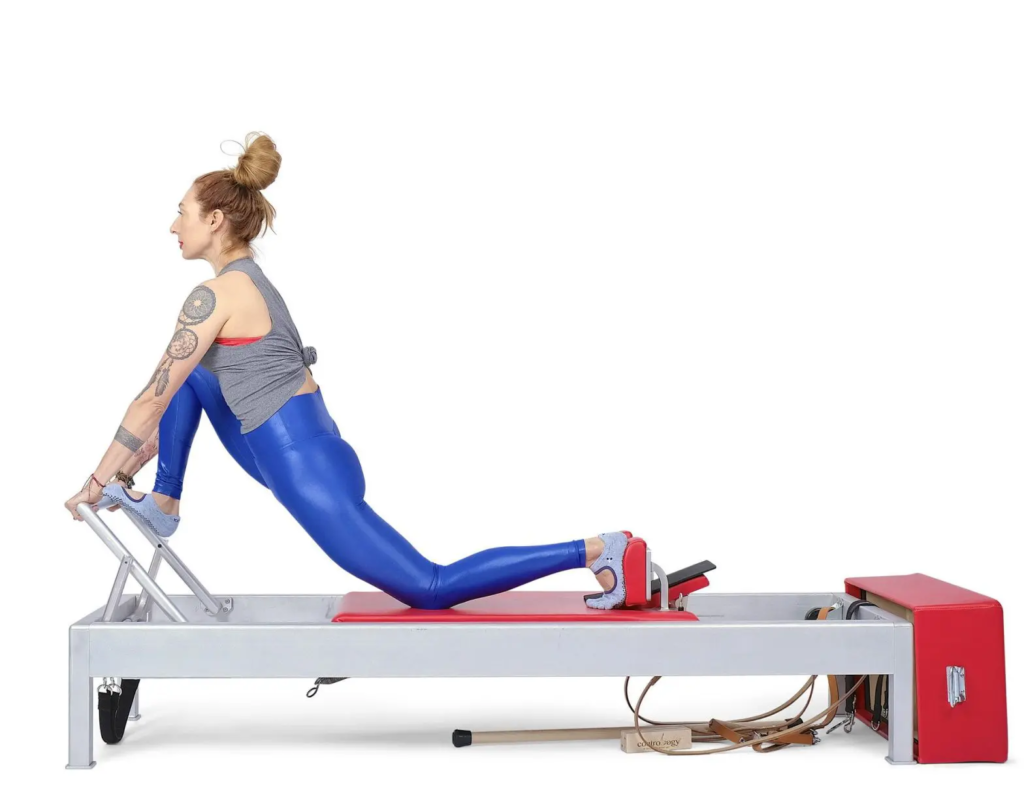
Splits on the reformer places one foot on the footbar and the other on the moving carriage, then drives the carriage out to progressively deepen the hip flexor and adductor stretch under dynamic spring load. It is one of the reformer Pilates moves names that directly translates to athletic performance in runners, dancers, and martial artists. It suits practitioners who have already achieved near-full hip range of motion in static positions. The limitation is that spring tension must be conservative initially to prevent adductor strain.
14. The Advanced Tier – Snake and Twist, Star, and Control Balance as the Canonical Hardest Reformer Pilates Moves
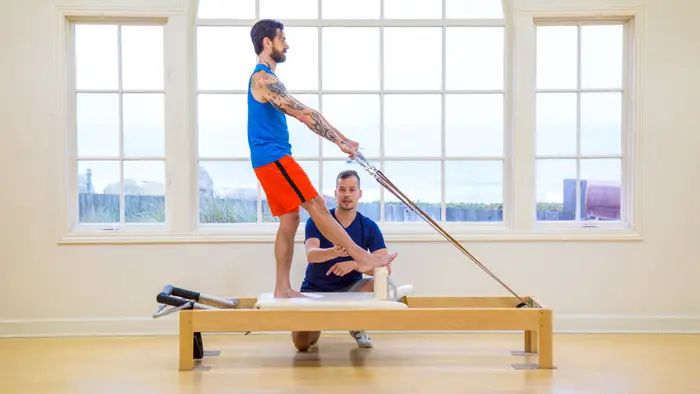
When practitioners and instructors ask what the hardest reformer Pilates moves are, three reformer Pilates moves names consistently emerge as the canonical answers: Snake and Twist for its rotating side-plank demand, Star for its unilateral lateral balance extremity, and Control Balance for its simultaneous spinal articulation and hamstring flexibility requirement. These three represent the method’s true ceiling, exercises that even experienced practitioners spend years refining. No single prerequisite unlocks all three; each demands a distinct combination of strength, flexibility, and neuromuscular precision.
How Each Major Reformer Exercise Is Performed for Beginners Who Want Real Technique Cues
Knowing the name of a reformer exercise is not the same as knowing how to do it. Without one precise cue, most beginners spend their first weeks reinforcing compensations rather than building the movement quality the exercise is designed to develop. Here is how each major category works, organised by body area so you have a practical training map rather than a classical sequence to memorise.
1. LOWER BODY CATEGORY – Footwork Series – Heels, Toes, and Arches on the Footbar
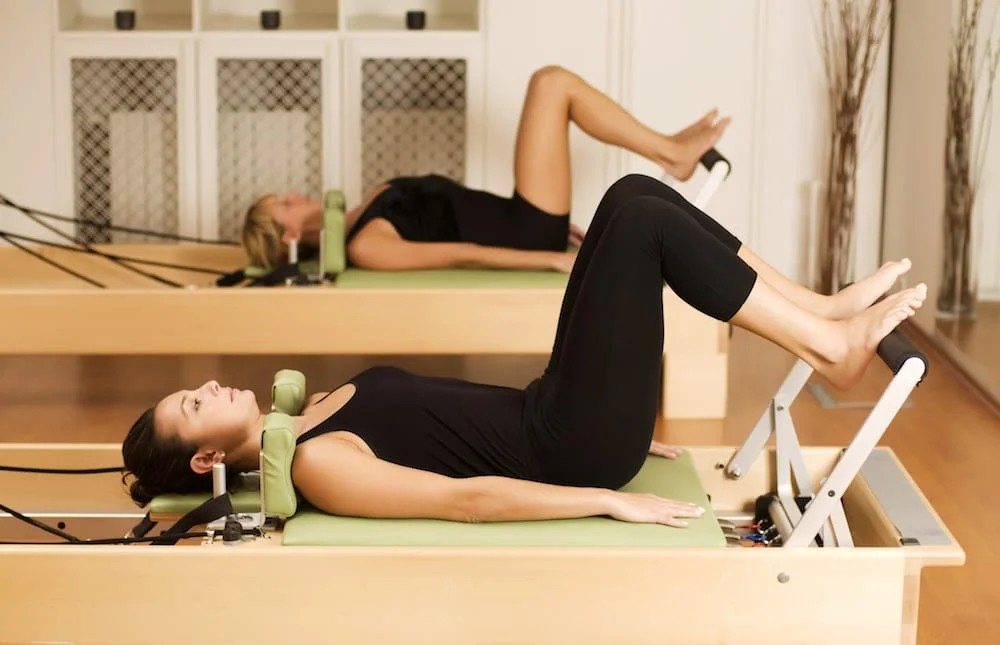
Set two to three springs for a beginner load, lie supine on the carriage, and press through the footbar without allowing the lower back to flatten or arch. The pelvis stays level throughout every push and return. Beginners consistently tuck the tailbone on the return phase, which shifts load off the glutes and onto the lumbar spine.
Keep the hip bones and pubic bone in one flat plane for the entire set. Running follows Footwork with the same spring load and supine position. Alternate heel drops toward the carriage, one foot at a time, keeping the knees soft and the pelvis absolutely still.
The cue that matters: let the heel drop below the footbar level to get genuine calf lengthening. Beginners rush this and turn it into a leg-cycling drill. Slow the tempo down until each heel drop feels like a deliberate stretch, not a transition.
2. LOWER BODY CATEGORY – Running on the Reformer – Heel-Drop Calf and Hip Flexor Warm-Down
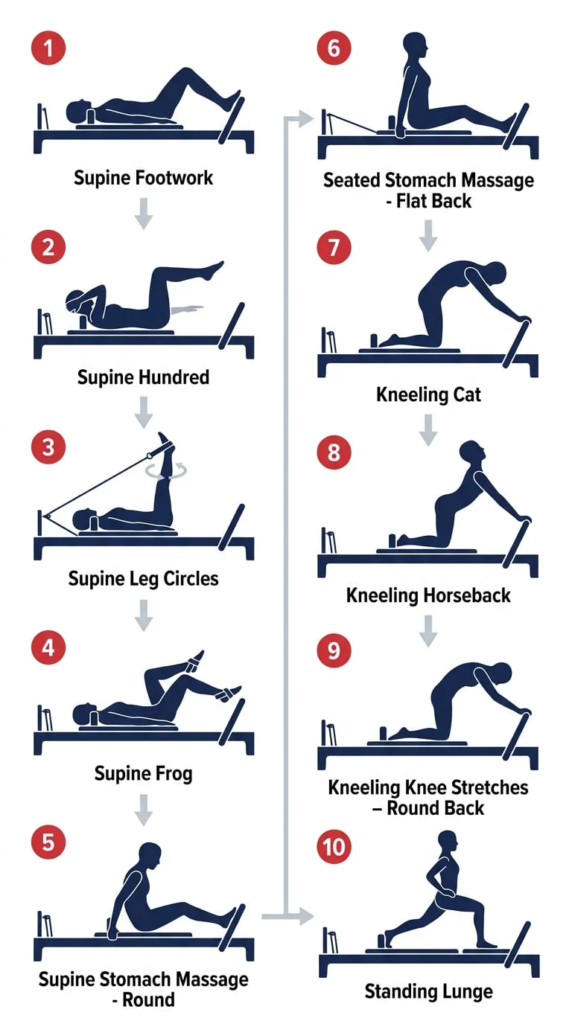
Running follows Footwork and targets calves, hip flexors, and ankle mobility through an alternating heel-drop pattern. Beginners often rush the tempo; the correct cue is to alternate heels slowly, allowing each heel to drop below the footbar level to stretch the calf fully. Breath pattern: exhale as each heel lowers. Use 2-3 springs, too light and the carriage wobbles, undermining the ankle stability work.
3. LOWER BODY CATEGORY – Leg Circles in Straps – Hip Mobility and Adductor Control
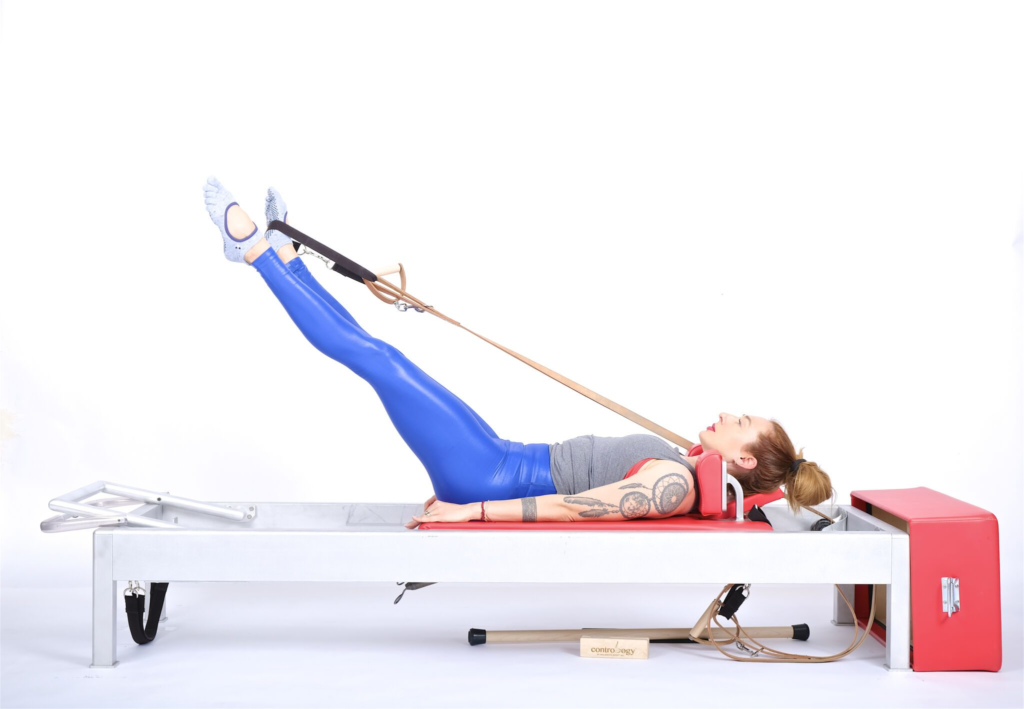
Leg Circles use the long straps to draw full circles with both legs, targeting hip joint mobility, adductors, and deep rotators. The beginner technique cue: keep the pelvis completely still on the carriage, any rocking means the circle is too large. Breathe in on the outward arc, exhale to close. Use 1 spring; the lighter load demands more intrinsic hip control and exposes tightness in the hip flexors quickly.
4. CORE AND ABDOMINALS CATEGORY – The Hundred – Breath-Pumping Abdominal Endurance Starter
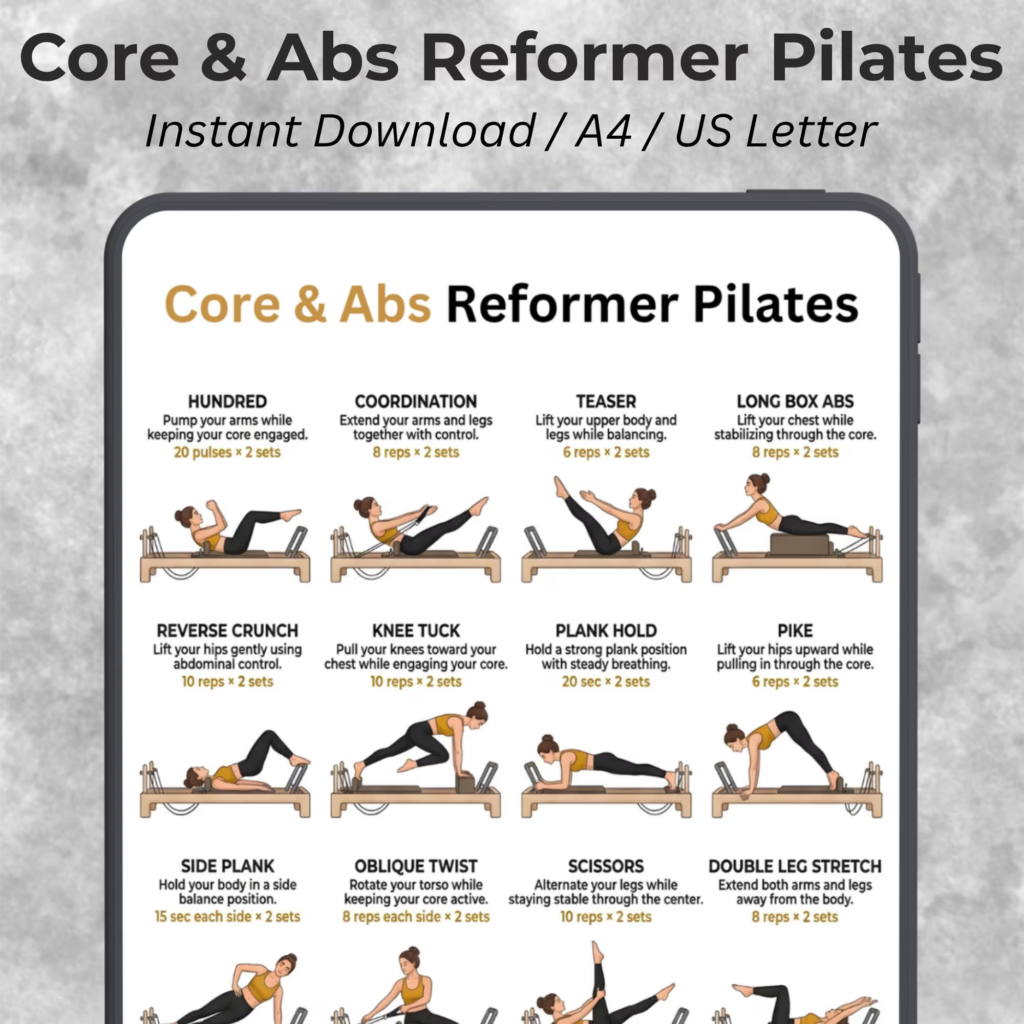
Sit at the front edge of the carriage facing the footbar, spine in a C-curve, feet on the bar, and use two to three springs. Push the carriage out and draw it back with control. The cue: maintain the C-curve without collapsing the chest toward the knees. This series catches beginners off guard with its cardiovascular demand; the combination of seated spinal compression and continuous leg pumping elevates heart rate faster than any supine exercise on the machine. It previews the strength-and-cardio combination that defines a well-executed reformer session.
5. CORE AND ABDOMINALS CATEGORY – Stomach Massage Series – Seated Core Work That Surprises Beginners With Its Cardio Demand
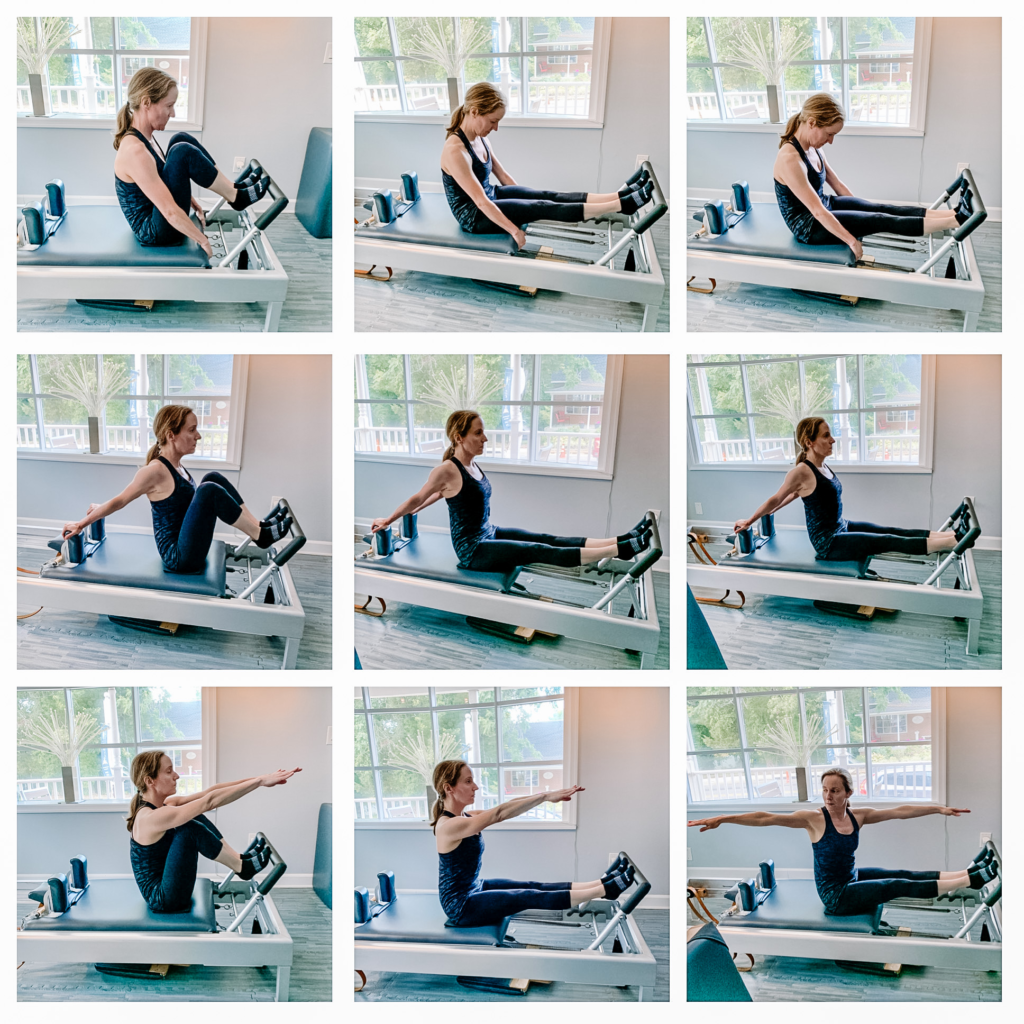
Stomach Massage is a seated series where the practitioner perches at the edge of the carriage, spine rounded or upright, and presses the footbar away with both feet. Beginners are consistently surprised: the upright seated position demands simultaneous core stability and leg drive, creating a dual core-and-cardio challenge. Cue: lift tall through the crown before each press. Use 2 springs; too light collapses the seated posture immediately.
6. CORE AND ABDOMINALS CATEGORY – Short Spine Massage – Spinal Articulation and Deep Abdominal Control
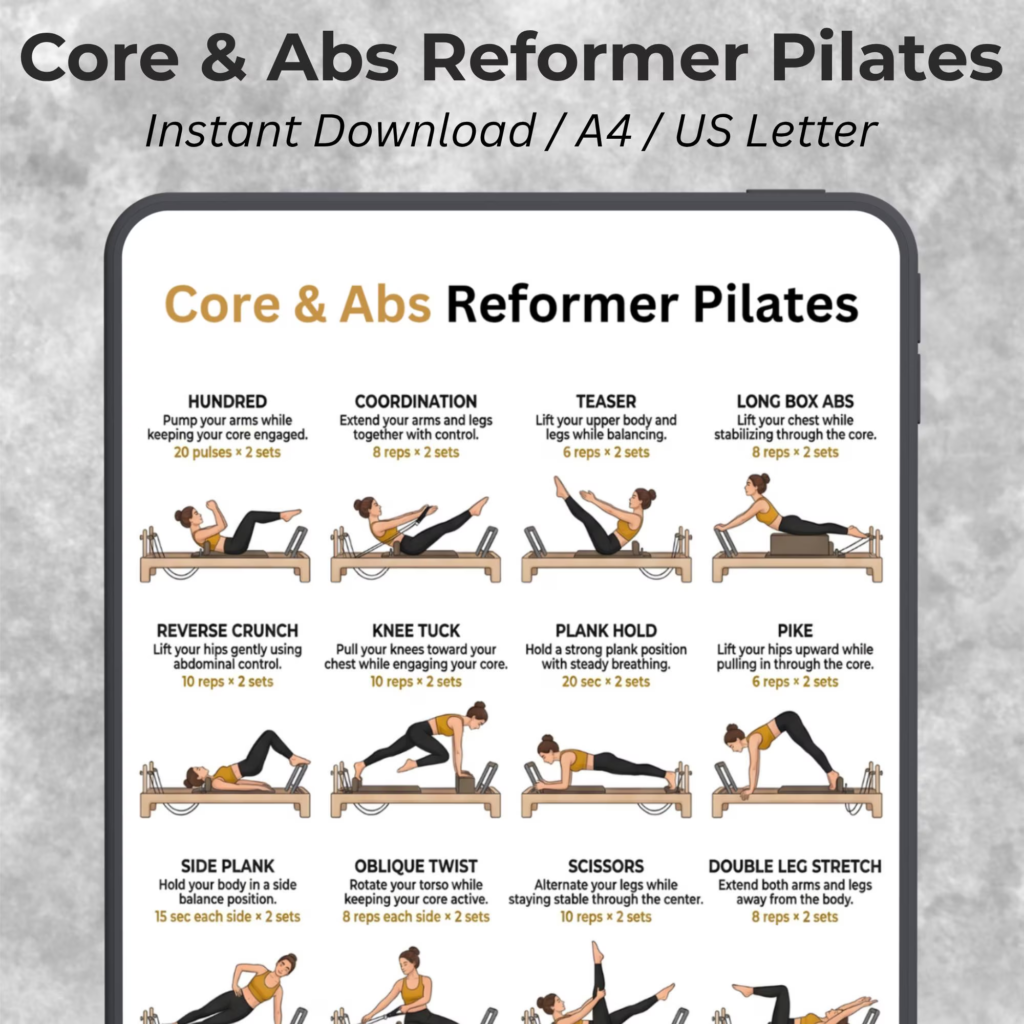
Short Spine Massage uses the long straps to fold the legs overhead and then slowly roll the spine down vertebra by vertebra, making it one of the most demanding spinal articulation exercises for beginners. The technique cue: resist the urge to flop down, control each spinal segment individually on the way down. Inhale to fold the hips overhead, exhale to roll down. Use 1 spring; heavier resistance rushes the descent and defeats the articulation goal.
7. UPPER BODY AND ARMS CATEGORY – Rowing Series Front – Seated Scapular Stability and Arm Reach
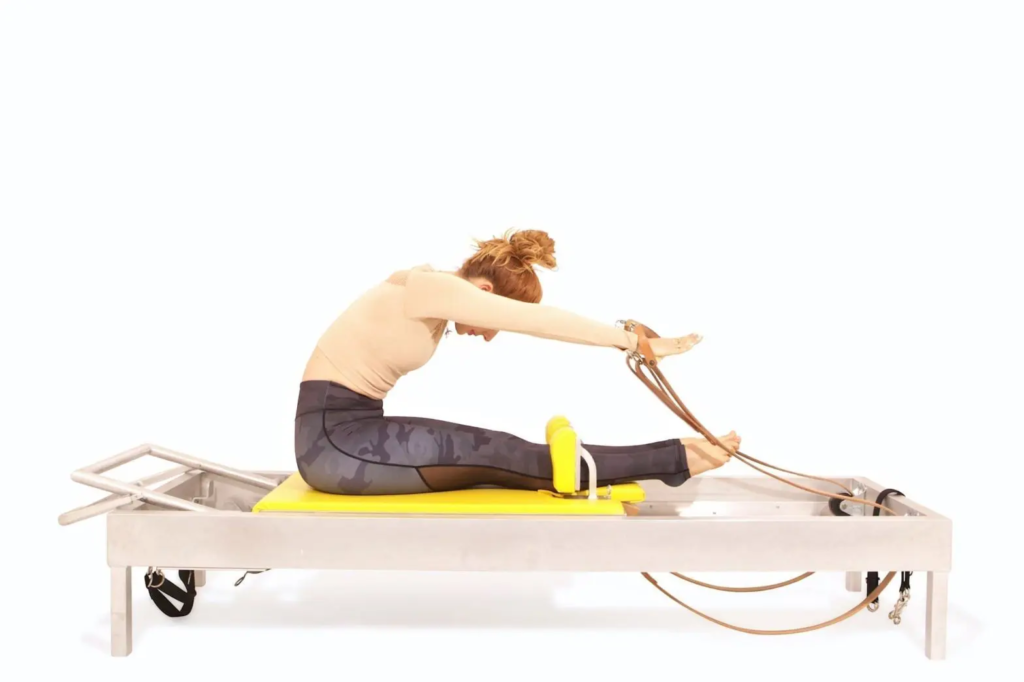
The Rowing Series Front begins seated facing the footbar, using the handles to row the arms from a rounded spine into a full overhead reach. It targets the rhomboids, trapezius, and posterior deltoids while demanding core stability to prevent the torso from collapsing. Beginner cue: draw the shoulder blades down before initiating the pull. Use 1 light spring; the seated position with no back support exposes core weakness rapidly.
8. UPPER BODY AND ARMS CATEGORY – Long Stretch Series – Plank-Based Core-and-Cardio Dual Demand
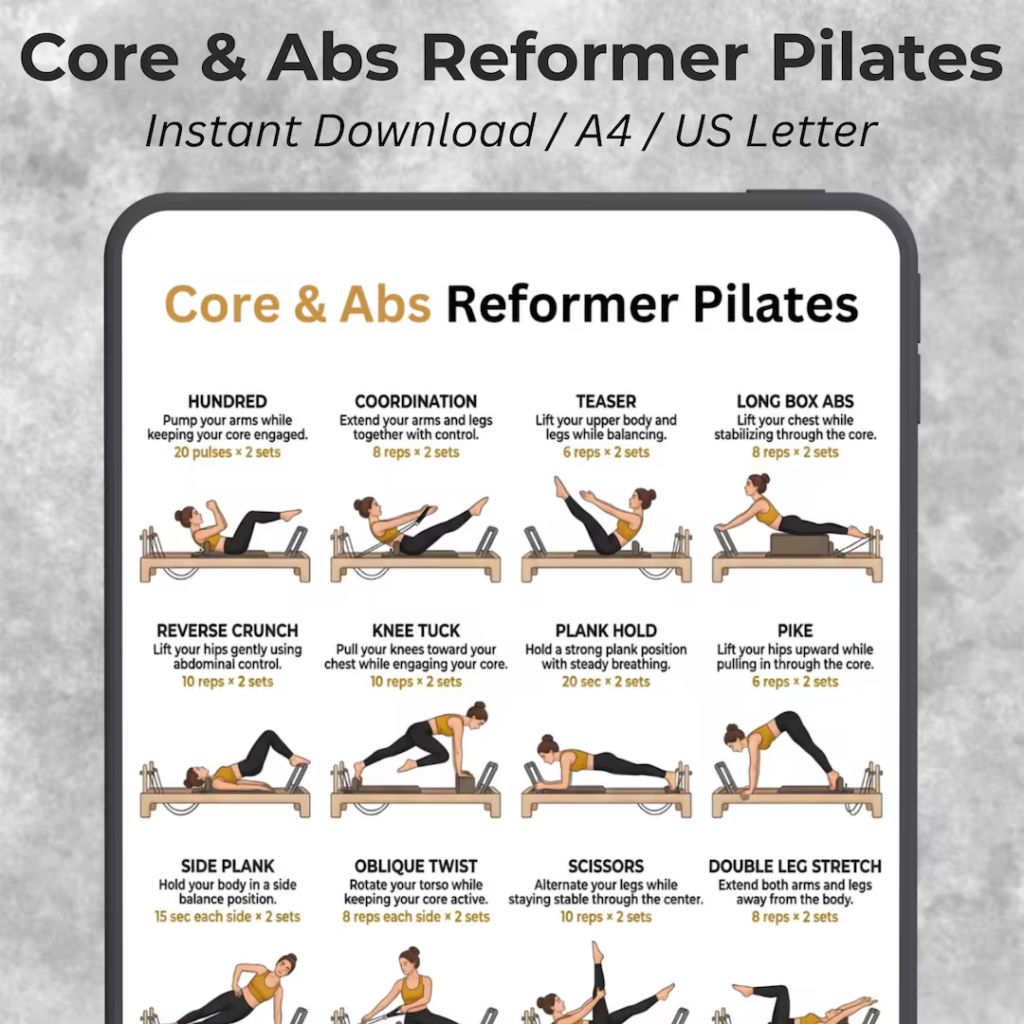
Long Stretch places the practitioner in a moving plank, hands on the footbar, toes on the carriage, and pushes the carriage back and pulls it in repeatedly. Like Stomach Massage, beginners are caught off guard by how cardiovascularly demanding this move is; the instability of the sliding carriage under the feet turns a standard plank into an intense full-body challenge. Cue: keep hips level, not piked. Use 2 springs to start.
9. LOWER BODY CATEGORY – Feet in Straps – Frog – Hip Flexor Release and Inner Thigh Activation
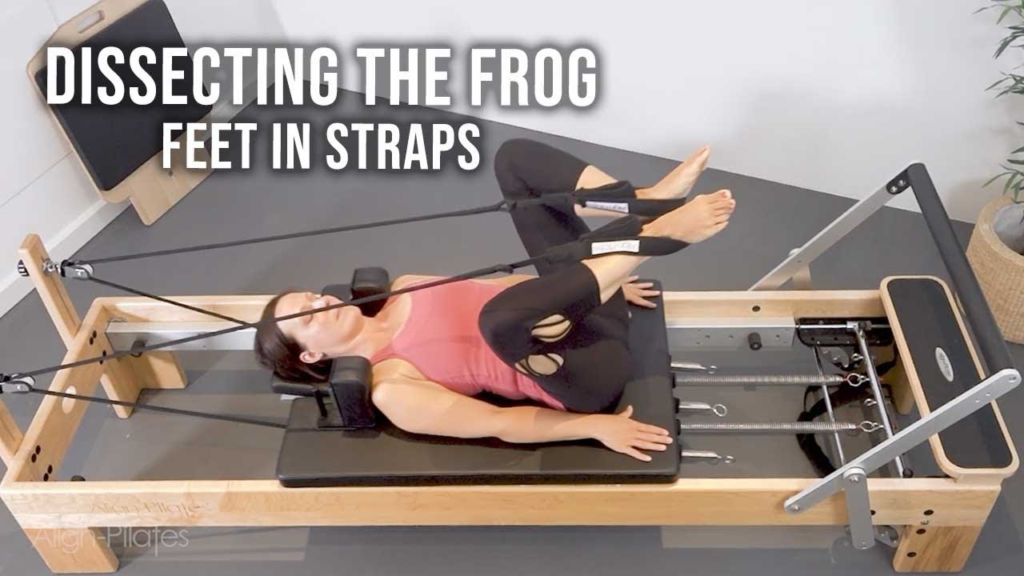
Frog uses the long straps around the feet while lying supine, pressing the legs out on a diagonal and drawing them back in a frog-leg pattern. It targets the inner thighs, hip flexors, and glutes simultaneously. Beginner cue: press out only as far as the lower back stays flat, the moment the lumbar lifts, the range is too large. Use 1 spring; the strap tension guides the movement path and teaches hip external rotation naturally.
10. CORE AND ABDOMINALS CATEGORY – Coordination – Arm-and-Leg Sequencing for Neuromuscular Core Challenge
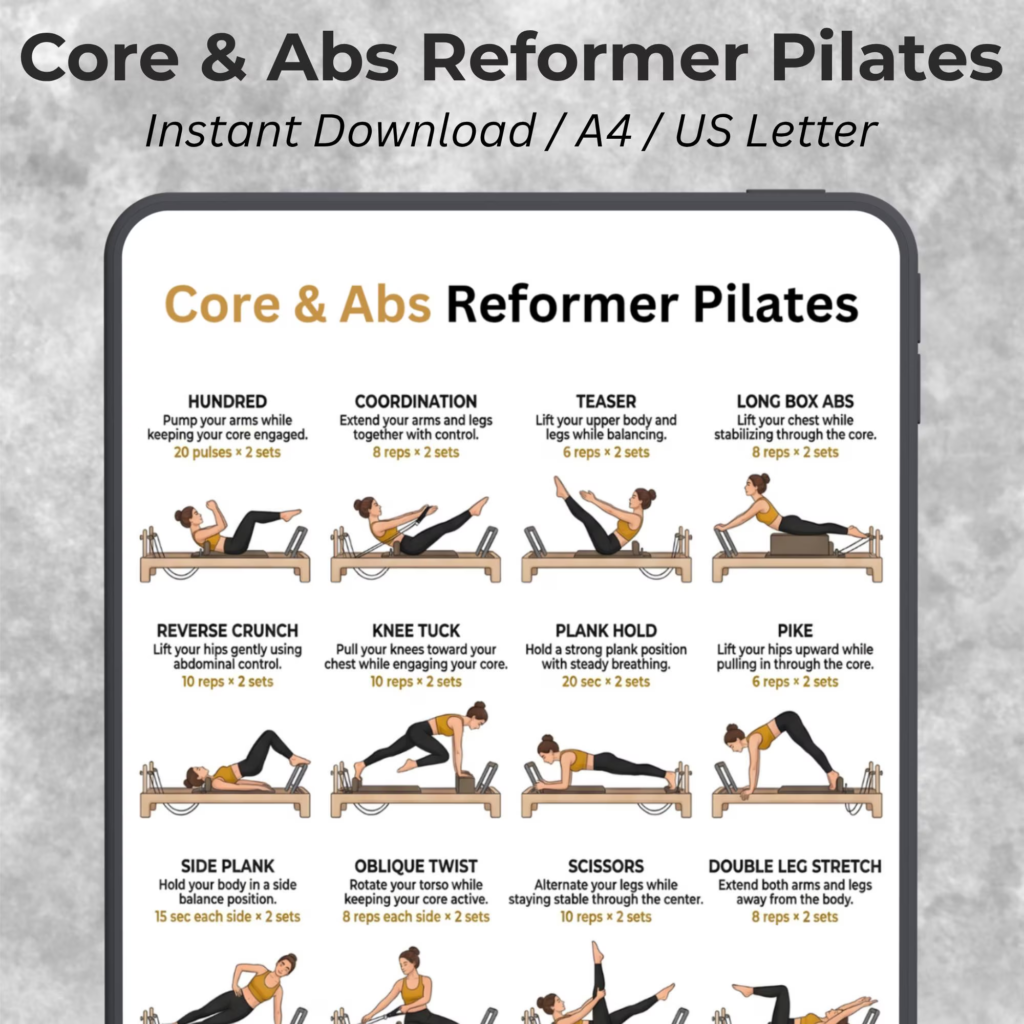
Coordination requires lying supine, curling the head and chest up, extending the arms and legs simultaneously, opening and closing the legs, then reversing the sequence, all in one fluid breath cycle. It is one of the most cognitively demanding beginner exercises because the sequencing must be memorized before the core work can be felt. Cue: exhale fully as you open and close the legs. Use 1 spring; the light load keeps the focus on sequencing rather than strength.
11. LOWER BODY CATEGORY – Elephant – Standing Hip Hinge and Hamstring Lengthening on the Carriage
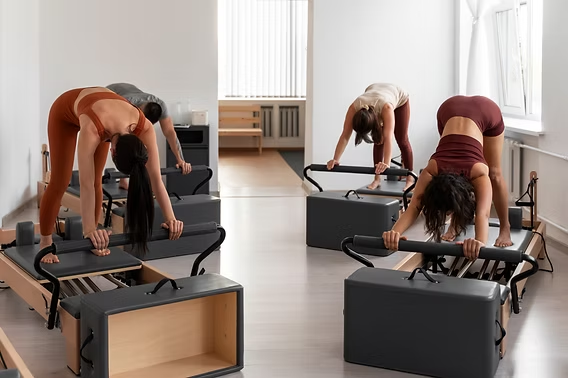
Elephant places the practitioner standing on the carriage with hands on the footbar, spine rounded in a C-curve, pushing the carriage back with the feet and drawing it in using hamstring and abdominal engagement. It is a powerful hamstring-lengthening and hip-hinge exercise that also demands significant shoulder stability. Beginner cue: press the heels down and round the lower back, do not let the lumbar arch. Use 2 springs; lighter resistance causes the carriage to shoot back uncontrollably.
12. CORE AND ABDOMINALS CATEGORY – Knee Stretch Series – Kneeling Core Stability With Spinal Flexion
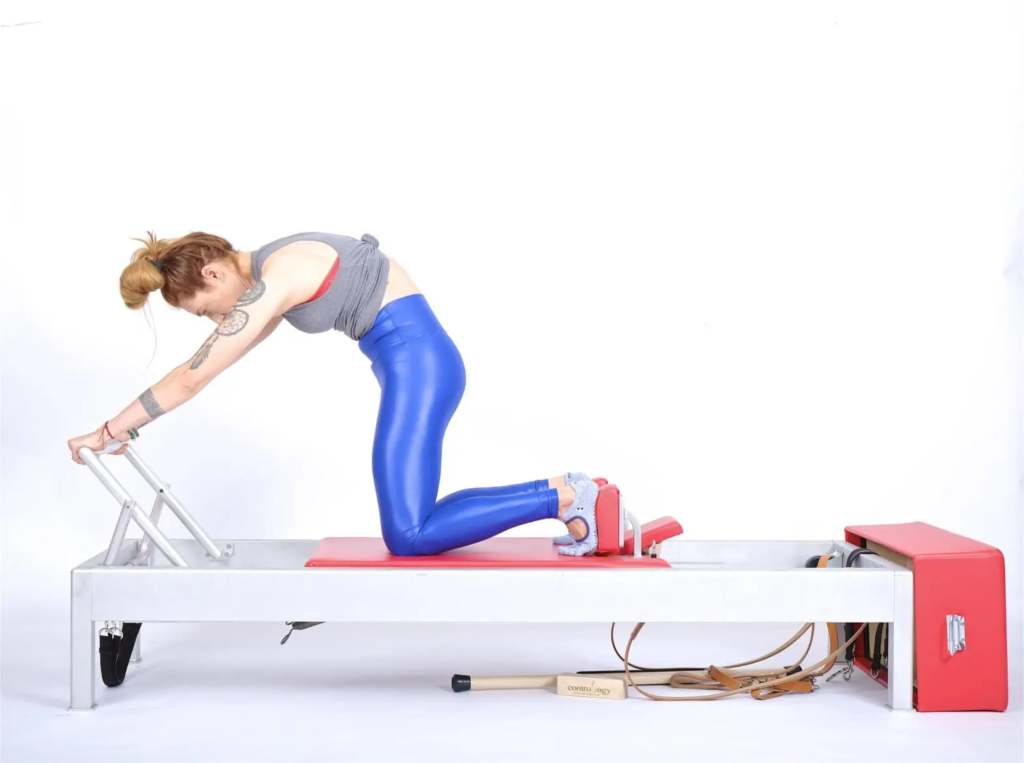
Knee Stretch places the practitioner kneeling on the carriage with hands on the footbar, spine in a deep C-curve or arched position, and drives the carriage back and in using the knees. It targets deep abdominals, hip flexors, and spinal stabilizers in a kneeling load that beginners find surprisingly intense on the core. Cue: scoop the belly up before each push, the movement should come from the abs, not the hip flexors alone. Use 2 springs.
13. UPPER BODY AND ARMS CATEGORY – Chest Expansion – Standing Arm Pull for Posture and Thoracic Extension
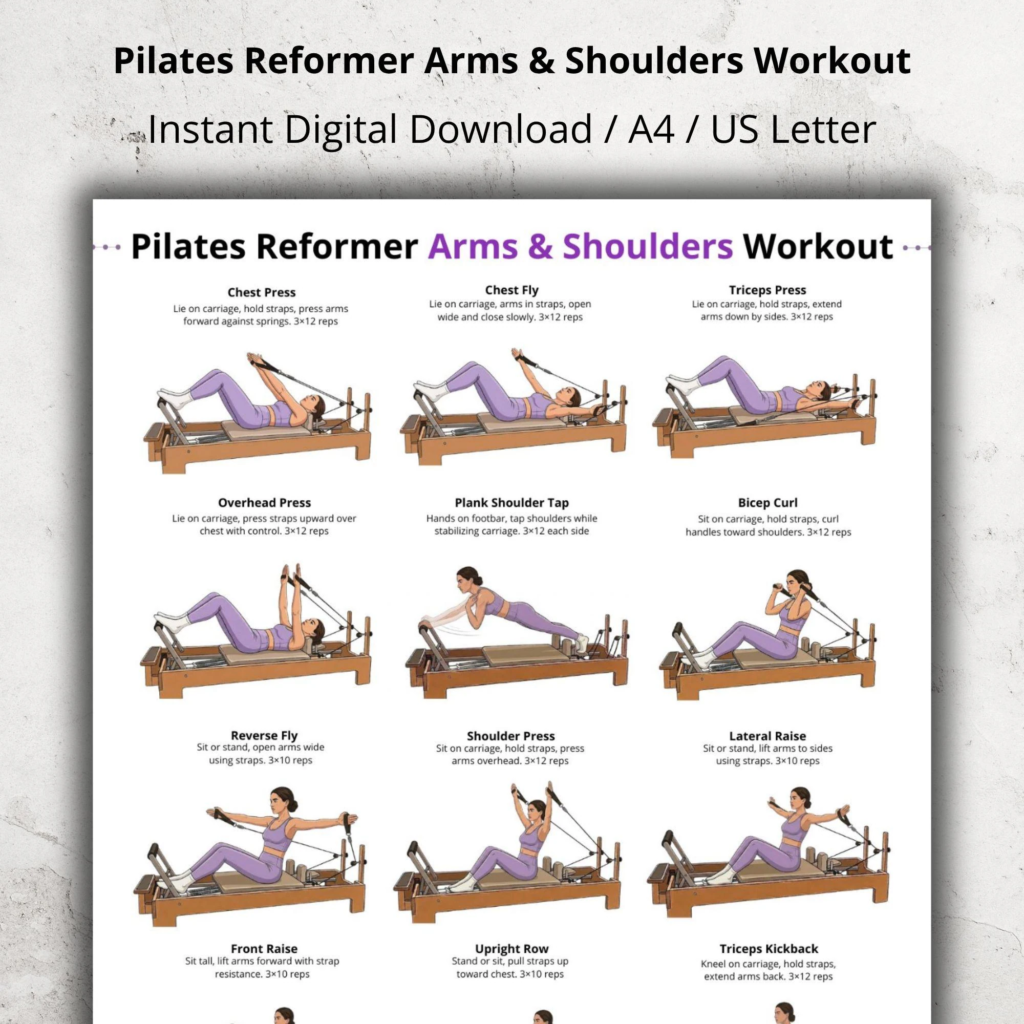
Chest Expansion is performed kneeling on the carriage, pulling the straps back behind the hips while lifting tall through the spine and gently extending the thoracic spine. It directly counters the forward-rounded posture most beginners carry into the studio. Technique cue: pull the straps back on the exhale and hold for two counts, feeling the chest open and shoulder blades draw together. Use 1-2 springs; heavier resistance rewards good posture with a satisfying posterior chain activation.
When You Know All 14 Reformer Move Names – Here Is What Happens Next
The reformer has done exactly what it was built to do. That is the mechanism, and understanding it changes everything about what you do next. A July 2025 randomised controlled trial published in Scientific Reports found that after eight weeks of reformer Pilates, participants showed no significant change in body fat percentage compared to controls.
The study’s protocol used a fixed classical sequence with spring resistance as the sole adjustable variable, which is not a flaw in the study design. That is the method’s actual structure.
Key takeaway: The plateau is architectural.
Industry research confirms that mastery of the named exercises represents the method’s ceiling by design, with spring and tempo variations offering only marginal extension beyond it. Once you can execute the full classical repertoire cleanly, spring resistance maxed and tempo controlled, you have completed a finite curriculum. The honest question at that point is which apparatus is still the right tool for the result you want.
The hidden cost of staying inside a closed system is time: weeks of consistent attendance that no longer produce new physical challenge, not because effort is lacking, but because the method has already given everything it was designed to give. There is no fixed named-move ceiling to reach, because the sequence is never the same twice. Reformer fluency is the clearest possible signal that you are ready for a system built to keep progressing you.
Next steps
If you have worked through every exercise on this list and the carriage no longer surprises you, the problem is not your effort. As the body of this guide makes clear, the classical reformer repertoire is a finite curriculum, and fluency in it is the exit sign, not the destination. The moment Footwork feels automatic and the Stomach Massage Series stops raising your heart rate, the method has delivered everything it was architecturally designed to deliver. Start with our Lagree classes in London.
That conclusion follows directly from two things this guide establishes. First, beginner exercises like Footwork and the Hundred are the most neurologically dense moments of any session, and once they feel familiar, the machine’s primary adaptation window has already closed. Second, when clients plateau at the advanced tier, expert instructors prescribe regression rather than more classes, because the advanced repertoire exposes the ceiling rather than extending it. Those two facts together make the next step obvious: a structurally different training system, not more repetitions on the same apparatus.
Start with Lagree classes in London at BST Angel. The Megaformer controls time under tension, instability, and load simultaneously, three variables the classical reformer sequence never touches. A free intro workshop class is available via the on-site form, with a complimentary coffee included on your first visit.
Frequently Asked Questions
What are the 34 Pilates moves, and where do they come from?
The 34 exercises are the classical mat repertoire established by Joseph Pilates himself, a fixed, deliberate sequence where every exercise earns its position by preparing your body for the one that follows. They were never published in a single authoritative written text; instead they were transmitted as an oral tradition across the small group of instructors Pilates personally trained before his death in 1967.
What is the classical Joseph Pilates reformer order?
The classical sequence is organised across three tiers, beginner, intermediate, and advanced, with each tier built progressively on the level before it. The named clusters run from Footwork and the Hundred through Short Box, Long Box, Stomach Massage, Knee Stretches, Running, Pelvic Lift, Elephant, Long Stretch, Side Splits, and Mermaid.
How does the Footwork series work on the reformer, and why does it come first?
Footwork is performed lying on the carriage facing the footbar, cycling through foot positions, toes, arches, heels, parallel, and V-position, to establish foundational alignment before any other movement begins. It comes first because it trains the posterior chain and establishes carriage control; without it, exercises like Elephant and the Long Stretch Series have no foundation to build on.
How do you modify The Hundred on the reformer when your neck starts to strain?
If your neck strains within the first twenty pumps, your head goes down, not your chin further in. Neck strain during this move is almost always caused by insufficient abdominal strength rather than poor effort.
What do feet-in-straps exercises like Leg Circles actually train?
Leg Circles are performed lying on the back with both feet in the reformer straps, drawing controlled circles to train hip mobility and hamstring length, with the target zone being hip joint mobility and lower-back decompression. The key beginner cue is to keep the pelvis completely still, if the hip rocks with each circle, the range is too large.