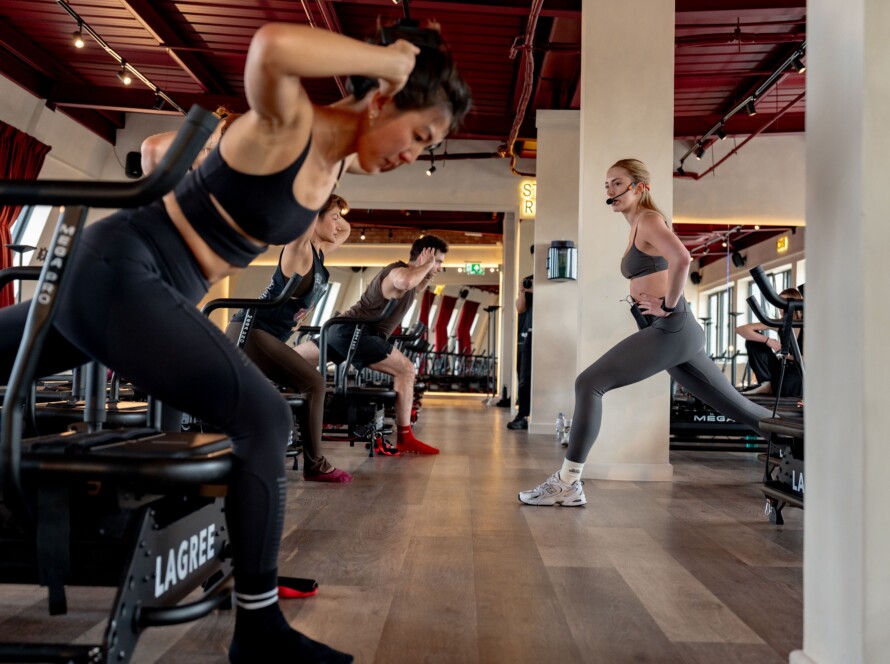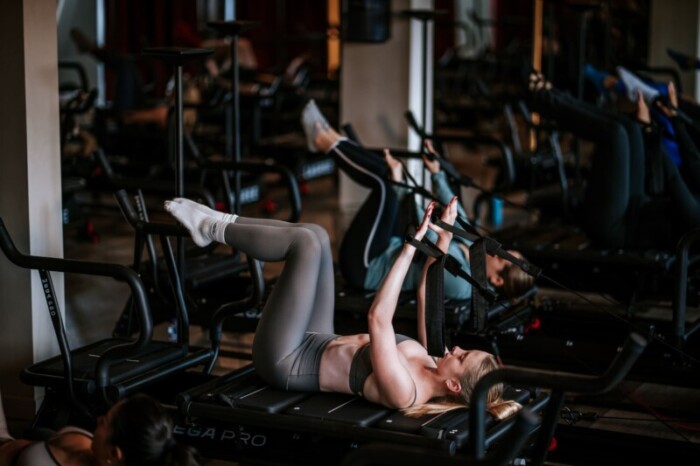
Your reformer sessions still feel hard, but the mirror stopped changing. Here is exactly why spring resistance hits a ceiling, and what finally breaks through it.
Consistency is supposed to be the answer. Show up, do the work, trust the process. So when you have been turning up to reformer classes three times a week for four months and your legs look exactly the same as they did on day one, it is reasonable to feel confused, and a little cheated.
The common assumption is that if she just learns more exercise variations or tweaks her spring settings, the reformer will start producing results again. That assumption is understandable. It is also wrong.
The real reason progress has stopped has nothing to do with your effort or your exercise list. It is structural. If you want to understand where the ceiling actually sits, the science behind the Lagree Method makes it clearer than any new exercise variation will.
See our Lagree London for how this works in practice. The mechanism is called the repeated-bout effect. As Hughes, Ellefsen, and Baar documented in Cold Spring Harbor Perspectives in Medicine, skeletal muscle adapts to a given training stimulus over time, and continued exposure to the same load produces diminishing returns until adaptation effectively stops. Once your body has adapted to the available load, adding new leg press variations within the same resistance ceiling produces more of the same stimulus, not a new one. The same research is direct: low-to-moderate fixed resistance does not provide the progressive mechanical overload required to continue stimulating muscle protein synthesis once adaptation has occurred.
Hughes, Ellefsen, and Baar are clear that increasing exercise variation alone does not substitute for progressive mechanical overload; hypertrophy and strength gains are driven by the magnitude of tension imposed on the muscle, not the number of different movements performed. A longer exercise list inside the same method ceiling is not a new stimulus. It is a longer loop of the same one.
A longer exercise list inside the same method ceiling is not a new stimulus. It is a longer loop of the same one. The good news is that every exercise in the reformer catalogue was building something real. The next section maps exactly what that foundation gave you, and where, biomechanically, it runs out of road.
Key takeaways
- Reformer leg exercises build body awareness and joint alignment under light load, that value is real, but it has a ceiling, and most women hit it within months without knowing why.
- The plateau isn’t a motivation problem. It’s a method problem: the reformer’s spring-resistance range runs out before your legs do.
- Knowing all 20 reformer leg variations, footwork series, leg press, legs-in-straps, tells you exactly what the machine can deliver, and where it stops delivering.
- A 2025 randomised controlled trial confirms that muscular endurance load and tempo control are the variables that drive visible tone; reformer work undershoots both once you’ve adapted.
- Tweaking spring settings or adding exercise variations doesn’t fix a structural ceiling, it just delays the moment you admit the tool has limits.
- BST Lagree in Angel, Islington offers 45-minute group Lagree classes, strength building and cardio in one session, with a free introductory class that lets you feel the difference before you commit to anything.
What Foundational Reformer Leg Exercises Are Actually Building
Reformer leg training encompasses a wide range of movements, from the footwork series and leg press variations to legs-in-straps work, and understanding what each is actually built to do is the clearest way to explain why results stall and what to do about it.
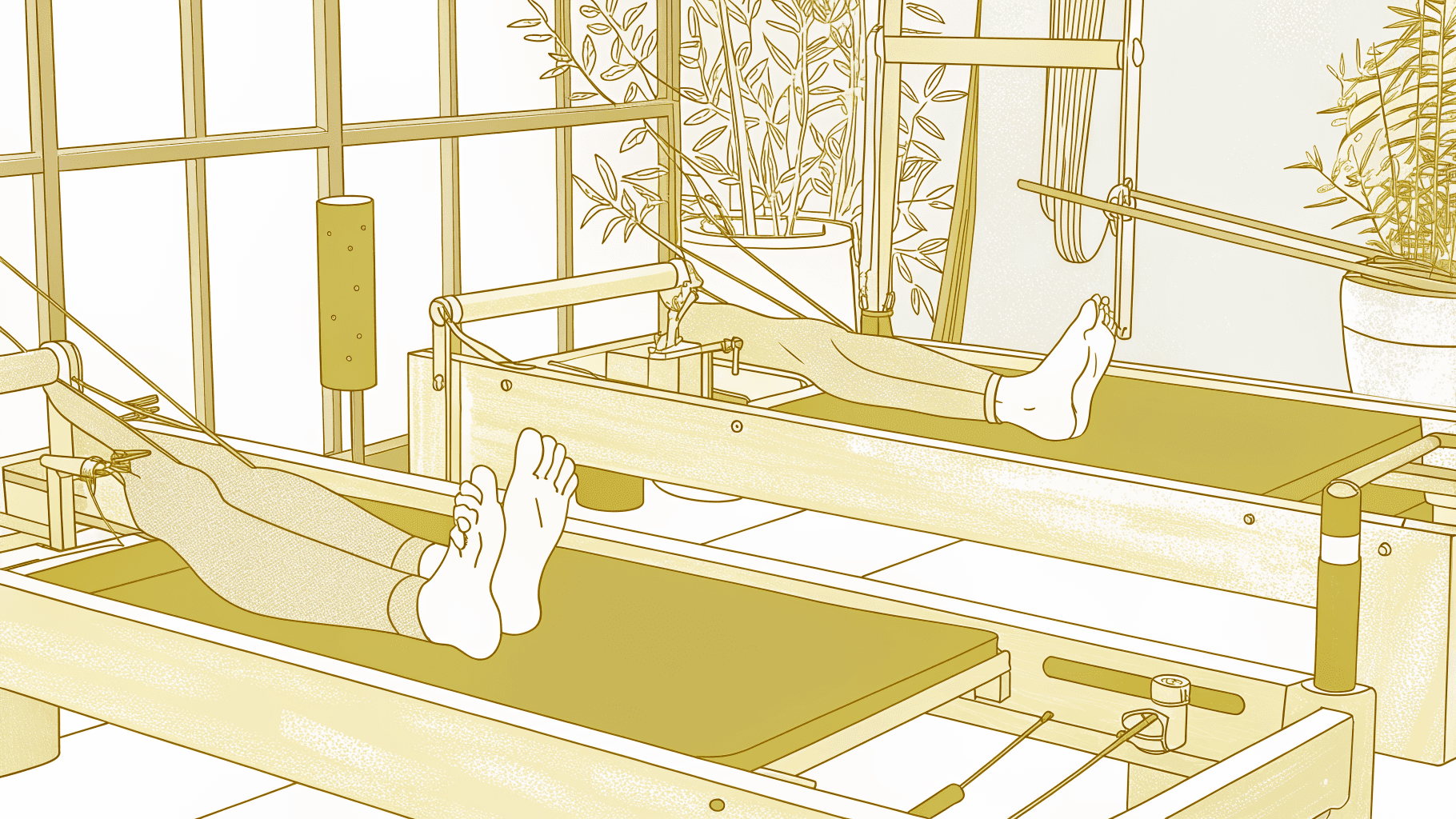
What Footwork, Leg Presses, and Strap Work Are Actually Designed to Do
“Those of us familiar with traditional reformer Pilates miss foundational leg exercises like ‘feet in straps,’ which build leg and hip strength through full-body carriage movement, and I really feel that gap in the field’s programming.”
— what we hear from boutique fitness enthusiasts
Reformer leg exercises were designed for rehabilitation and controlled mobility, not progressive strength. Footwork trains ankle-to-hip alignment and proprioception through a guided, supported range of motion, and that proprioceptive foundation matters more than most people realise. Limited body awareness is one of the most consistent barriers in early reformer work: knowing precisely where your hips are relative to the carriage, or where your arms sit in space relative to your torso during a legs-in-straps sequence, is a genuinely difficult skill that takes deliberate coaching to develop.
Leg press variations add a small load challenge while keeping the spine decompressed. Legs-in-straps work targets hip mobility and inner-thigh activation through long-lever positions that would be difficult to hold unsupported on a mat. Practitioners who move between studio formats notice this gap acutely; feet-in-straps-style work builds leg and hip strength through full-body carriage movement in a way that most static-tension formats cannot replicate. These are legitimate physical qualities worth training, particularly after injury or in early movement education. The honest description is rehabilitation-grade load.
Spring Settings – Feature and Flaw
Spring resistance is the defining mechanical variable in reformer training, and understanding it explains why results stall. For lighter spring settings, the carriage moves freely and the muscle works hardest at the start of the push, where the spring is longest. As the carriage travels and the spring shortens, resistance drops.
But no setting holds peak resistance through the full range. Mechanical tension, the sustained, progressive force placed on a muscle, is the primary driver of hypertrophy, and spring-based elastic resistance generates substantially less of it than free-weight or machine-based progressive overload. This is precisely why Lagree’s methodology is designed to keep the low-impact feel that makes Pilates accessible while engineering a stimulus that progresses visible strength and tone over time, a combination that spring resistance alone cannot deliver.
The Gap Between Feeling the Burn and Building Visible Change
The burn is metabolic stress, lactate accumulation and cellular fatigue that makes your quads shake on the carriage. That sensation is real effort. The problem is that metabolic stress is a secondary hypertrophy mechanism.
Industry research confirms that feeling muscular fatigue during a session does not equate to the mechanical tension required to produce visible toning or strength adaptations over weeks of consistent training. Time under tension, the duration a muscle spends under meaningful load, is a key variable that distinguishes a workout that feels hard from one that moves the body composition needle. A pattern many reformer practitioners recognise eventually sets in: the sessions still feel hard, but the mirror stops changing.
The body has adapted to the load ceiling, and adjusting spring colours within the same modality does not constitute meaningful progressive overload and will not restart stalled results. At BST Lagree’s Angel studio, transformation-focused training is built around consistent class attendance over time; a structured progression that accumulates across a member’s ongoing fitness journey. That is the architecture behind the Speakeasy class packs: a single drop-in at £25 lowers the barrier to a first experience, while the 10 Class Speakeasy Pack (£199, or £19.90 per class) is the format that gives the methodology enough runway to produce the visible change that reformer-only training consistently stalls before reaching.
New clients can experience the approach firsthand, without financial risk, through the free intro workshop class, available via the on-site form and paired with an in-studio café serving gluten-free, vegan, low-sugar acai bowls and specialty coffee. Pages for acai bowls, smoothies, protein shakes, and the London café are already live on the site, extending the visit into a social, aspirational ritual, so the decision to progress is based on real experience rather than guesswork. Understanding what these exercises are built for, mobility, body awareness, and rehabilitation-grade load, does not make them worthless; it makes choosing the right next step far smarter.
The 20-exercise index that follows maps every reformer leg variation worth knowing, annotated with the coaching cues that separate form that feels good from form that produces results.
20 Pilates Reformer Leg Exercises Ranked From Foundation to Full Burn
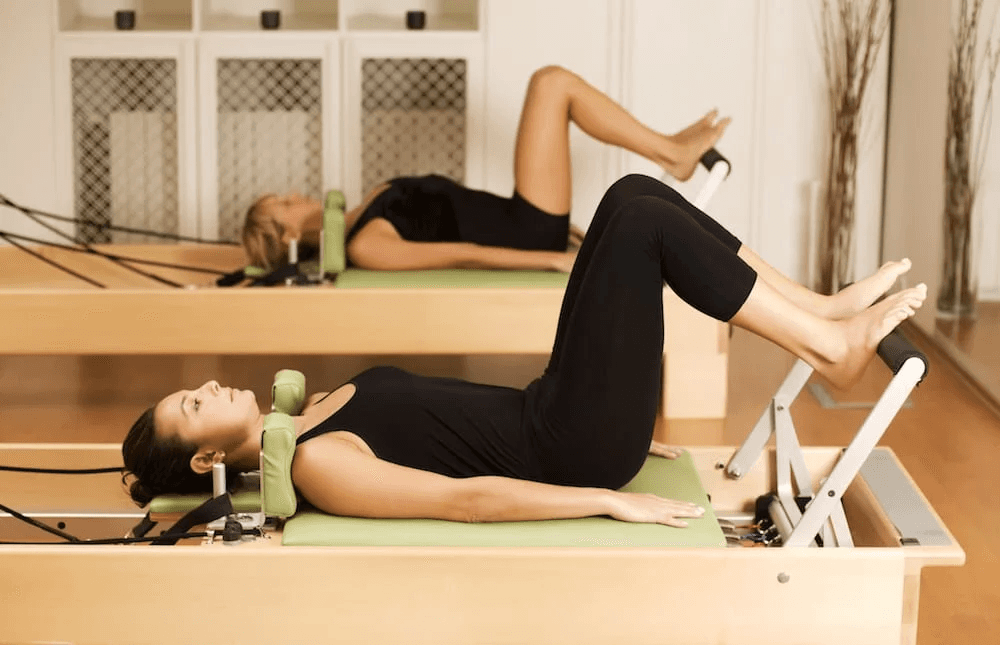
1. Footwork – Heels on Footbar (Parallel Stance)
47
Women tested in reformer RCT study
The non-negotiable starting point for every reformer leg session. Heels sit hip-width on the footbar; press the carriage to full extension without locking the knees, then return slowly against the spring. This targets the quadriceps, glutes, and hamstrings simultaneously while training ankle stability and neutral spinal alignment. Beginners use two to three springs. The most common error is rushing the return phase, which removes the eccentric load that actually builds strength.
2. Calf Raise on Footbar (Standing Footwork Finish)
Performed at the end of the footwork series, this isolates the gastrocnemius and soleus through a controlled rise and lower on the balls of the feet. The spring assists on the way up and resists on the way down, making the eccentric phase the productive one. Most people cut the range short at the top. Full plantarflexion, held for one count, is what separates a calf exercise from a calf stretch. Ankle stability carries over directly to every single-leg variation on this list.
3. Standard Leg Press – Bilateral Parallel
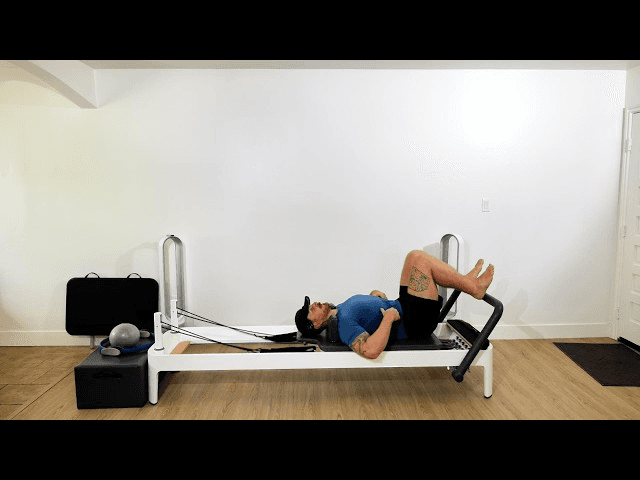
Both feet flat on the footbar, hip-width, pressing the carriage out and returning under control. The bilateral press builds foundational quad and glute strength and teaches the body to maintain pelvic neutrality under load. The limitation here is real: because both legs share the resistance, a dominant side can compensate without the body ever flagging it. If you have been doing bilateral presses for months and still feel one glute more than the other, that is compensation, not progress.
4. Leg Press – Heels High on Footbar (Quad Emphasis)
Elevating the heels on the footbar shifts the load forward into the quadriceps and reduces the contribution of the posterior chain. This variation is useful for building quad definition and for clients who struggle to feel the quads fire in standard footwork. The trade-off is reduced glute activation, so this should not replace the standard press entirely. Use it as a targeted addition when quad strength is the specific gap, not as a default setting because it feels easier on the hamstrings.
5. Single Leg Press – Parallel (Imbalance Correction)

One foot on the footbar, the other held in tabletop at ninety degrees. This is the most diagnostically honest exercise on the reformer. Research on bilateral deficit consistently shows that untrained legs carry meaningful strength asymmetries between sides, and the single leg press is where those asymmetries become visible and correctable. The pelvis must stay square; any lateral shift signals hip stabiliser weakness rather than leg weakness. This is the exercise most people skip when they should be doing it every session.
6. Leg Circles in Straps – Inner Thigh Targeting

Lying supine with both ankles in the straps, the legs trace controlled circles from the hip joint. The inner thigh adductors work to control the inward phase; the hip abductors resist the outward phase. Circles target inner thighs, hip mobility, and core stability simultaneously, making them one of the most time-efficient strap exercises in the series. Keep the circles small enough that the pelvis stays still. A moving pelvis means the core has dropped out, and the hip work becomes superficial.
7. Frog in Straps – Hip Mobility and Adductor Strength

Frogs can be performed in both parallel and turned-out positions, with the cue to squeeze the heels together on the press-out phase emphasising adductor engagement. The hip flexors and deep core stabilisers work to hold the pelvis neutral through the full range. This is one of the strap exercises practitioners consistently report as genuinely effective for inner thigh work, provided the heels stay connected and the movement comes from the hip rather than the knee. Rushing the tempo removes the adductor load almost entirely.
8. Long Spine Stretch in Straps – Hamstring and Spinal Decompression

From a supine position with legs in straps at ninety degrees, the carriage rolls in as the spine articulates off the mat, stacking vertebra by vertebra. The hamstrings work eccentrically to control the leg position throughout the spinal movement. This is as much a mobility exercise as a strength exercise, making it appropriate after intense leg work when the posterior chain needs length alongside load. The limitation: it requires significant spinal mobility and is not the right entry point for anyone with lower back sensitivity.
9. Short Spine in Straps – Posterior Chain Mobility
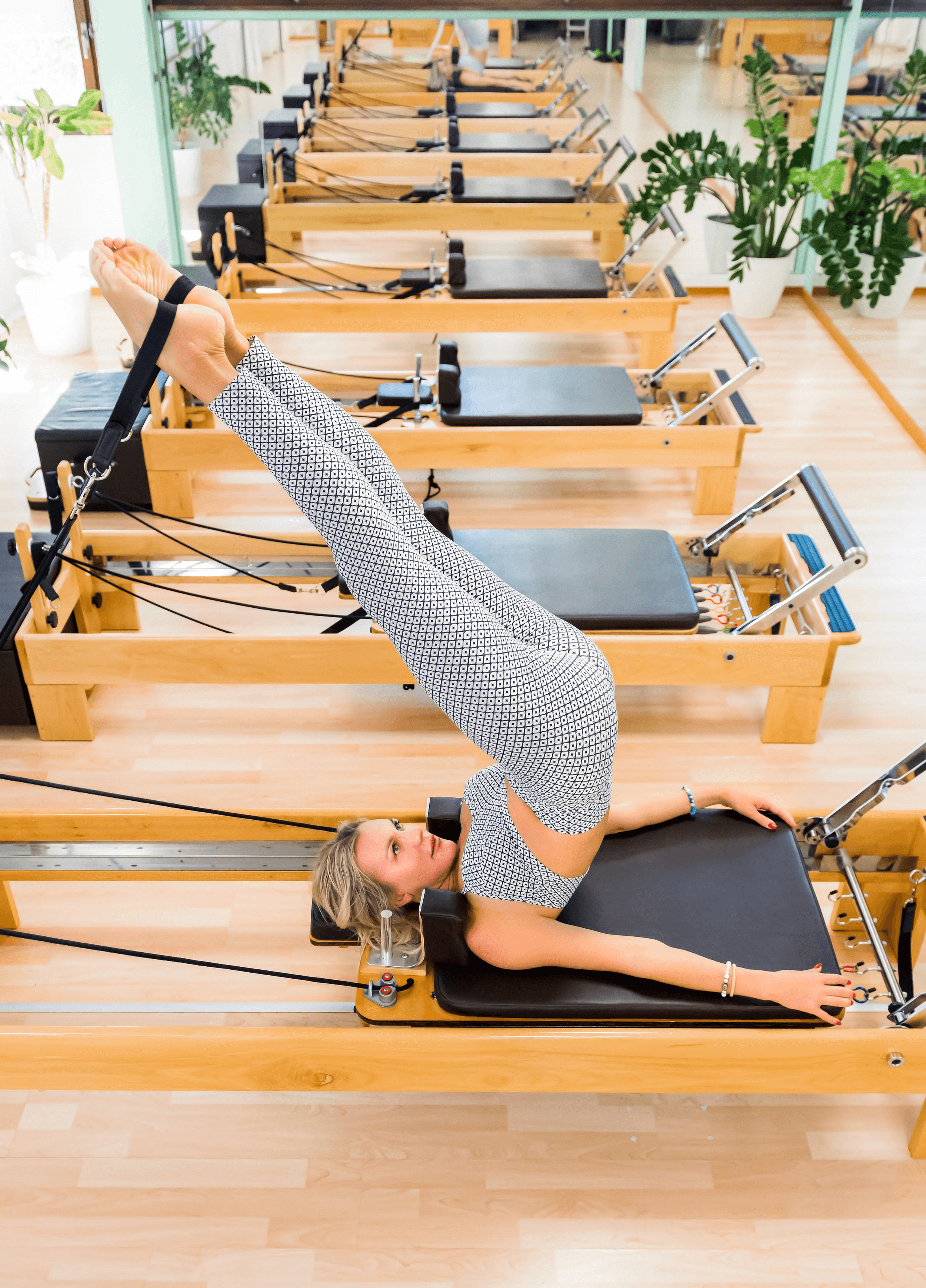
A more compact version of the long spine, with the knees bending as the hips roll up. The hamstrings, glutes, and spinal erectors all engage to control the articulation. Short spine is often underestimated as a leg exercise because the movement looks gentle, but the posterior chain is working isometrically through the entire range. The coaching detail that changes the exercise: keep the inner thighs connected throughout. Letting the knees drift apart turns a posterior chain exercise into a passive stretch.
10. Adductor Squeeze in Straps – Isolated Inner Thigh
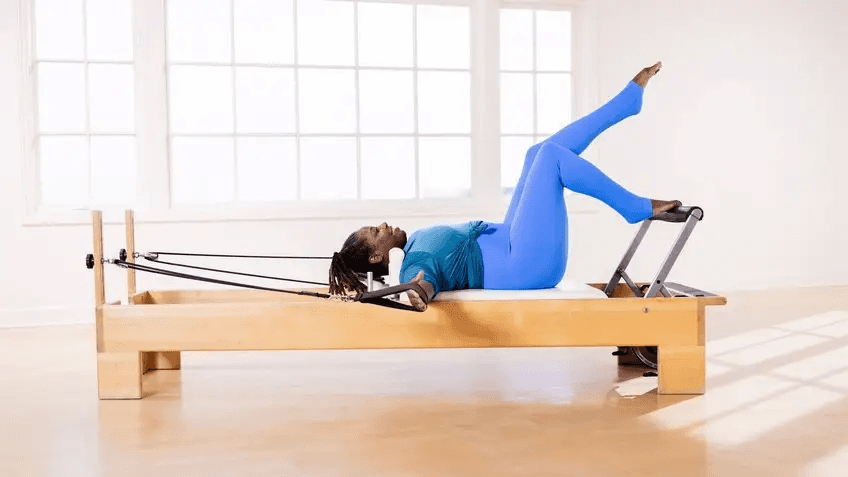
With both legs extended in the straps and a small ball or rolled towel placed between the inner thighs, the exercise focuses purely on adductor contraction and hold. This is the most isolated inner thigh exercise on the reformer, and it is genuinely effective for building the medial quad line when performed with sustained contraction rather than rhythmic pulsing. The honest limitation: it is a low-load isolation exercise. It builds awareness and activation, not the kind of strength that changes how the inner thigh looks from across the room.
11. Hip Abduction in Straps – Glute Medius and IT Band
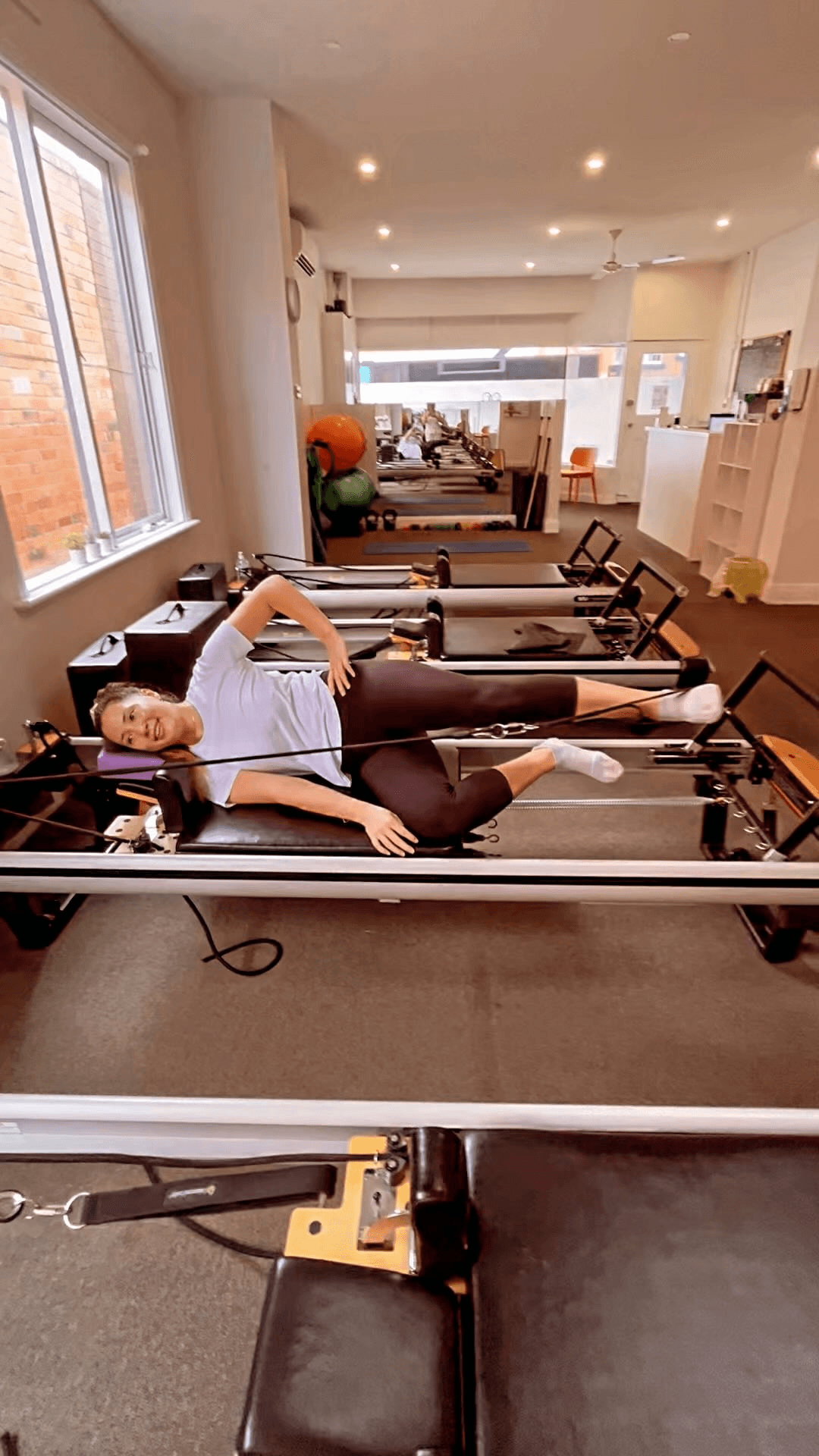
Lying supine, legs in straps, the movement opens the legs out against the strap resistance, targeting the gluteus medius and tensor fasciae latae. Glute medius weakness is a significant contributor to knee valgus, particularly in runners, and this exercise is frequently prescribed by physiotherapists as a corrective. The key coaching note: the movement should come from the outer hip, not from rolling the pelvis. If the lower back arches on the open phase, the load has shifted away from the glute medius and the corrective value is lost.
12. Single Leg Balance – Footbar Press with Tabletop Hold
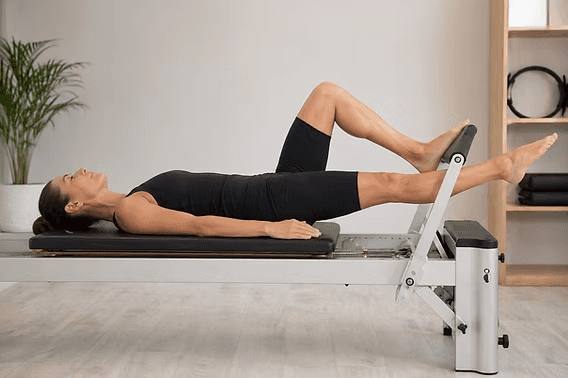
One foot presses the footbar through a full leg press range while the other leg holds at ninety degrees in tabletop. The standing leg works the quad and glute; the tabletop leg challenges hip flexor endurance; the core works to prevent the pelvis from dropping. This is the single-leg stability exercise that exposes the most compensations in a single movement. Most people discover their hip flexor on the tabletop side is far weaker than they expected. That finding is the exercise’s entire point.
13. Glute Bridge on Reformer – Supine Hip Thrust
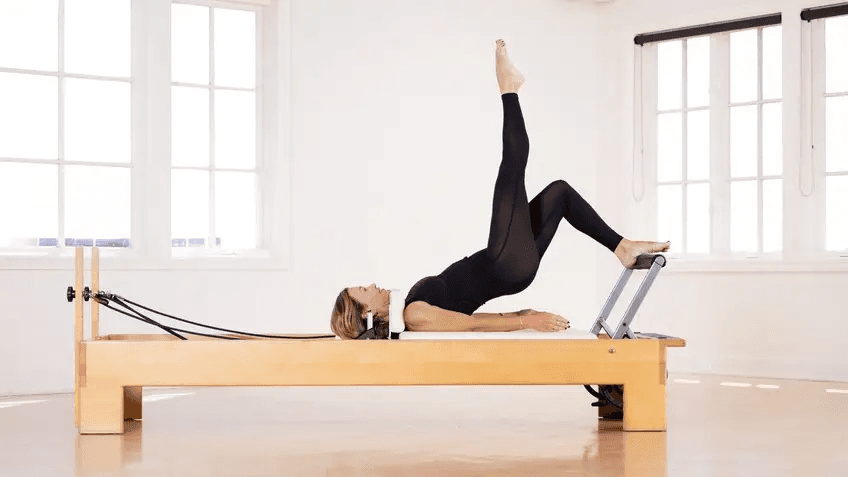
Feet flat on the footbar, hips lifted into a bridge position, the carriage presses out and returns while the hips stay elevated. The glutes and hamstrings work together to maintain hip height against the moving carriage. The reformer version of the bridge is more demanding than a mat bridge because the carriage instability requires constant posterior chain engagement. The limitation: because the feet are elevated on the footbar, the range of hip extension is limited compared to a floor-based hip thrust. It trains glute endurance more than peak glute strength.
14. Hamstring Curl on Reformer – Prone Leg Curl

Lying prone with the feet hooked under the footbar, the carriage is pulled in by bending the knees, loading the hamstrings through their full range. This is one of the few reformer exercises that isolates the hamstrings in a knee-flexion pattern, which is distinct from the hip-extension pattern trained in bridges and presses. The prone position also requires the core to stabilise the lumbar spine, adding a secondary demand. The common error is letting the hips rise off the carriage as the knees bend, which shifts load away from the hamstrings and into the lower back.
15. Supine Hamstring Press in Straps – Eccentric Hamstring Load
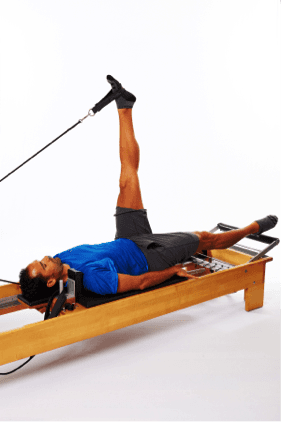
Lying supine with both heels in the straps, the legs press down against the strap resistance in a straight-leg pattern, loading the hamstrings eccentrically on the return. Eccentric hamstring training has a strong evidence base for injury prevention: industry research found eccentric hamstring protocols reduced hamstring strain injury rates by approximately 51% in team sport athletes. The reformer strap version delivers that eccentric stimulus at a controlled, low-impact load that is appropriate for rehabilitation and prevention alike.
16. Double Leg Lower and Lift in Straps – Hip Flexor and Hamstring
Both legs in straps, extended toward the ceiling, then lowered toward the footbar and lifted back. The hip flexors work on the lower phase; the hamstrings and glutes work on the lift. The abdominals must stabilise the pelvis throughout, making this as much a core exercise as a leg exercise. The honest coaching note: most people feel this primarily in the hip flexors and miss the hamstring load entirely. Slowing the lift phase and pressing the heels slightly into the straps on the way up shifts the emphasis toward the posterior chain where it belongs.
17. Side-Lying Leg Lift – Glute Medius Isolation

Lying on one side on the carriage, the top leg lifts against gravity or a light spring, isolating the gluteus medius. This is the lateral hip stabiliser exercise that physios most commonly prescribe alongside the hip abduction in straps, and for good reason: the gluteus medius is a primary stabiliser of the knee during single-leg loading. A weak glute medius allows the knee to collapse inward under load, which is one of the most common movement faults in both runners and reformer practitioners. The side-lying position removes compensation patterns that standing abduction exercises often allow.
18. Elephant on Reformer – Hamstring and Calf Stretch with Load
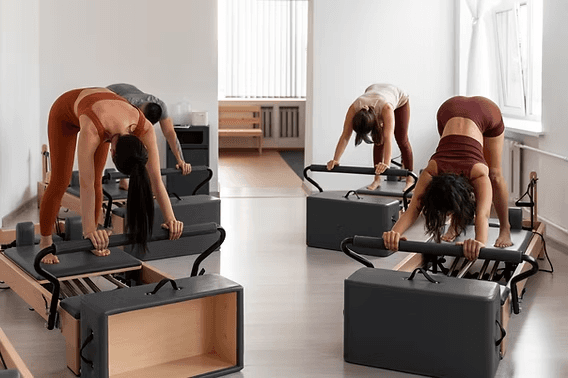
Standing on the carriage facing the footbar, hands on the bar, the carriage is pushed back by the feet while the hips hinge and the spine lengthens. This loads the hamstrings and calves through a stretch position while the spring provides resistance on the return. It is simultaneously a strength exercise and a mobility exercise, which makes it one of the most efficient movements in the series for people who carry chronic hamstring tightness. The limitation: it requires sufficient hamstring length to maintain a flat spine. A rounded lower back removes the hamstring load and stresses the lumbar spine instead.
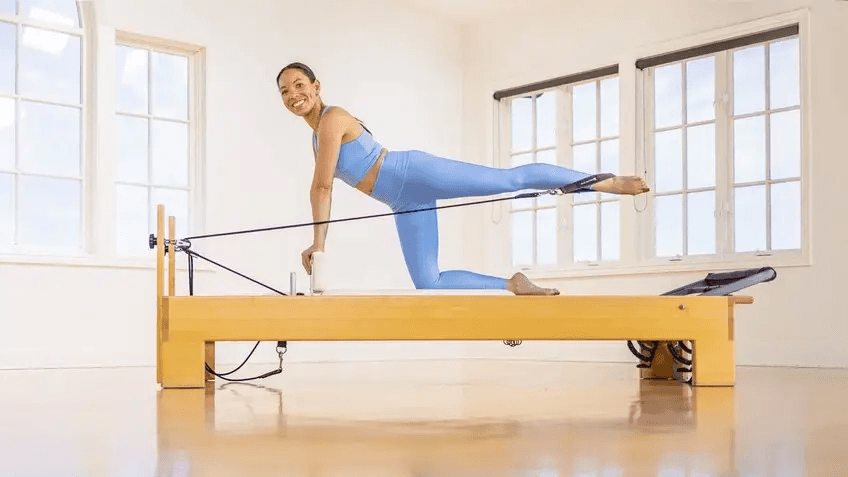
19. Knee Stretch Series – Quadruped Leg Drive
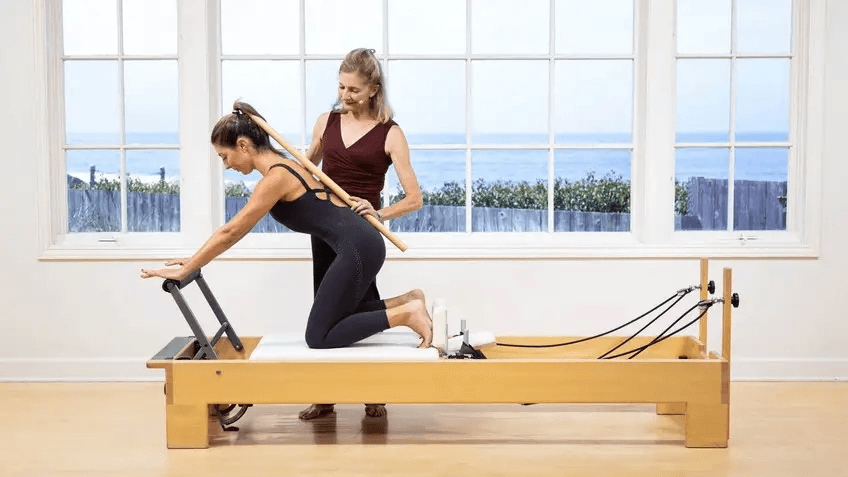
On hands and knees on the carriage, the knees hover just above the surface as the carriage pushes back and returns, driven by the legs. The quadriceps, hip flexors, and core all engage to control the movement. The knee stretch series is one of the most underrated leg exercises on the reformer because it trains the quads in a functional, closed-chain pattern that transfers directly to running, stairs, and any activity that involves pushing off a bent knee. The coaching detail: the hover position must be maintained throughout. Dropping the knees onto the carriage removes the core demand and reduces the exercise to a passive stretch.
20. Jumping on the Reformer – Plyometric Leg Power
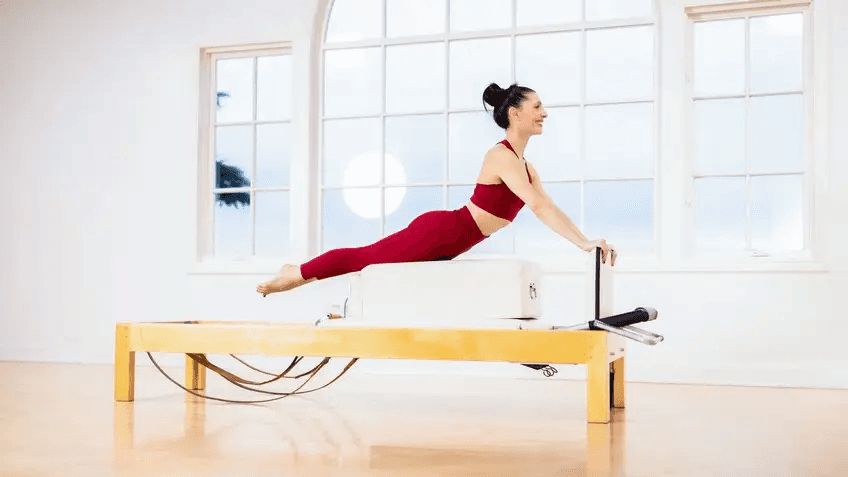
Standing or lying supine with feet on the jump board, the carriage is propelled away by a jump and received on landing, training explosive leg power with spring-assisted impact absorption. This is the only genuinely plyometric exercise on the reformer, and it is the one that most directly trains the fast-twitch muscle fibres that contribute to leg power and athletic performance. The spring reduces landing impact, making it appropriate for people who cannot tolerate full bodyweight jumping. The limitation is also its defining characteristic: the spring assistance means the landing load is significantly lower than real-world plyometric training, which limits its transfer to high-impact sport. The remaining eighteen exercises extend the list into more specialised territory, covering variations that build on the foundational twenty above.
Related Reading
- Lagree Before and After 3 Months
- What To Bring To Pilates Reformer Class
- How Many Times A Week Should You Do Pilates Reformer
- Can You Do Reformer Pilates While Pregnant
- What To Wear To Pilates Reformer Class
- What Reformer Does Club Pilates Use
When the Full Exercise List Still Isn’t Enough to Build the Legs You Want
The plateau doesn’t announce itself. One week you’re feeling the burn, the next you’re completing the same footwork series on autopilot, wondering why three months of consistent sessions haven’t moved the needle on strength or visible tone. As the spring-resistance ceiling covered earlier confirms, the problem isn’t effort. The problem is that the method has run out of room to grow with you.

Why Spring Resistance Has a Ceiling No New Variation Can Break Through
Adding a 38th reformer variation produces the same physiological signal as the 12th. Industry research makes this structural: the reformer’s spring system creates a load curve that peaks and drops through the range of motion, which is structurally distinct from constant-tension or time-under-tension training modalities, and no variation in exercise selection or spring configuration can replicate a sustained, tempo-controlled muscular endurance load within the reformer format. That dropping load curve is the ceiling. Your muscles never hold peak tension long enough to trigger the sustained stimulus that drives hypertrophy and lasting tone. More exercises won’t fix a mechanical constraint baked into the machine itself.
Why the Megaformer Delivers a Different Leg Stimulus Than the Reformer
The Lagree Megaformer operates on a different logic entirely. Where the reformer is largely self-paced, Lagree’s method is built around slow, controlled eccentric contractions held at the point of maximum tension, producing the kind of time-under-tension that research consistently links to muscular endurance adaptation and hypertrophy. That’s not a harder version of reformer work. It’s a different category of demand. Clients who book a Lagree class at BST in Angel regularly report genuine muscle soreness two to three days after a single 45-minute session, the clearest signal that fibres the reformer never reached have finally been recruited.
How Instructor Cueing Quality Changes Which Muscles Your Leg Exercises Actually Target
Karley, BST’s head instructor, trained with LA Ballet and American Contemporary Ballet before teaching Lagree at its Los Angeles source. Classical dance training builds a proprioceptive precision that generic fitness instruction rarely matches: the ability to identify, in real time, whether a client’s hip is rotating out of alignment, whether the heel is loaded or the arch is compensating, whether the glute is actually contracting or the lower back is taking over. That level of cueing doesn’t just make a class feel premium.
It changes which muscles actually work. A well-cued Megaformer class at BST makes 45 minutes of low-impact leg work genuinely hard in exactly the right places. Karley’s dual background in LA Ballet and American Contemporary Ballet means alignment corrections are specific to joint position rather than generic form cues, a distinction that determines whether the target muscle or a compensating one does the work. The gap between knowing the full reformer list and actually building the legs you want isn’t closed by more exercises.
It’s closed by a different kind of class, taught by a different kind of instructor. That class exists, it’s 45 minutes, and it’s in Angel, which is exactly where the next section takes you.
Next steps
If months of consistent reformer sessions have left your legs looking exactly the same as day one, the path forward starts with accepting that the spring-resistance ceiling is structural, not a technique problem.
The repeated-bout effect means your body stopped responding to reformer leg work the moment it adapted to the available load, and no new variation closes that gap. The load curve that peaks and drops through each spring’s range of motion means sustained mechanical tension, the stimulus that actually drives visible tone, is physically unavailable on a reformer regardless of which exercises you select. Together, they point to a genuinely different machine, a different tempo, and a different class.
Start with Lagree classes in London at BST Angel, where the first introductory session is free and the 45-minute Megaformer format applies instructor-controlled time under tension to the muscles the reformer never reached. Five sessions is where the cumulative stimulus begins to register.
Frequently Asked Questions
Why do my legs still look the same after months of consistent reformer classes?
Your body has adapted to the available load, a process called the repeated-bout effect, where continued exposure to the same stimulus produces diminishing returns until adaptation effectively stops. Adding new leg press variations within the same resistance ceiling doesn’t create a new stimulus; it’s a longer loop of the same one. Visible change requires progressive mechanical overload, which spring-based resistance alone can’t sustain once adaptation has occurred.
What are leg circles in straps actually targeting on the reformer?
Lying supine with both ankles in the straps, leg circles target the inner thigh adductors on the inward phase, the hip abductors on the outward phase, and core stability simultaneously. The key coaching detail is to keep the circles small enough that the pelvis stays completely still, a moving pelvis means the core has disengaged and the hip work becomes superficial.
Why does the single leg press matter more than the standard bilateral leg press?
The single leg press is the most diagnostically honest exercise on the reformer because it exposes strength asymmetries between sides that a bilateral press allows a dominant leg to hide through compensation. The pelvis must stay square throughout; any lateral shift signals hip stabiliser weakness rather than leg weakness, making it a corrective exercise most people should be doing every session.
Is the burning sensation I feel during reformer leg work a sign I’m building visible muscle?
Not necessarily, the burn is metabolic stress from lactate accumulation and cellular fatigue, which is a secondary hypertrophy mechanism, not the primary driver of visible toning or strength. Mechanical tension, sustained across meaningful load over time, is what actually moves the body composition needle, and feeling muscular fatigue during a session does not equate to that stimulus.
Can I fix a reformer plateau by trying different spring settings or more exercise variations?
No, adjusting spring colours or extending your exercise list within the same modality does not constitute meaningful progressive overload and will not restart stalled results. Because spring-based elastic resistance generates substantially less mechanical tension than free-weight or machine-based progressive overload, the ceiling is structural, not a problem solved by variation or tweaking spring settings.