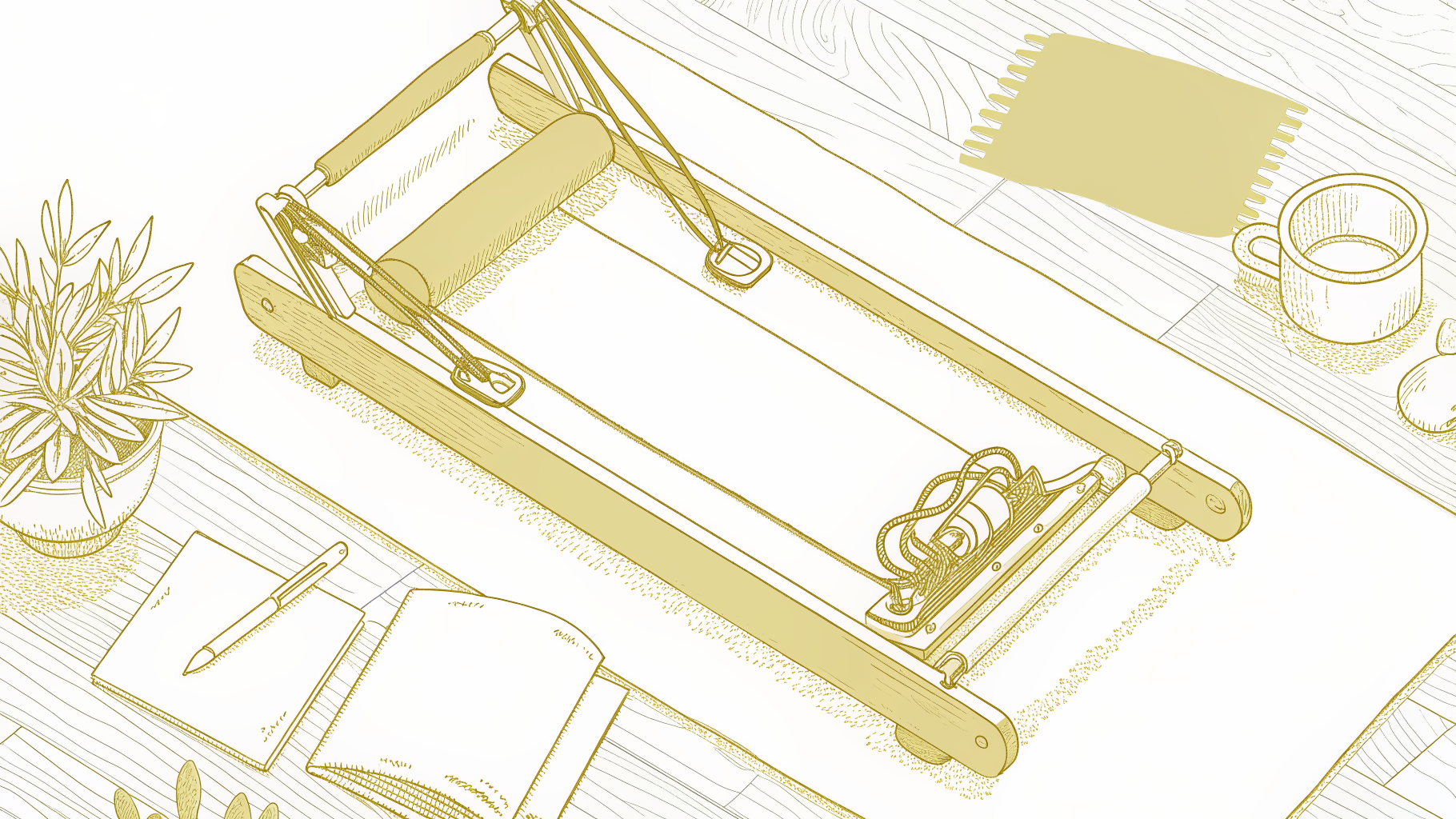
Your glutes adapted weeks ago. Here is why the reformer stops delivering results faster than most people expect, and exactly how to target every zone before you hit the ceiling.
Feeling the burn and making real progress are two very different things. Most pilates plateau-ers and wellness explorers assume that if an exercise is hard and their glutes can feel it working, the programme must be doing its job, and that the solution to a stalled result is simply more consistency or more reps. If you’ve been showing up to your reformer sessions consistently, hitting your footwork and shoulder bridges every week, and somewhere around month two noticed that the glute soreness quietly stopped, you’re not imagining it.
That’s adaptation, and it’s working exactly as it should, just not in your favour anymore. The reformer creates resistance through spring tension, demands core stability, and produces that deep, specific muscular fatigue that keeps people coming back. But the same quality that makes it effective early on, its predictable, fixed-load system, becomes the ceiling once your body figures it out.
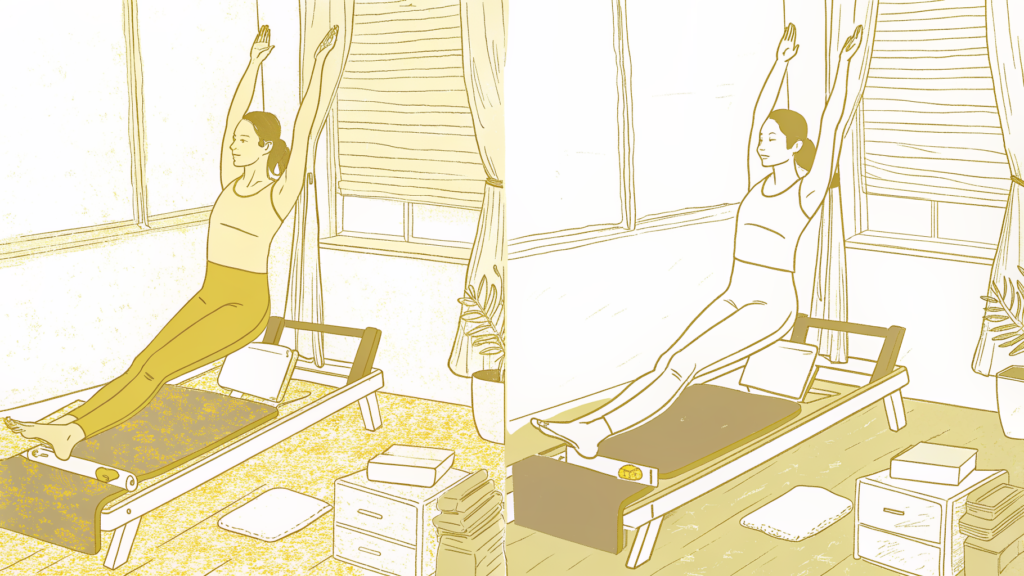
See our Lagree London for how this works in practice. For the first four to six weeks, reformer glute work delivers. The spring resistance is novel, the movement patterns challenge your stabilisers, and your slow-twitch Type I muscle fibres are being recruited and stressed in ways they haven’t been before.
That’s real physiological work. The soreness is real. The initial shape change is real.
The problem is that slow-twitch fibres adapt quickly, and the reformer’s spring mechanics are built for exactly that fibre type. Fixed loads favour endurance over maximal tension. Once your glutes have learned the pattern, the stimulus becomes maintenance, not growth.
The adaptation window closes sooner than most people expect. Exercise science consistently recognises that a repeated load-and-rep scheme stops driving meaningful neuromuscular or hypertrophic adaptation within a matter of weeks. After that point, research confirms that muscle protein synthesis returns to near-baseline within roughly 48 hours of each session, so the same repeated stimulus produces a progressively smaller anabolic signal over time.
The session still feels challenging because your cardiovascular system and slow-twitch endurance fibres are still being taxed. But the fast-twitch Type II fibres, the ones with the greatest hypertrophic potential, require progressive overload to be recruited at all. The reformer’s spring resistance, without deliberate increases in load or pattern variation, doesn’t reliably reach them.
You’re working hard. You’re just not working differently.
This matters beyond aesthetics. Weak or under-recruited glutes are consistently linked in sports science literature to reduced hip stability, compromised knee tracking, and increased load on the lumbar spine.
The gluteus medius plays a critical role in keeping the pelvis level during single-leg movement. When it’s underdeveloped, the lower back compensates, and over time, that compensation shows up as pain. A plateau on the reformer is a functional frustration as much as a cosmetic one. Before you can understand why the plateau happens, you need to know exactly which part of your glutes is, and isn’t, being reached by each movement. The next section maps your glute anatomy to the specific reformer exercises designed to hit each zone.
You’re working hard. You’re just not working differently.
48 hours
until anabolic signal fades after repeated stimulus
Key takeaways
- Feeling the burn in your glutes and actually building them are two different outcomes, consistent reformer sessions can produce the first without ever delivering the second.
- Three glute muscles operate across three movement planes; most reformer formats treat them as one, which is why side glutes stay flat despite months of showing up.
- The gluteus maximus is predominantly fast-twitch, meaning it responds to heavy, explosive load, not the slow, low-resistance endurance sets that dominate most reformer classes.
- Spring resistance is the variable that determines whether your glutes fire or your quads compensate, and most reformer users never adjust it deliberately enough to matter.
- The reformer’s spring system unloads at the end of every rep, giving the muscle a micro-rest that kills the mechanical tension research identifies as the primary driver of hypertrophy.
- Constant tension across the full range of motion is what separates real glute development from the feeling of a glute workout, and the reformer’s design makes that structurally impossible to sustain.
- BST Lagree in Angel, Islington runs 45-minute Megaformer classes that deliver strength building and cardio in one session, with a free intro class, a certified instructor, and a complimentary coffee included from the first visit.
How to Target Every Glute Area with Reformer Exercises Before You Hit the Ceiling
Three glute muscles. Three jobs. Three movement planes.
If your Reformer routine treats them as one, you’re already leaving results on the table, and the frustration of flat side glutes despite consistent training is one of the most common walls people hit in group Pilates formats. The common assumption is that the exercises must be right because they’re hard and your glutes feel them, you just need to be more consistent or add more reps. But effort and correct targeting are not the same thing, and that distinction is exactly what this section unpacks.
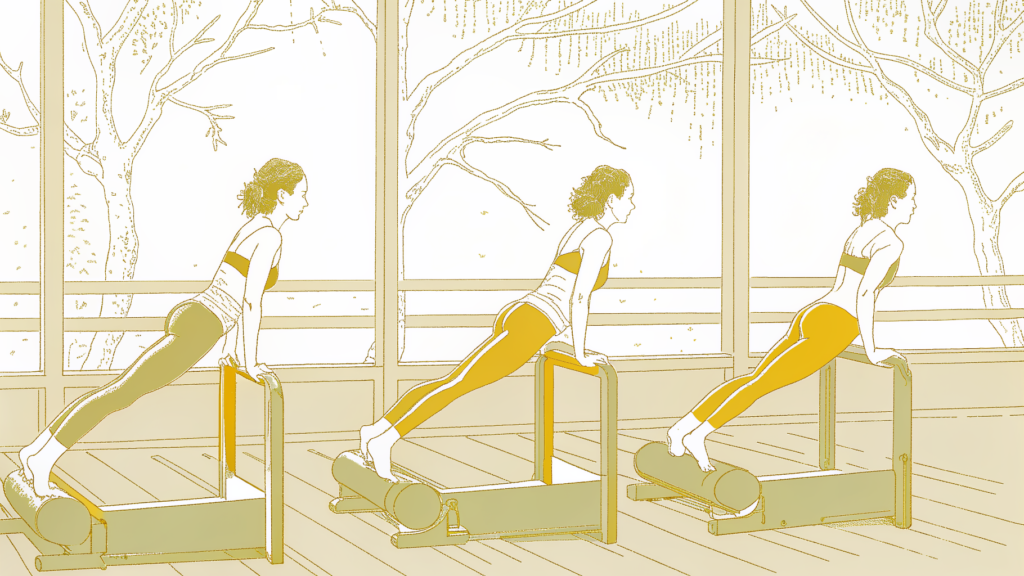
This challenge is particularly sharp for clients who come in with an existing training background. Experienced lifters we work with at BST Lagree often arrive unsure whether a reformer-style class is challenging enough to drive real glute activation across every zone, especially the medius and lower-lift fibres that conventional gym work routinely misses. That uncertainty is worth taking seriously, because the answer lives in the method, not just the effort level.
Your Glute Anatomy Is a Three-Zone Targeting Map Not One Muscle to Activate
The gluteus maximus is the largest muscle in the body and the one most Reformer footwork and bridge sequences load well. It drives hip extension: think pushing the carriage away, standing up from a squat, climbing stairs. The gluteus medius sits higher and to the side, and its job is entirely different.
As Total Health Systems explains, it is the primary pelvic stabiliser during any single-leg activity, and when it’s weak, the pelvis drops on the opposite side, forcing compensatory stress onto the lumbar spine and knees. Then there is the gluteus minimus, tucked beneath the medius, which fine-tunes hip abduction and rotation to keep the femur tracking cleanly in the socket. Cooper et al. Writing in the European Spine Journal, found that gluteus medius weakness is common in people with chronic non-specific low back pain, reframing glute training as a functional health priority, not a vanity project.
If your current routine is leaving the medius chronically under-loaded, you are not just missing an aesthetic outcome, you are carrying an avoidable structural risk.
Side Glutes vs Lower Glute Lift Why the Distinction Changes Which Reformer Exercise You Choose
To target the side glutes, you need frontal-plane loading: movements that take the leg out to the side or hold it there under sustained tension. Side-lying leg presses, abduction work against spring resistance, and lateral lunge variations all shift demand away from the maximus and into the medius. Lower glute lift targets the lower fibres of the gluteus maximus, responsible for the visual shelf at the base of the glute.
These fibres respond best to hip extension with a posterior pelvic tilt held at the top: prone leg presses, arabesque variations, and bridges with deliberate end-range squeeze. A routine built entirely on footwork and standard bridges will develop the mid-maximus while leaving the medius and lower lift fibres chronically under-stimulated, exactly why consistent training can produce effort without visible change in those two zones. This is where a transformation-focused studio like BST Lagree, based in Angel, London, is structured differently from a generic group class.
The sequencing is built to address all three zones within a single session, with the spring-resistance system allowing medius and minimus work to be held under sustained lateral tension, the specific stimulus those muscles require to adapt.
Why One Reformer Exercise Is Never Enough
Most group Reformer formats cycle through four to six glute-adjacent movements, the majority sagittal-plane pushing. That leaves medius and minimus work compressed into a brief side-lying sequence, rarely held under tension long enough to drive adaptation. The gluteus medius is a postural, endurance-oriented muscle: it needs sustained lateral tension, not a quick set of 12 reps tagged onto the end of a footwork block.
Transformation across all three glute zones materialises with consistent class attendance over time, not from any single session, but from a programme that correctly sequences all three planes across weeks and months. For clients fitting training around demanding schedules, early-morning slots before client meetings or a full conference day, BST Lagree’s Angel studio offers classes structured to deliver this full three-zone stimulus in a single, time-efficient session. If you want to experience the method before committing, new clients can claim a free introductory workshop class via the on-site form, which also includes a complimentary coffee.
Those ready to build consistency can move directly into a class pack, structured so that the cost per session falls as commitment increases, which mirrors exactly how the glute adaptation itself works. Now that you have the targeting map, maximus for power and lower lift, medius for the side-glute shelf and hip stability, minimus for fine-tuned balance, you’re ready to read an exercise list differently. The next section ranks all seven Reformer glute exercises by which muscle zone they actually load and what that means for the results you’re after.
Related Reading
- Lagree Before and After 3 Months
- What To Bring To Pilates Reformer Class
- How Many Times A Week Should You Do Pilates Reformer
- Can You Do Reformer Pilates While Pregnant
- What To Wear To Pilates Reformer Class
- What Reformer Does Club Pilates Use
7 Pilates Reformer Glute Exercises Ranked by the Results They Actually Deliver
Spring load is the variable most Reformer users never think to adjust, and it matters more than almost anything else in the seven movements ranked below. Whether your glutes actually fire depends on three things working together: the resistance level, your body position, and the specific joint angle the exercise puts you in. According to industry research, EMG activation levels vary significantly by exercise type and body position, which means exercise selection, not just effort or volume, determines how much glute recruitment actually occurs. Get the setup wrong and your quads and lower back quietly take over. Get it right and you’ll feel the difference in the first rep.
“I’m doing Pilates reformer glute exercises but not seeing any visible results or volume changes in my glutes. I’m frustrated with how ineffective the reformer seems to be for glute work.”
— what we hear from Pilates enthusiasts
This matters especially if you have been training consistently on a Reformer and still are not seeing the visible shape or volume changes you expected. That frustration is real, and it is almost always a setup and sequencing problem, not a work-ethic problem. The movements below are ranked precisely because getting the right exercise, at the right load, with the right cue, is what separates a workout that feels familiar from one that actually progresses your strength.
A note on spring loads across brands: Merrithew and Balanced Body use different colour-coding systems, so the same colour spring does not equal the same resistance on both machines. Where resistance is described below, treat the load level (light, medium, heavy) as the reference point and match it to your reformer’s specific spring chart.
Quick-Reference: 7 Reformer Glute Exercises at a Glance
| # | Exercise | Primary Muscle | Spring Load | Best For |
| 1 | Footwork (Heels + V-Position) | Gluteus Maximus | Medium, Heavy | Foundation activation |
| 2 | Shoulder Bridge | Glute Max + Medius | Light | Strength + stability |
| 3 | Side-Lying Leg Press | Gluteus Medius | Light, Medium | Outer-hip isolation |
| 4 | Scooter / Standing Lunge | Glute Max + Medius | Light, Medium | Unilateral strength |
| 5 | Leg Circles with Straps | Lower + Outer Glute | Light | Mobility + integration |
| 6 | Long Box Arabesque | Gluteus Maximus (terminal extension) | Light | Posterior chain sculpt |
| 7 | Glute-Hamstring Bridge Variation | Glutes + Hamstrings | Medium, Heavy | Heavy posterior chain finisher |
Use this table to plan your session: pair at least one medius move (3 or 4) with one maximus move (1, 2, or 7) and finish with a posterior chain exercise (6 or 7) to cover all three glute zones in a single visit.
1. Footwork (Heels + V-Position) – The Foundation Glute Activator

Set the foot bar at standard height, load 2 red springs (or 1 red + 2 blue for Balanced Body users, note Merrithew reds equal roughly one Balanced Body heavy spring, so translate accordingly). Place heels hip-width apart in parallel, then shift to V-position (heels together, toes apart) for the second set. Press the carriage out on an exhale, controlling the eccentric return over 3 counts. The V-position externally rotates the hip, recruiting the gluteus maximus and medius simultaneously. Best opening exercise for any glute-focused session; limitation is that bilateral loading reduces unilateral demand.
2. Shoulder Bridge – The Glute-Hamstring Strength Builder
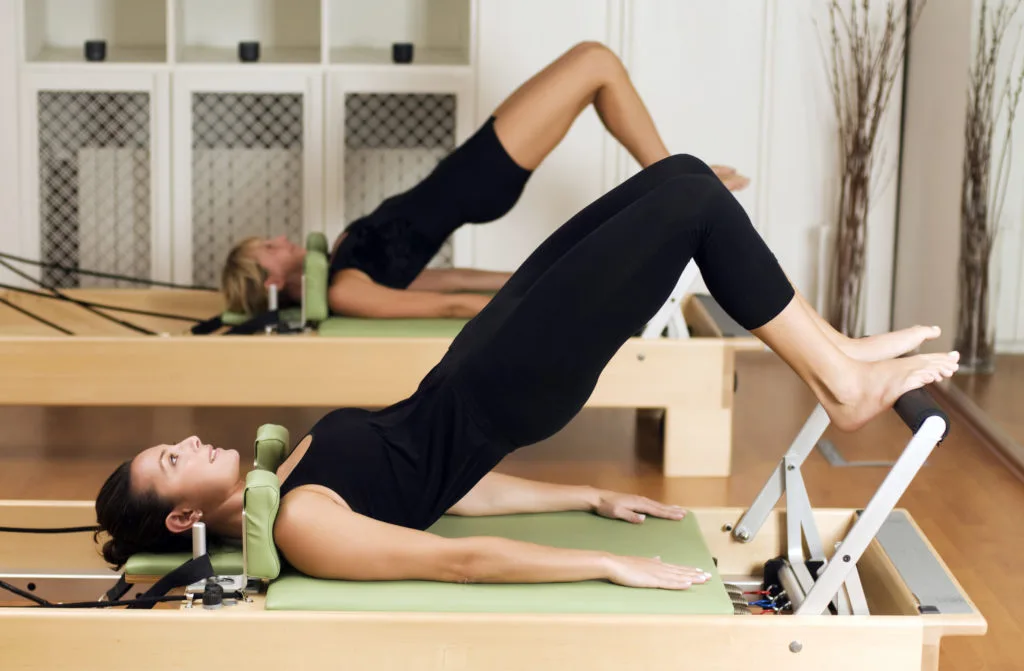
Set up with light spring load (1 red, or 1 red plus 1 blue/yellow) so the carriage stays controlled. Feet flat on the footbar, hip-width apart, pelvis in a neutral tuck at the top of the bridge. Industry research has identified bridging patterns as a direct gluteus maximus and gluteus medius recruitment exercise, and the Reformer version adds the challenge of stabilising against a moving carriage while holding the isometric glute squeeze. That instability is the point. If the carriage drifts unevenly, your glutes are not holding. This is not the exercise to rush through at the end of class.
3. Side-Lying Leg Press – The Gluteus Medius Isolation Move
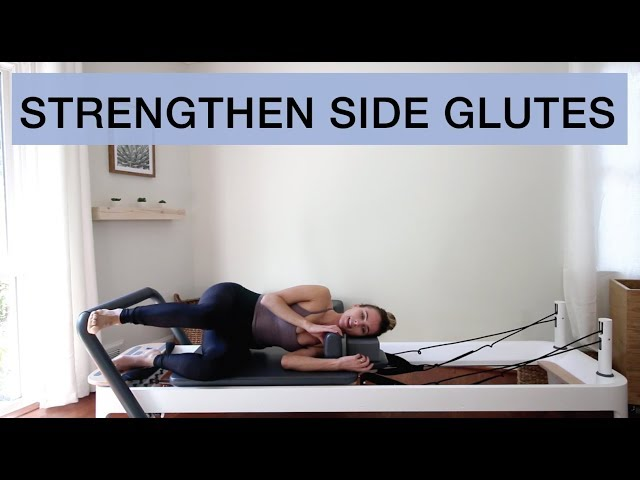
Set up with 1 to 2 medium springs. The gluteus medius, the muscle responsible for the outer-hip shape and pelvic stability during single-leg loading, is the primary target here. Industry research confirms that the gluteus medius functions as a hip abductor and pelvic stabiliser, and side-lying positions that challenge that abduction pattern produce measurably higher medius activation than most upright exercises.
The limitation: if your pelvis rolls back even slightly, the hip flexors compensate and the medius disengages. Alignment is everything in this one. This exercise is also worth noting for anyone who experiences knee discomfort from repetitive bilateral movements like squats, pliés, or lunges.
The side-lying position removes axial load from the knee entirely, making it one of the most accessible high-yield glute moves in the sequence. The Side-Lying Leg Series builds on this same position by varying the angle and range of motion, which allows you to target different portions of the medius across a single set.
4. Scooter / Standing Lunge – The Unilateral Functional Strength Exercise
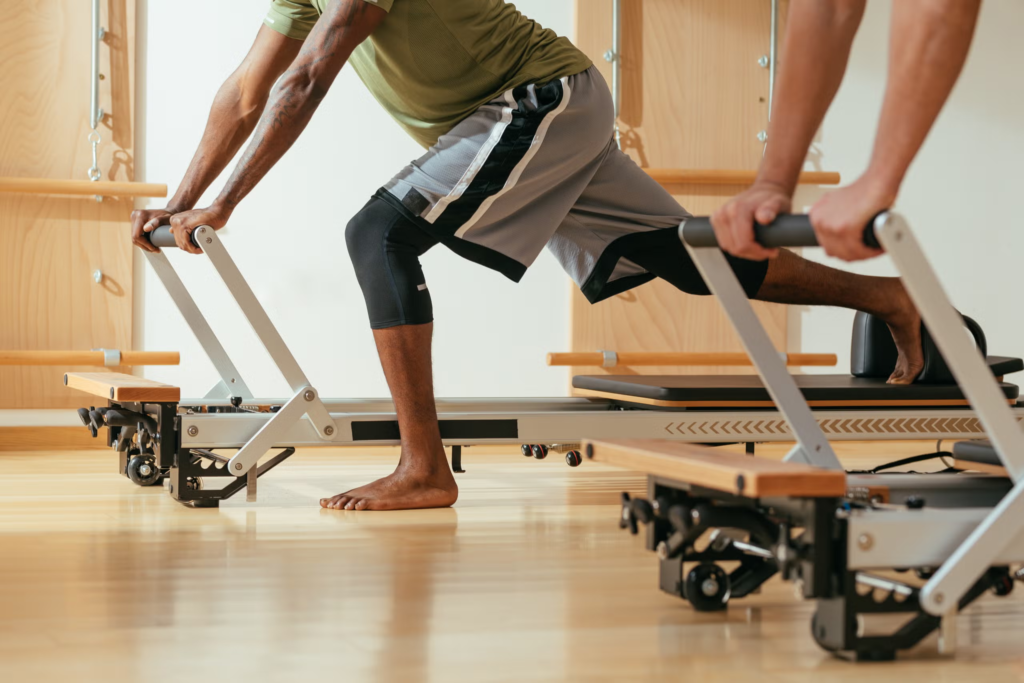
Set up with light-to-medium spring load (1 red or 1 blue). The standing leg does all the work, and that is exactly the point. Industry research found that single-leg stance variations produced higher gluteus medius and gluteus maximus EMG activation than bilateral exercises, which explains why this movement exposes left-right strength differences that bilateral footwork never reveals.
The Skater variation of this pattern shifts the emphasis slightly by changing the angle of the standing hip, making it a useful progression once the basic Scooter feels controlled. Runners and anyone who has noticed one glute working harder than the other will feel this asymmetry immediately. It is uncomfortable in a useful way.
5. Leg Circles with Straps – The Hip Mobility and Glute Integration Exercise
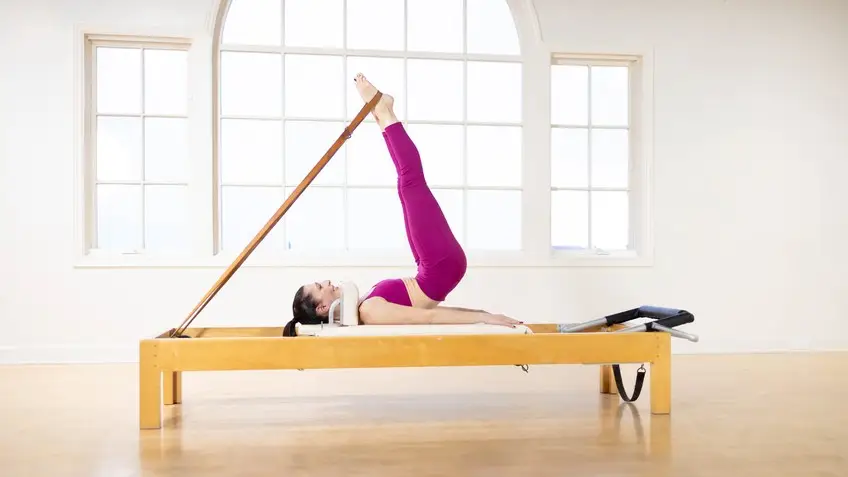
Set up with light spring load. Draw controlled circles from the hip, not the knee, keeping the pelvis anchored to the carriage throughout. The lower and outer glute fibres fire to control the arc against the strap resistance, while the deep core stabilises the pelvis.
The honest trade-off: this exercise demands a level of hip mobility that many people do not yet have. If the lower back lifts off the carriage during the circle, reduce the range of motion rather than compensating through the spine. The Long Box Arabesque complements this movement by targeting the gluteus maximus in terminal hip extension, a range that Leg Circles with Straps does not reach.
6. Long Box Arabesque / Arabesque with Straps – The Posterior Chain Sculptor
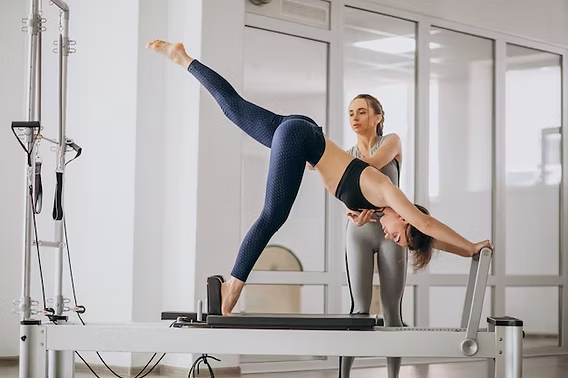
Set up with light spring load. Lie prone on the long box with feet in the straps or pressing against the footbar. Extend one leg into hip hyperextension behind you, squeezing the glute at the top of the range. The prone position matters mechanically: it places the gluteus maximus in a terminal extension range that upright exercises rarely reach, which is why this movement produces a distinctly different kind of soreness the following day. It is not the most beginner-friendly setup, and anyone with lower back sensitivity should keep the range small and focus on glute initiation rather than height.
7. Glute-Hamstring Bridge Variation – The Heavy-Load Posterior Chain Finisher
Set up with medium-to-heavy spring load. Feet on the footbar, hips lifted into a full bridge position. From here, press the carriage out and resist it back in, maintaining the bridge height throughout. The glutes and hamstrings work simultaneously through both the press and the return, making this the closest a reformer gets to a loaded posterior chain exercise. The limitation worth naming: because spring resistance decreases as the carriage moves away from the stopper, the glutes are under the least tension exactly when the leg is most extended. That tension drop is a structural feature of spring-based resistance, not a coaching error.
Most reformer sessions deliver these exercises in sequence, but the biomechanical precision that makes each one work, the V-position cue, the eccentric return, the pelvic alignment in side-lying, collapses the moment a class moves too fast to reset spring loads or an instructor skips the external rotation cue. At BST Lagree in Angel, every 45-minute Megaformer class is instructor-led at a pace built around slow-twitch time under tension, a structural feature of the Lagree method, not a reformer add-on, so the cueing that turns a leg press into a gluteus medius isolation move is baked into the session itself, not something you have to self-police mid-rep.
Transformation-focused results materialise with consistent class attendance over time, and that consistency is easier to build when the method itself removes the guesswork from setup and progression. If you are new to BST Lagree, the free intro workshop class (claimable via the on-site form) is the practical starting point: you work through the Megaformer in a guided setting, with a complimentary coffee included, before committing to a pack. From there, the Speakeasy packs are structured so that each additional class costs progressively less, which makes consistent attendance the financially logical choice as much as the physiological one.
You now have the full exercise toolkit. But knowing which seven movements to do is only half the equation. The other half, and the one most reformer programmes get wrong, is whether you are training these exercises for endurance or for strength, because the answer changes everything about whether your glutes actually grow or simply stay toned and static.
Related Reading
- Is Reformer Pilates Strength Training
- Is A Pilates Reformer Worth It
- Pilates Reformer Footwork
- Tower Vs Reformer Pilates
- Pilates Reformer Moves Names
- Does Pilates Reformer Build Muscle
Should You Train Reformer Glutes for Endurance or Strength to Actually See Change
The gluteus maximus is predominantly a fast-twitch muscle. That single anatomical fact should reshape how you think about every spring setting you have ever chosen on the reformer. Research into skeletal muscle fibre composition indicates that the gluteus maximus has a meaningful proportion of Type II (fast-twitch) fibres, so it responds strongly to high-force loading rather than sustained, low-load endurance work alone.
The implication is uncomfortable: the light-spring, high-rep approach that most reformer classes default to is working with the wrong fibre type for visible glute development. It is also precisely why experienced lifters who walk into a standard reformer class for the first time often leave unconvinced. The stimulus was not matched to the muscle fibre type that drives visible change.
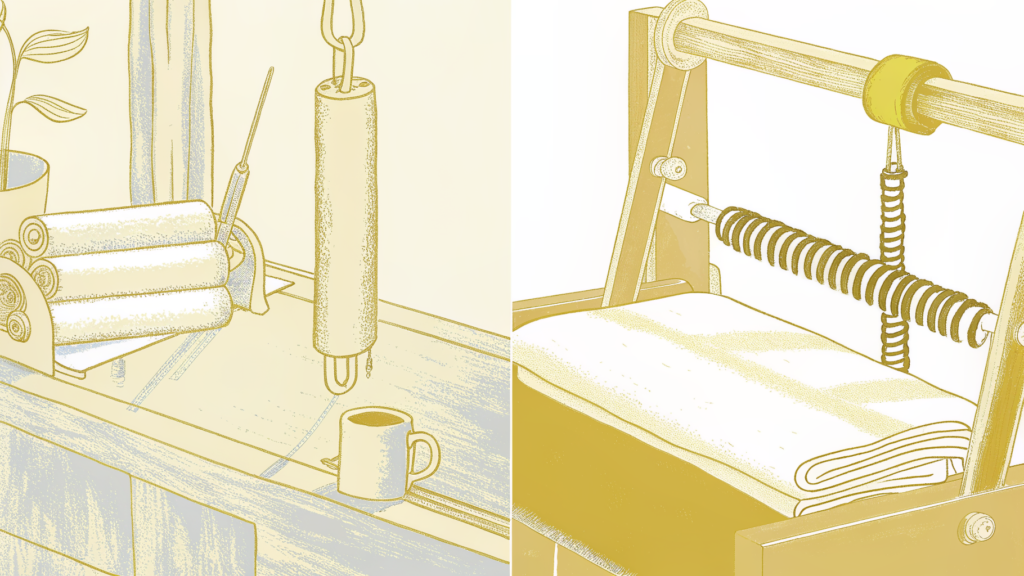
Slow-Twitch vs Fast-Twitch Glute Fibres and What the Reformer’s Spring System Actually Reaches
Endurance training drives shifts toward Type I (slow-twitch) fibre expression, while resistance training drives shifts toward Type II (fast-twitch) fibre expression, as broader exercise science consensus has long established. Hypertrophy is predominantly a Type II adaptation; slow-twitch fibres have a meaningfully smaller capacity for cross-sectional growth. Twenty slow footwork reps at light spring load recruits the endurance fibres well, but leaves the fast-twitch fibres that build the shape largely untouched.
This is the gap that practitioners who come from a traditional strength training background feel most acutely. The cardio burn is real; the full-body demand is real. But if the loading scheme never reaches fast-twitch territory, glute development stalls, and no amount of consistent attendance closes that gap on its own. Getting a real strength and cardio workout depends on spring selection and rep range being matched deliberately to the muscle fibre you are trying to recruit. Heavier springs move you closer to fast-twitch territory, but heavier springs alone do not solve the problem, because of what happens at the end of every rep.
The End-Range Tension Drop, Why Your Glutes Never Finish the Rep Under Full Load
Spring resistance is highest when the carriage is at rest and the spring is fully coiled. As the carriage extends and the spring lengthens, resistance drops. The problem is that end-range is precisely where the glute should be under peak tension, with the hip approaching full extension and the muscle fibre at its shortest, highest-force position.
Instead, the load goes slack at the moment it matters most. This physics problem compounds a separate coordination issue. Many people default to hamstring dominance during reformer bridging work; the hamstrings fire first and the glutes are underloaded even within the range where the spring is still providing meaningful resistance. Correcting that recruitment pattern requires intentional spring load selection and coaching cues that direct tension into the hip, not just the knee flexors.
Mechanical tension through the full range of motion is a primary driver of hypertrophy; training modalities that fail to sustain that tension reduce the stimulus delivered, particularly to fast-twitch fibres. This is physics. No spring load choice removes it, but understanding it lets you programme around it.
How to Periodise Endurance and Strength Phases to Delay the Plateau
The most practical way to extend your reformer results is to cycle deliberately between phases. Run a block of higher-rep, lighter-spring work to build slow-twitch endurance and motor control, then shift to a heavier-loading phase to chase the fast-twitch stimulus. Prioritise hip extension movements for the heavier phase and abduction-focused work for the endurance phase. The goal across both phases is to keep low-impact movement while adding real intensity.
Maintaining that structure consistently is where most people stumble. Transformation-focused training materialises with consistent class attendance over time, not occasional sessions. The multi-class Speakeasy packs support the kind of sustained, periodised attendance a full strength-then-endurance cycle requires, spreading the cost meaningfully compared to drop-in pricing. If you are newer to the method and want to test whether the intensity matches what you need before committing, the free intro workshop class, available to new clients via the on-site form and paired with a complimentary coffee, gives you a no-risk first session at BST Lagree’s Angel studio to assess the loading and coaching approach directly.
This periodisation delays the plateau, but it is not a permanent fix. The tension drop at end-range is present in both phases, and over time your nervous system adapts to working around it rather than through it. Smart periodisation will extend your reformer results further than most people ever push them. There is a ceiling baked into the machine’s physics, and knowing where that ceiling sits is the first step to training intelligently beneath it.
When Reformer Glute Exercises Are No Longer Enough and What Serious Results Actually Require
Reformer glute exercises have a ceiling, and most people hit it without realising the equipment itself is the limiting factor. What looks like a training plateau is often a structural feature of how a standard reformer delivers resistance, and understanding that distinction changes what you should be looking for in a class. This section breaks down exactly where the reformer falls short for glute development and why the Megaformer, and by extension Lagree, operates on a different mechanical basis entirely.
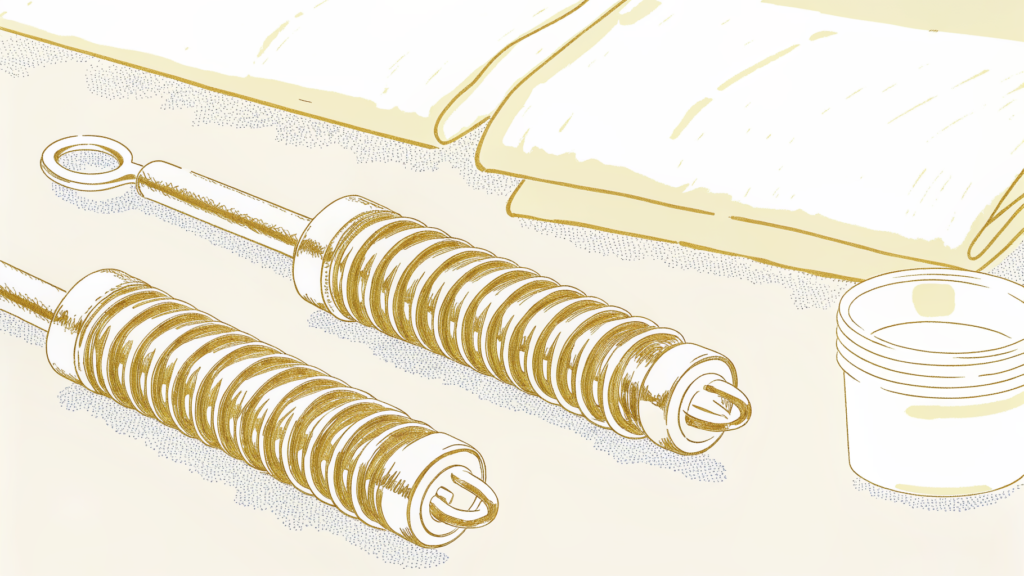
Why the Megaformer Is Not a Reformer With Extra Steps
The reformer’s spring system has one structural flaw for glute development: it unloads at the end of every rep. The moment you reach full extension, resistance drops, and the muscle gets a micro-rest. That micro-rest feels minor, but industry research identifies continuous mechanical tension across the full range of motion as a key driver of hypertrophic stimulus, because any unloading interrupts the tension signal that triggers adaptation.
The Megaformer eliminates that gap entirely. Its spring architecture, built around a dual-resistance cable-and-spring system rather than a single coiled spring, keeps the glute loaded through every millimetre of the movement, including the end-range position where a standard reformer spring unloads. Research into resistance mechanics supports the finding that constant-tension cable systems maintain higher muscle activation at end-range than free-coil spring systems, supporting this distinction. Changing spring weight or exercise selection on a reformer reshuffles what you are doing, while the muscle continues to rest when it should be working hardest.
One 45-Minute Class, Two Sessions’ Worth of Glute Work
The same research confirms that total time under tension accumulated across an entire session, not per-set difficulty, is what drives muscle growth. A standard reformer class breaks that tension repeatedly. A Lagree class on the Megaformer sustains it. The result is that the metabolic stress, the lactate accumulation that signals the body to adapt, builds continuously rather than resetting with each rep.
Key takeaway: The posterior-chain stimulus accumulated in a 45-minute Lagree session is driven by sustained tension architecture rather than session length, because the tension architecture never lets the glute clock out.
Research into resistance training methodology has identified continuous inter-set metabolic stress as a key differentiator in hypertrophic response between resistance modalities. That mechanistic difference means the session delivers more adaptive stimulus not because it is longer or harder in a generic sense, but because the Megaformer’s design sustains the conditions for adaptation throughout.
Instructor Cueing Is the Hidden Variable in Glute Activation
The machine creates the conditions. The instructor determines whether you actually meet them. Neuromuscular research consistently shows that specific verbal and tactile cueing measurably increases the depth of glute activation during exercise, because the mind-muscle connection is a trainable, coachable variable, not a fixed output.
Clients who have trained on the reformer for months without experiencing two-day glute soreness often feel it after a single session at BST’s Lagree classes in Angel, because the cueing shifts which fibres are recruited. Lagree delivers sustained, low-impact tension that crosses the adaptation ceiling the reformer cannot. The method is the mechanism, and the instructor is the multiplier.
Related Reading
- Best Pilates Reformer App
- Pilates Reformer Leg Exercises
- Pilates Reformer Springs Explained
- Pilates Reformer Ab Exercises
Next steps
If your reformer sessions keep producing the same burn without new results, the path forward starts with recognising that feeling the burn is not the same as creating a new stimulus. Once the spring load becomes predictable, your glutes stop adapting, and no amount of consistency closes that gap on its own.
The research on single-leg and unilateral exercises showing higher gluteus medius and gluteus maximus activation than bilateral movements means your exercise selection matters more than your effort level. The finding that no single exercise maximally recruits both glute max and glute med simultaneously means a ranked, varied sequence is not optional, it is the only structure that delivers full-zone stimulus. Together, they point to a method built around sustained tension, deliberate sequencing, and instructor cueing that shifts which fibres actually fire.
Start with Lagree classes in London at BST’s Angel studio. New clients can book a free intro workshop through the on-site form, arrive to a full Megaformer session coached by a certified Lagree instructor, and leave with a complimentary coffee and a clearer sense of what your glutes have been missing.
Frequently Asked Questions
Can you actually build glutes with reformer Pilates, or does it just tone?
Yes, but only within a specific window and with the right setup. The post explains that the reformer delivers real physiological glute work for the first four to six weeks, after which the fixed spring-load system stops driving meaningful hypertrophic adaptation unless resistance and movement patterns are deliberately varied.
Why do my glutes stop getting sore after a few weeks of reformer classes?
That’s adaptation, and the post explains exactly why it happens: once your glutes learn the movement pattern, muscle protein synthesis returns to near-baseline within roughly 48 hours of each session, meaning the same repeated stimulus produces a progressively smaller anabolic signal over time. The session still feels hard because your cardiovascular system and slow-twitch fibres are still being taxed, but the fast-twitch Type II fibres that drive visible change are no longer being recruited.
Which reformer exercise is best for targeting the side glutes specifically?
The side-lying leg press is the dedicated gluteus medius isolation move in the post’s ranked list. It uses a side-lying position with one to two medium springs, and the post notes that side-lying positions challenging the abduction pattern produce measurably higher medius activation than most upright exercises, though it stresses that alignment is everything, because even a slight backward pelvic roll disengages the medius and lets the hip flexors take over.
What do leg circles in straps actually do for the glutes?
The post explains that during leg circles with straps, the lower and outer glute fibres fire to control the arc against the strap resistance while the deep core stabilises the pelvis. It’s classed as a hip mobility and glute integration exercise, and the post notes an honest trade-off: if you lack the hip mobility to keep your lower back anchored to the carriage throughout the circle, you should reduce the range of motion rather than compensate through the spine.
Does the long box arabesque actually hit the glutes differently from bridges and footwork?
Yes, and the post gives a specific mechanical reason why. The prone position of the arabesque places the gluteus maximus in a terminal extension range that upright exercises like bridges and footwork rarely reach, which is why the post notes it produces a distinctly different kind of soreness the following day. It’s flagged as not the most beginner-friendly setup, and anyone with lower back sensitivity is advised to keep the range small and focus on initiating from the glute rather than lifting for height.