The answer is conditional, and most studios won’t tell you that. Here is what actually determines whether Reformer Pilates is safe at your stage of pregnancy.
Most pregnant women searching “is reformer Pilates safe during pregnancy” get one of two answers: a breezy yes from a studio front desk, or a spiral of contradictory information that leaves them more anxious than when they started. The common assumption is that if a studio offers prenatal modifications, the method itself must be safe enough, and the instructor will just adjust a few exercises for the bump. Neither is actually useful. See our Lagree London for how this works in practice.
The honest answer is conditional, and understanding those conditions is the difference between exercising safely and assuming you’re covered when you’re not. The stakes here are real. As Tommy’s makes clear, exercise is safe and beneficial during pregnancy for most women, including those who weren’t active before conceiving. The harder truth is that safety is contingent on the type of activity, the stage of pregnancy, and your individual health circumstances, and a blanket endorsement of any single class or method isn’t appropriate without those qualifications. Reformer Pilates is not on any clinical “avoid” list for uncomplicated pregnancies, but the word “most” is doing serious work in that sentence.
It excludes women with pregnancy complications, placenta praevia, a history of preterm labour, or conditions their OB or midwife has flagged as high-risk. For everyone else, low-impact, controlled resistance exercise is broadly supported by UK clinical guidance. Medical clearance is the filter that determines whether the conditional yes applies to you specifically.
Tommy’s is direct: before starting or continuing any exercise during pregnancy, women should get medical clearance, particularly if any complications or health conditions are present. Without it, every other piece of guidance here is theoretical. A studio that welcomes pregnant clients without specifying how it modifies spring loads, eliminates supine work after the first trimester, or assesses each client’s individual health picture is offering reassurance, not a safety protocol.
Those are different things. The gap between “we accommodate pregnant clients” and genuine prenatal qualification is where the conditional yes can quietly become a no, and where the next section picks up.
Key takeaways
- Reformer Pilates carries four specific physiological risks during pregnancy, supine positioning, fixed spring loads, intra-abdominal pressure spikes, and a class format that rarely adapts past week 20, and most studios only address one of them.
- Nearly 48% of pregnant women develop pregnancy-related low back pain, and the real case for continuing resistance-based training is managing that, not staying toned.
- A modification safe at eight weeks can actively work against you at twenty-eight, a static checklist is not a trimester-by-trimester plan.
- Starting reformer Pilates for the first time during pregnancy means learning spring-resistance mechanics and breath management from scratch while your body is already under physiological load, the instructor qualification bar is higher than most studios advertise.
- ‘Prenatal-friendly’ on a studio website has no standardised meaning and no regulatory body enforces it at the point of booking.
- The Lagree method’s continuous tension and instant resistance adjustment make trimester-by-trimester modification more precise than fixed-spring reformer formats allow, and BST Lagree in Angel, Islington runs 45-minute group classes built around exactly that, with instructor certification courses that train the people who teach pregnant clients.
What Reformer Pilates Positions Become Unsafe as Your Pregnancy Progresses
Four specific physiological mechanisms determine which Reformer positions become dangerous as pregnancy progresses. Understanding each one matters because the body can be under genuine mechanical stress before you feel a single warning sign. The common assumption is that if a studio offers prenatal modifications, the method itself must be safe enough and the instructor will just adjust a few exercises for her bump. Most studios hand pregnant clients a generic modifications sheet and leave them to self-police mid-class, which is an anxious, isolating experience when you’re not sure whether the footwork you just did at 22 weeks was actually fine.
Why Standing Exercises on a Moving Carriage Become Unsafe During Pregnancy
The absence of subjective symptoms does not indicate the absence of mechanical risk.
Standing exercises on a moving carriage become unsafe during pregnancy because relaxin peaks in the first trimester and remains elevated throughout, progressively loosening the ligaments in the pelvis, ankles, and knees. A moving carriage demands rapid, reactive stabilisation from those same joints. Standing split squats or lunge variations on a rolling carriage at 28 weeks, with a shifted centre of gravity and reduced proprioception, present a genuine fall risk that no amount of instructor attention can fully offset in a group class setting.
The hidden cost of standard Reformer architecture here is real: fixed spring loads mean an instructor cannot instantly dial resistance down the moment a movement tips from safe to risky. These four risk categories demand a machine and an instructor capable of real-time intervention, not a modifications sheet.
The studio’s Angel location means that assessment happens in a premium London environment, not a makeshift prenatal corner of a general fitness floor. Understanding what to remove from your practice is only half the equation. The more important question, and the one most prenatal fitness content skips, is what the right modifications actually give you back, and why those gains matter far beyond the studio floor.
1. Supine (Flat-on-Back) Positions – Unsafe After 12 Weeks
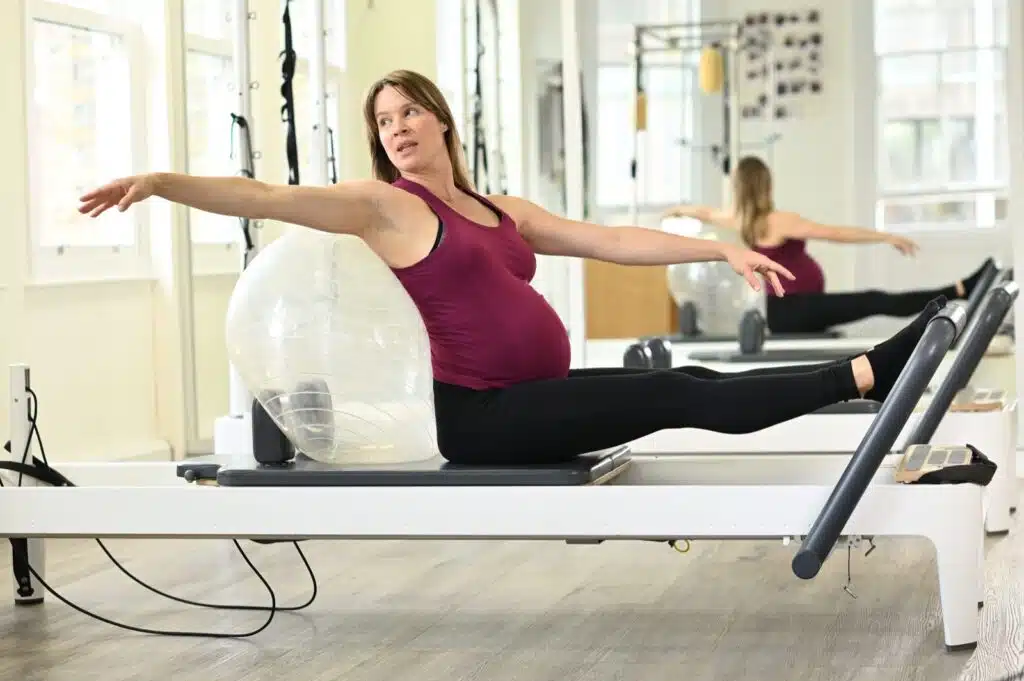
Lying flat on your back is the most clinically clear-cut restriction in prenatal exercise. According to the StatPearls review of aortocaval compression syndrome, the condition typically occurs after 20 weeks gestation, when the growing uterus is large enough to compress both the inferior vena cava and the aorta simultaneously. That dual compression reduces venous return to the maternal heart and limits arterial blood flow out to the placenta, creating what the same source describes as a vascular compromise that cannot be resolved by minor exercise modifications alone.
As industry research further notes, the resulting supine hypotensive syndrome can manifest rapidly and without clear forewarning, so instructor vigilance is the essential safety layer. Footwork supine at 20 weeks, an exercise most instructors never flag, sits squarely inside that risk window. The danger is mechanical.
Reduced cardiac output means less oxygen reaching the placenta, and neither you nor your instructor will necessarily see it coming before dizziness or faintness arrives. This is precisely the kind of gap that leaves pregnant clients who trained at standard Reformer studios, trusting a generic modifications sheet, discovering mid-class that no one was actively tracking their gestation milestone or spring load. At BST Lagree’s Angel studio, instructors are trained to track these thresholds as part of each client’s ongoing fitness journey, not as a one-time intake note.
2. Prone (Belly-Down) Positions – Must Be Dropped as the Bump Grows
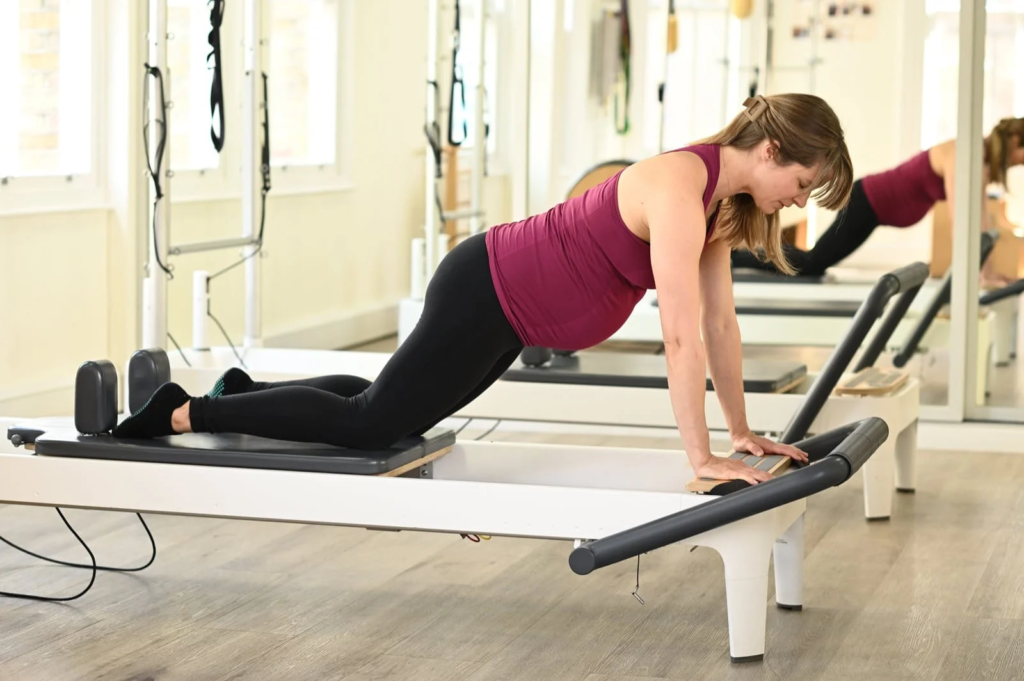
Lying belly-down on the carriage becomes structurally impossible and unsafe as the pregnancy progresses, for reasons that go beyond obvious discomfort. Direct pressure on the uterus compromises fetal positioning and places uneven load on the lumbar spine at exactly the point where relaxin, the hormone responsible for ligament laxity, is already reducing joint stability. Prone spinal extension work, common in Reformer classes, compounds that spinal load without the muscular support to manage it safely.
A recurring struggle for pregnant clients who come to us having trained elsewhere is that they weren’t told when to drop prone exercises; they waited until discomfort forced the issue. By that point, compensatory movement patterns were already established. The transformation-focused approach at BST means modifications are progressive and pre-emptive: the goal is to keep you finding the next level of a workout that still challenges your strength, rather than reactively removing exercises after the fact.
3. Loaded Abdominal Flexion and Crunching – Diastasis Recti Risk
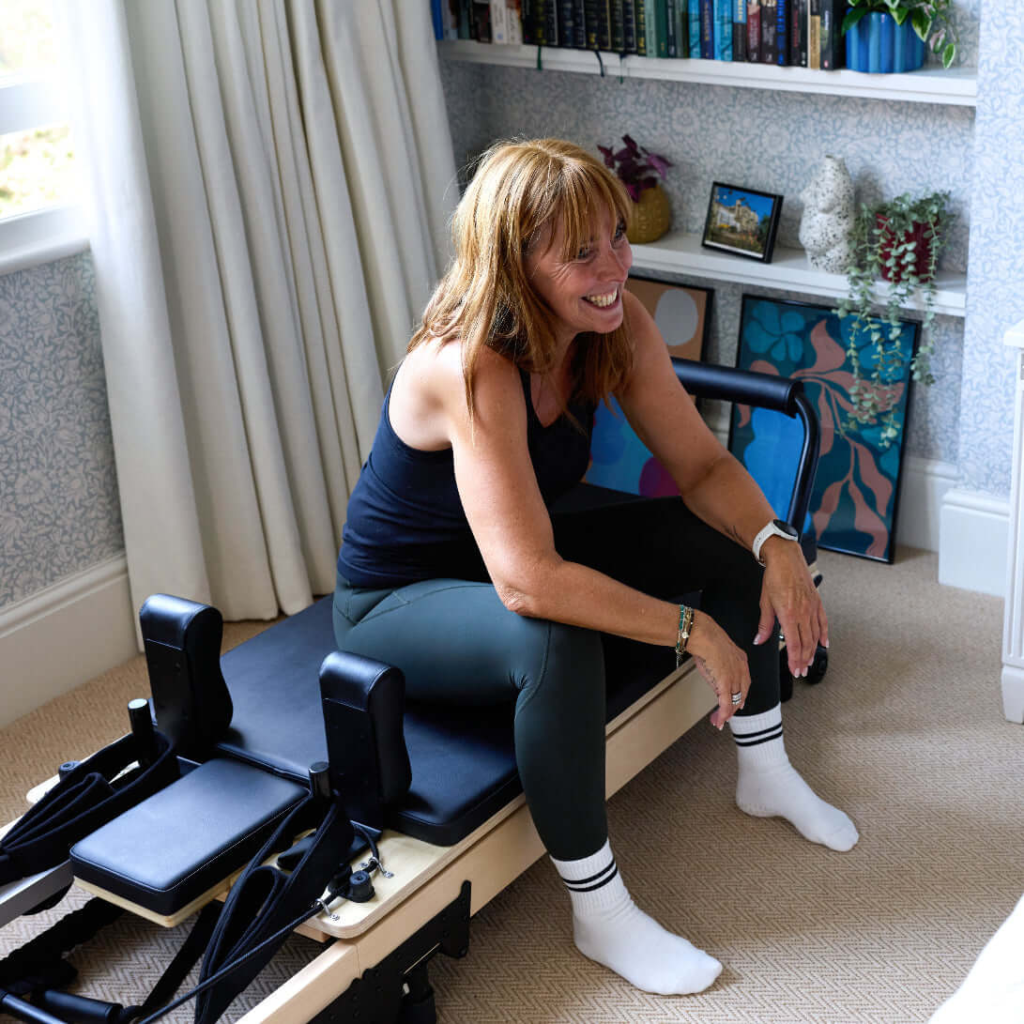
Exercises that drive forceful spinal flexion under load, the hundred, roll-ups, and any crunch-style movement, dramatically increase intra-abdominal pressure and can widen the linea alba, causing diastasis recti (abdominal wall separation). This separation can persist long after birth, weakening the core and contributing to pelvic floor dysfunction. Pregnant women doing reformer Pilates should stop these movements at the first sign of coning or doming at the midline, regardless of trimester.
4. Standing on a Moving Carriage – Balance and Ligament Laxity Hazard
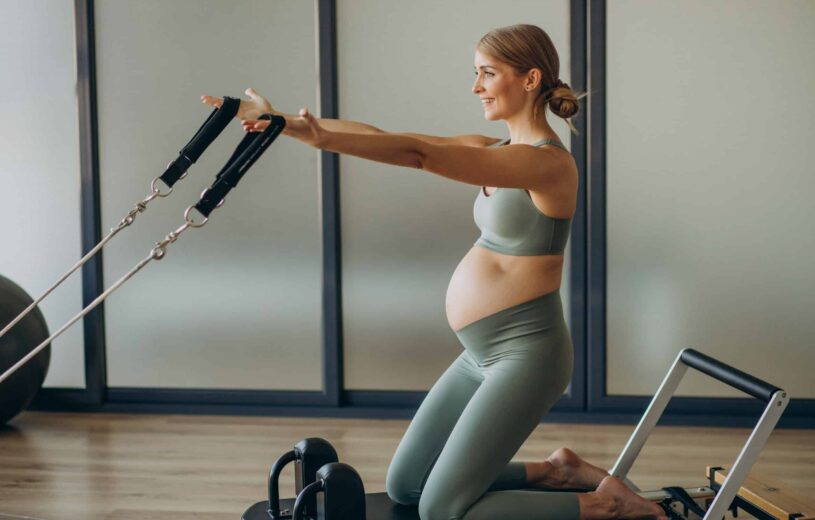
Relaxin, the hormone that loosens ligaments to prepare the pelvis for birth, also destabilises ankles, knees, and hips, while the shifting centre of gravity from a growing bump further compromises balance. Standing exercises performed on the moving reformer carriage, such as standing lunges or squats, carry a genuine fall risk that escalates each trimester. Instructors should transition pregnant clients to kneeling or seated carriage variations well before balance feels noticeably impaired.
Related Reading
- Lagree Before and After 3 Months
- What To Bring To Pilates Reformer Class
- How Many Times A Week Should You Do Pilates Reformer
- Can You Do Reformer Pilates While Pregnant
- What To Wear To Pilates Reformer Class
- What Reformer Does Club Pilates Use
Benefits of Reformer Pilates During Pregnancy That Make the Modifications Worth It
Nearly the majority of pregnant people will develop pregnancy-related low back pain, and that figure climbs sharply in the third trimester. The common assumption is that continuing reformer-style Pilates is mostly about staying toned and keeping weight gain in check. The real payoff is functional strength that protects your body through labour and speeds up what comes after it.
The modifications aren’t a watered-down version of the workout. They’re a redirect toward the outcomes that matter most in the next six to twelve months. One important caveat first: a class that simply removes exercises without substituting resistance-equivalent alternatives eliminates the benefit along with the risk.
Genuine prenatal modification means replacing, not just deleting. A concern we hear often from pregnant women is real uncertainty about whether reformer Pilates is even feasible during pregnancy, whether it’s safe, what it looks like, and whether any local studio actually offers specialised prenatal sessions they can get to. That uncertainty is worth addressing head-on before anything else, because the answer shapes everything that follows.
1. Core and Pelvic Floor Strengthening – Your Foundation for Carrying a Growing Bump
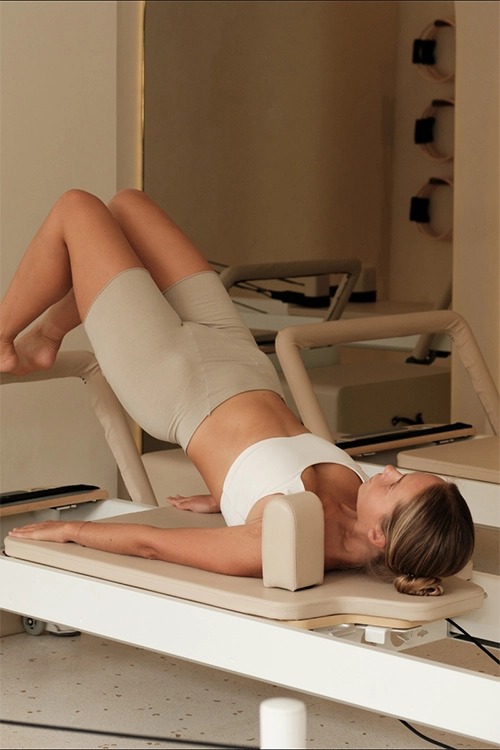
As your belly grows, your deep core and pelvic floor muscles work overtime to support the extra load. Reformer Pilates targets these structures with precision, using spring-assisted movements that activate the transverse abdominis and pelvic floor without the impact risks of other exercise. Stronger pelvic floor muscles also reduce the risk of incontinence and prolapse. The tradeoff: traditional crunching or curl-up movements must be avoided to prevent worsening diastasis recti.
2. Pregnancy Back Pain Relief – Why the Reformer Outperforms Most Alternatives
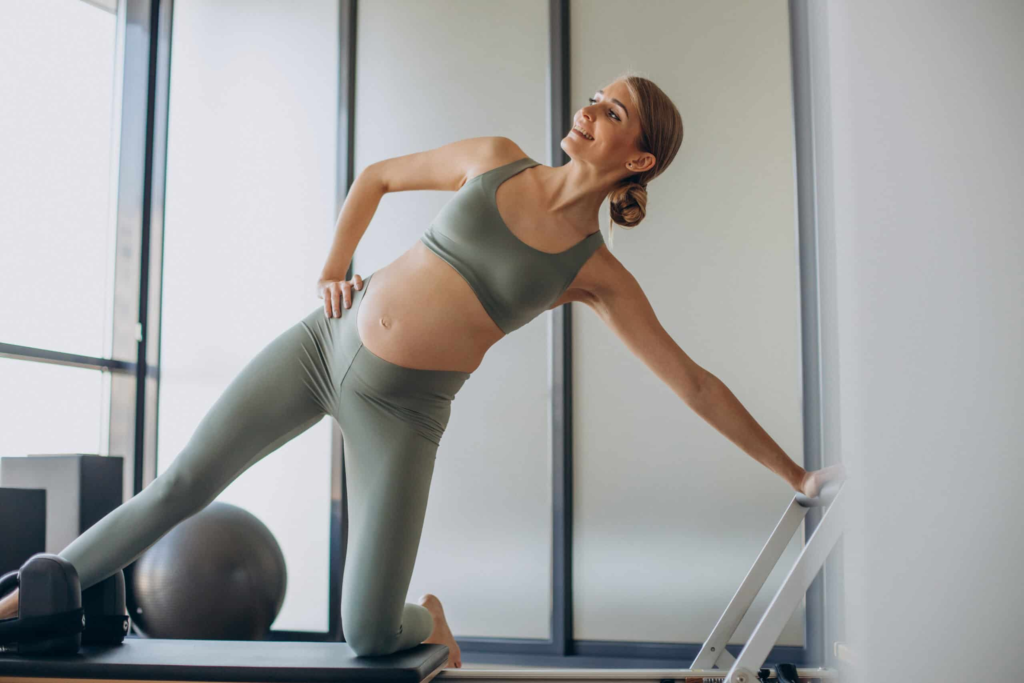
A 2023 meta-analysis confirmed that targeted core and posterior-chain exercise is a clinically relevant intervention for the vast majority of women who develop low back pain, not a comfort measure but a functional one. The reformer’s adjustable spring resistance means that as your capacity shifts day to day, the instructor can dial load mid-exercise to keep the session effective. That is the structural advantage. BST’s instructors are trained to modify precisely rather than generically, so you get back in shape with a method that works, with expert guidance at every step.
3. Birth Preparation Through Breath, Endurance and Mind-Body Connection
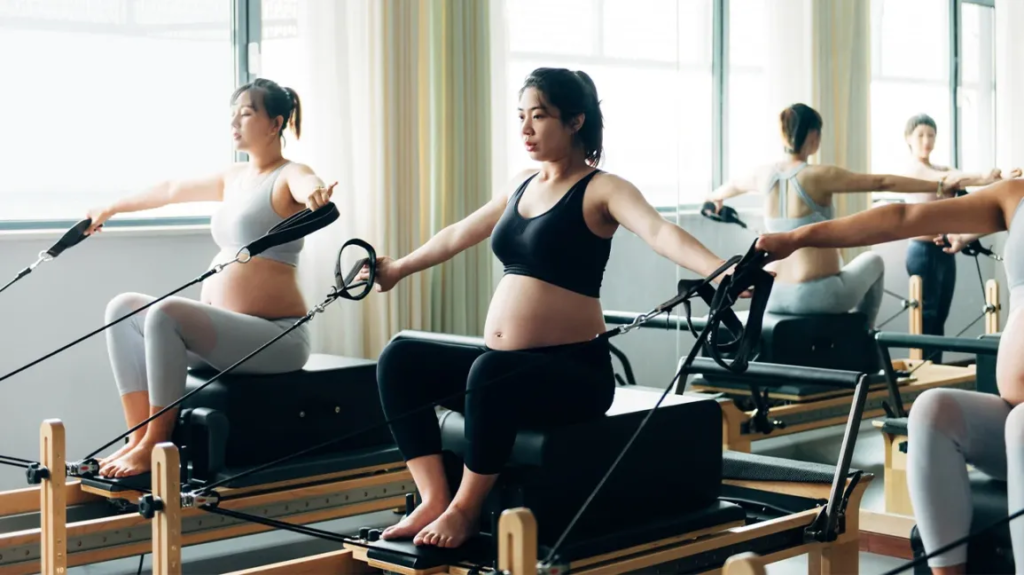
The exhale-on-effort pattern trained in every slow-tempo set is the same pattern midwives coach in the delivery room. That is not coincidence. It is rehearsal, and it compounds across the second and third trimesters for clients who attend consistently.
4. Adjustable Spring Resistance – How the Reformer Adapts to Every Trimester

The structural advantage of resistance-based reformer training is that load can be dialled to match a body that changes week by week. This is most beneficial when the instructor can adjust tension mid-exercise (not just between sets), as it keeps the session productive as pelvic floor capacity, balance, and energy shift across trimesters. A fixed-load format cannot do this. The honest trade-off: this level of precision requires an instructor who understands prenatal physiology, which is exactly the standard BST holds at its Angel studio.
5. Postpartum Return to Reformer Pilates – Rebuilding Safely After Birth
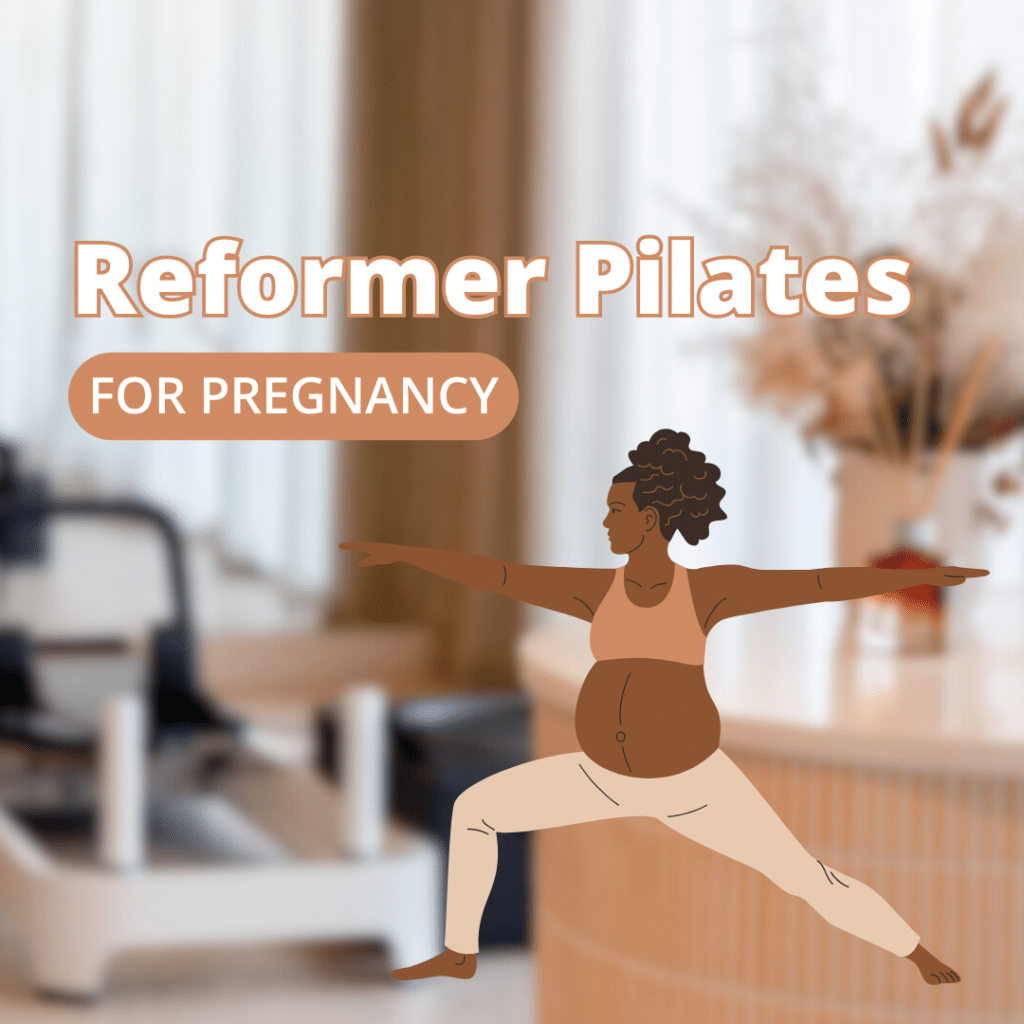
Clinical guidelines draw a firm line between vaginal birth recovery (typically 6 to 8 weeks before reintroducing resistance exercise, subject to GP clearance) and caesarean recovery, which requires longer tissue healing before any meaningful load returns to the anterior core. The benefit of maintaining training throughout pregnancy is that it changes the baseline you return to.
At BST Lagree in Angel, instructors assess that returning baseline before the first post-birth session, so your reintroduction is built around where you actually are, not where a generic programme assumes you to be. For clients returning after birth who want to rebuild without losing the sense of quality and progress they had before, the studio’s premium environment means you don’t feel like you’re starting over from scratch. You feel like you’re back somewhere familiar, picking up from a strong foundation.
Every benefit above, from pelvic floor resilience to postpartum recovery speed, depends on one thing: knowing precisely when and how to modify each exercise as your bump grows. That’s exactly what the next section maps out, trimester by trimester.
Trimester by Trimester Reformer Pilates Modifications That Actually Account for Your Bump
That returning baseline shifts constantly, and so does what the body needs from a session. A modification appropriate at eight weeks can actively work against you at twenty-eight. That gap between a static checklist and a trimester-by-trimester plan is precisely where outcomes diverge most.
One thing worth naming upfront: pregnant and trying-to-conceive women we work with at BST frequently tell us they feel scared or intimidated about starting, or continuing, reformer Pilates during pregnancy, especially when they are also navigating body changes and weight concerns. That fear is reasonable, and it is compounded by how few studios offer bump-specific, trimester-calibrated guidance that genuinely meets women where they are physically. The trimester breakdown below exists to close that gap.
1. First Trimester (Weeks 1-12): Get Medical Clearance, Tell Your Instructor, and Manage Fatigue Without Overhauling Your Routine
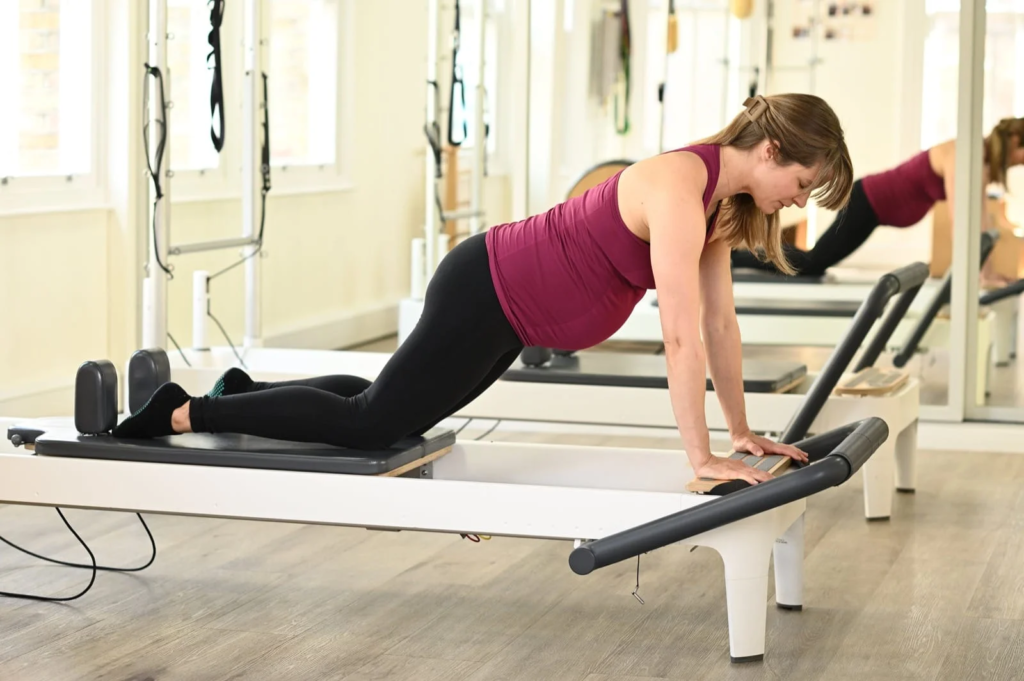
Weeks 1 to 12 are where most women change the least, and for good reason: the bump is not yet a mechanical problem. Communication is the priority. Get GP clearance, tell your instructor before class (not after), and let fatigue set your ceiling.
The talk test is the cleanest intensity guide available: if you cannot hold a full sentence mid-exercise, the load is too high. Reduce spring resistance by one clip if breathlessness hits. The one real tradeoff: this trimester feels deceptively manageable, which is exactly when women skip the instructor conversation and carry on at pre-pregnancy intensity.
That is the mistake that creates problems in trimester two. If you are new to BST and want to understand what bump-accommodating Lagree actually feels like before committing to a pack, the free intro workshop class, bookable via the on-site form and including a complimentary coffee, is the lowest-stakes way to have that instructor conversation in person, see the Megaformer’s spring system up close, and leave with a clearer picture of how your first trimester sessions would be structured.
2. Second Trimester (Weeks 13-26): Wedge the Supine Position, Drop Spring Load, and Eliminate Intense Abdominal Work
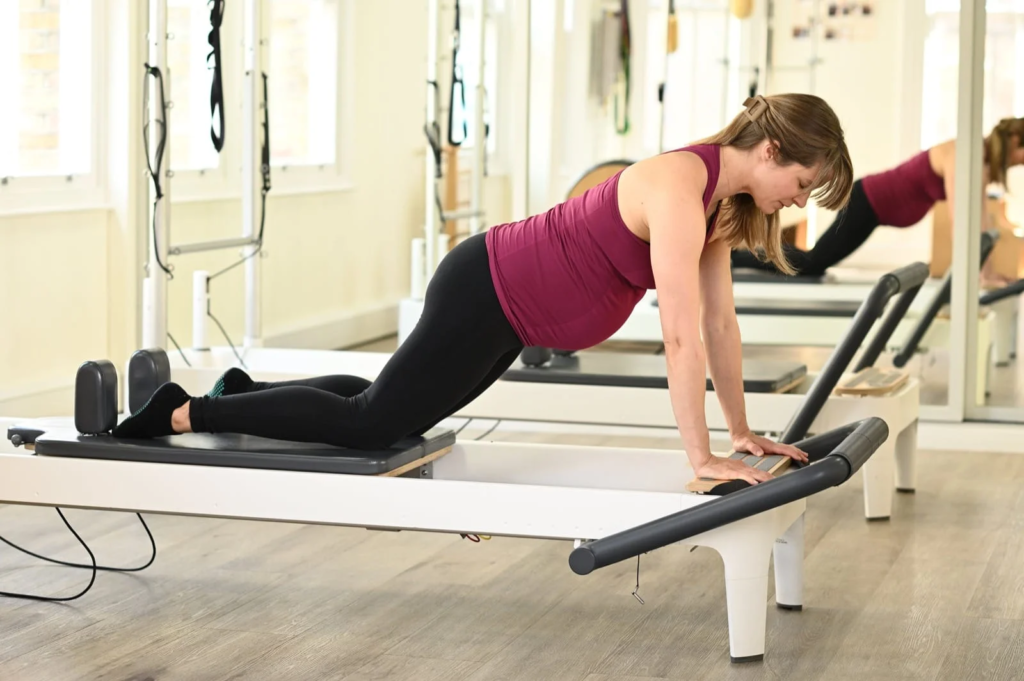
This is where the class must be structurally rebuilt, not tweaked. The clinical picture here is well established: from approximately 12 to 16 weeks onward, the growing uterus compresses the inferior vena cava in the supine position, reducing blood return to the heart and compromising circulation to the baby. Because the reformer’s foundational sequences, including footwork, stomach massage, and spinal articulation work, are performed flat on the back, a wedge under the shoulders is a clinical necessity.
Broader prenatal guidance echoes this concern, noting that lying flat on the back from mid-pregnancy onward places sustained pressure on major vessels that carry blood to both mother and baby. Reduce spring load by at least one full spring to account for relaxin-loosened joints, which peak in laxity during this window and raise injury risk under resistance. Loaded spinal flexion and any exercise that causes the abdomen to dome or bulge outward must be swapped for lateral or standing alternatives.
A studio that hands you a wedge pillow, removes one clip, and calls that a plan is approximating. Precise, incremental resistance adjustment, the kind that tracks the bump in real time on the Megaformer’s continuous-tension system at BST Lagree in Angel, is what makes the difference between a modification that fits week 14 and one that still fits week 24. Prenatal reformer Pilates classes are, in practice, underattended at many studios, which means bump-appropriate sessions are at genuine risk of being thinly scheduled or cancelled altogether, leaving pregnant women without consistent access to the trimester-specific work they need.
Booking flexibility helps maintain a trimester-by-trimester rhythm without being locked into a rigid schedule. Transformation-focused training materialises with consistent attendance over time, and that is as true during pregnancy as at any other point in a fitness journey.
3. Third Trimester (Weeks 27-40) and Postpartum Return – Prioritise Pelvic Floor and Breathwork, Then Wait for GP Clearance Before Coming Back
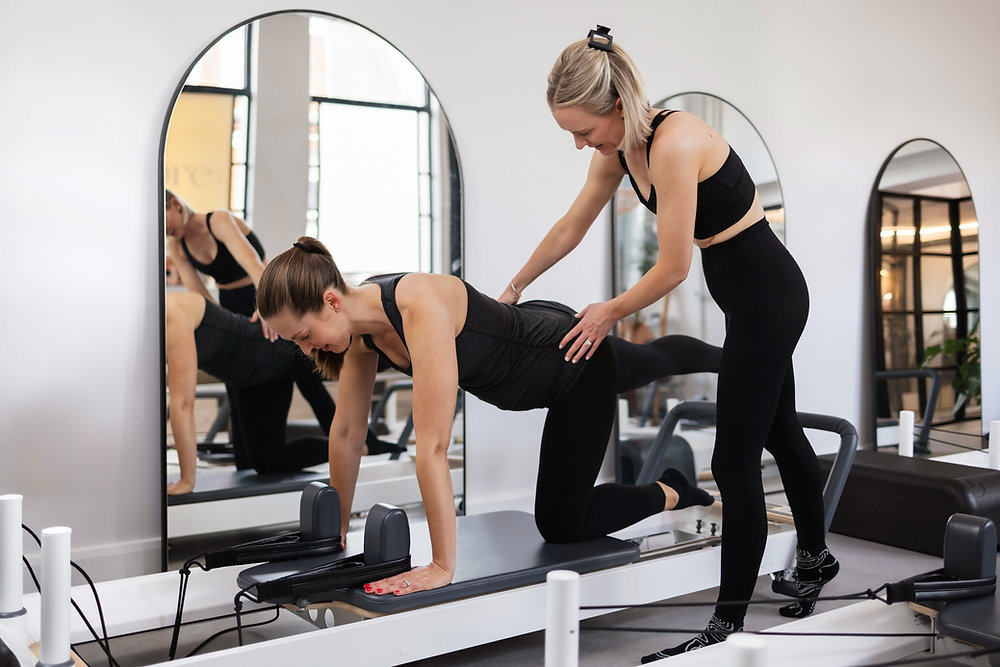
Balance loss is the defining challenge of the third trimester. The centre of gravity has shifted enough that a moving carriage becomes a genuine stability hazard; standing split-lunge sequences should be dropped in favour of seated or supported variations as the bump grows. Intensity stays governed by the talk test throughout.
Pelvic floor activation and diaphragmatic breathing become the primary training targets, not secondary add-ons. After birth, clinical guidance recommends waiting for GP clearance before returning to structured exercise, with vaginal birth recovery taking several weeks at minimum and caesarean recovery taking longer. Returning before clearance, even to low-load work, is the one limitation no modification can override.
The honest tradeoff of this trimester is that the class shrinks considerably: fewer exercises, lower loads, shorter duration. That is not a failure of the method. It is the method working correctly.
When clearance does arrive, the Speakeasy single drop-in at £25 is a clean way to return at your own pace, one class, no commitment, with an instructor at BST’s Angel studio who already knows where you left off. All of the above assumes one thing: that you have done reformer Pilates before. But what if pregnancy is the moment you were planning to start?
The answer is more nuanced, and more encouraging, than most studios will tell you upfront.
Related Reading
- Is Reformer Pilates Strength Training
- Is A Pilates Reformer Worth It
- Pilates Reformer Footwork
- Tower Vs Reformer Pilates
- Pilates Reformer Moves Names
- Does Pilates Reformer Build Muscle
Can Beginners Start Reformer Pilates During Pregnancy Safely for the First Time
Starting reformer Pilates for the first time during pregnancy is a different calculation entirely from continuing an established practice. You are not just learning to move safely with a bump; you are learning spring-resistance mechanics, breath management, and closed-chain loading from scratch, all while your body is undergoing real physiological change. That combination raises the instructor qualification bar significantly, and it changes the format you should be looking for before you book a single class.
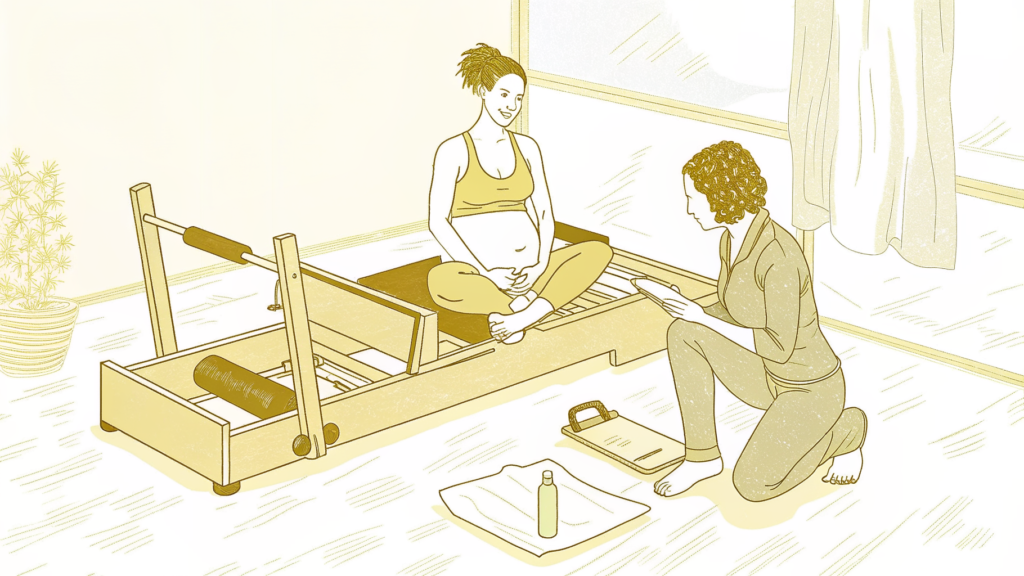
Yes, Beginners Can Start, But the Instructor Qualification Bar Is Higher, Not Lower
Beginners can start reformer-style training during pregnancy. Tommy’s is explicit that exercise safety depends on “the type of activity, the stage of pregnancy, and individual health circumstances,” and that medical clearance must come first. Once you have that clearance, the question shifts from “can I?” to “who is qualified to guide me?”
The answer matters more than most studios will admit. In the UK, safely instructing a pregnant client is classified as a special populations discipline, requiring a Level 3 Pre and Postnatal Exercise qualification, a dedicated certification that sits above a standard fitness instructor credential, covering specialist programme design, contraindication screening, and load modification for ante- and postnatal clients. You can verify what that qualification demands via HFE and Diverse Trainers, both of which make plain why a generic “certified instructor” badge does not cover what a pregnant beginner needs.
The instructor who can safely assess your movement baseline, cue your breath, and modify your load simultaneously is the exception. Showing up to a group class and trusting that the instructor holds that credential is, statistically, an optimistic assumption.
Why the Machine Matters as Much as the Instructor
A standard reformer operates on fixed spring loads. For a pregnant first-timer in the second trimester who has never felt spring resistance before, the instructor’s ability to adjust that load mid-exercise is not a nice-to-have. It is the safety mechanism.
Fixed springs make that impossible mid-rep. The Megaformer operates differently. Its continuous-tension system means resistance can be dialled up or down between reps, not approximated by a spring clip at the start of class.
For a beginner learning a kneeling plank in mid-pregnancy, the load can be reduced the moment form breaks, not at the next natural pause. That is the mechanical difference between a machine built for precision and one that requires the instructor to work around its limitations.
Why Private Sessions Beat Group Classes for Pregnant First-Timers
Group classes are built around a shared programme. The instructor cues for the group, not for the individual at 28 weeks who has never loaded a spring in her life. A first-timer cannot yet recognise when a movement is loading her incorrectly, because she has no baseline to compare against.
That gap is widest in the first sessions, which are precisely the sessions where she most needs individual attention.
One-to-one or very small group instruction is the credible minimum entry point for a pregnant beginner. For a first-timer, that level of attention is what makes starting during pregnancy safe rather than theoretically possible. That first session lets you assess the machine, the studio, and the instruction quality without any risk.
Real, lasting results from Lagree, including strength, posture, and controlled load tolerance, materialise with consistent class attendance over time, which is exactly what a well-priced pack structure is designed to protect. Knowing that beginners can start safely, given the right machine and the right instructor, immediately raises the next question: how do you actually identify a studio that will genuinely modify for your bump, rather than one that simply claims to? That is exactly what the next section unpacks.
How to Find a Reformer Pilates Class That Genuinely Modifies for Pregnancy
No regulatory body currently enforces that claim at the point of booking, which means a pregnant woman asking “do you offer prenatal modifications?” will almost always hear yes, regardless of whether any instructor in that studio holds the qualification that makes that yes meaningful.

The Three Qualification Markers Worth Asking About Before You Book
“I struggle to find Reformer Pilates classes that are specifically designed or genuinely modified for pregnancy, rather than generic classes that may not be safe.”
— what we hear from pregnant women seeking Pilates
The minimum bar is specific: a Level 3 Pre and Postnatal Exercise qualification, a certification entirely distinct from a general group fitness or personal training award. Instructors without this dedicated credential are not equipped to programme safely for pregnant clients, because a standard fitness cert does not cover the physiological and biomechanical considerations pregnancy demands. Beyond that, ask whether the studio’s instructors hold CIMSPA specialist endorsement, which sits above general practitioner status and signals population-specific competence.
Third, if the class uses a reformer-style machine, ask directly: “Can resistance be adjusted mid-exercise, for a specific client?” A yes that comes with a confident, technical explanation is a green flag. A pause, then a vague reassurance, is not.
Red Flags in Reformer Class Formats That Cannot Modify for Pregnancy
Fixed spring loads are the structural problem. If a class format cannot change resistance for one client without disrupting the whole group, modifications will always be superficial. No propping equipment, no pre-class health screening, and no bump consultation before your first session are equally telling. The CIMSPA framework makes clear that specialist populations require specialist provision, not general goodwill. A format built around instant, per-client resistance adjustment, such as the Megaformer used at BST Lagree in Angel, removes that structural barrier entirely, making trimester-specific modification a mechanical reality rather than an instructor’s best guess mid-class.
If You Feel Like a Burden, the Studio Wasn’t Built for You
Feeling like an afterthought mid-class is diagnostic. A studio built for pregnant clients adapts the format to you before you arrive. That looks like a pre-class conversation about your trimester and modification plan, an instructor who knows your name and your stage of pregnancy before you step on the machine, and a women-focused environment where your bump is the default consideration. If the studio you’re evaluating can answer the qualification questions above, adjust resistance in real time, and offer a consultation before your first class, you are looking at structural readiness, not just a verbal welcome.
Related Reading
- Pilates Reformer Leg Exercises
- Pilates Reformer Glute Exercises
- Pilates Reformer Ab Exercises
- Best Pilates Reformer App
- Pilates Reformer Springs Explained
Next steps
If the generic “prenatal-friendly” label on a studio website has left you no clearer on what safe actually looks like for your trimester, the path forward starts with evaluating the machine and the instructor’s qualification together, not separately.
A studio that cannot adjust spring resistance mid-exercise will always patch its modifications around a structural limitation, not around your bump. That is the mechanical gap that makes trimester-by-trimester reassessment impossible in practice, even when an instructor’s intentions are sound. At the same time, a Level 3 Pre and Postnatal qualification is the specific credential that separates a yes that means something from a yes that simply ends the conversation. Both conditions have to be met. One without the other does not close the gap.
For a deeper look at how to put both tests to a studio before you book, see Lagree classes in London as a starting point for understanding what a format built around continuous-tension resistance and qualified prenatal instruction actually looks like in practice.
Frequently Asked Questions
Does reformer Pilates actually help with pregnancy back pain, or is that just marketing?
It’s clinically supported, not just marketing. A 2023 meta-analysis confirmed that targeted core and posterior-chain exercise is a clinically relevant intervention for the roughly 48% of pregnant women who develop low back pain. Back-extension and posterior-chain work on the reformer directly counteracts the forward load of a growing bump in a way that walking and swimming don’t.
When exactly do I have to stop lying on my back during reformer Pilates?
The clinical cutoff is 20 weeks gestation. After that point, the growing uterus is large enough to compress both the inferior vena cava and the aorta simultaneously, reducing blood flow to both the maternal heart and the placenta, and neither you nor your instructor will necessarily see it coming before dizziness or faintness arrives.
What’s the risk of doing crunches or abdominal work on the reformer during pregnancy?
Loaded abdominal flexion, like the Hundred in full supine or seated roll-backs with heavy spring resistance, generates significant spikes in intra-abdominal pressure that push outward on the linea alba and are a primary driver of diastasis recti, the separation of the abdominal wall. The separation can begin forming well before it’s visible or painful, so the absence of pain is not a reliable signal that the exercise is safe.
Why does strengthening my pelvic floor on the reformer matter more than just doing Kegels?
You cannot meaningfully strengthen the pelvic floor by thinking about it, you need controlled resistance applied through functional movement. The reformer carriage provides that controlled load, and pelvic floor dysfunction is among the most common complications after vaginal birth, making consistent resistance-based training throughout pregnancy one of the clearest ways to reduce that risk.
Do I need my doctor’s sign-off before coming to a prenatal reformer class if I already exercise regularly?
Yes, regardless of your existing fitness level. Medical clearance is the filter that determines whether reformer Pilates is appropriate for your specific pregnancy, and Tommy’s is direct that women should get it before starting or continuing any exercise during pregnancy, particularly if any complications or health conditions are present.