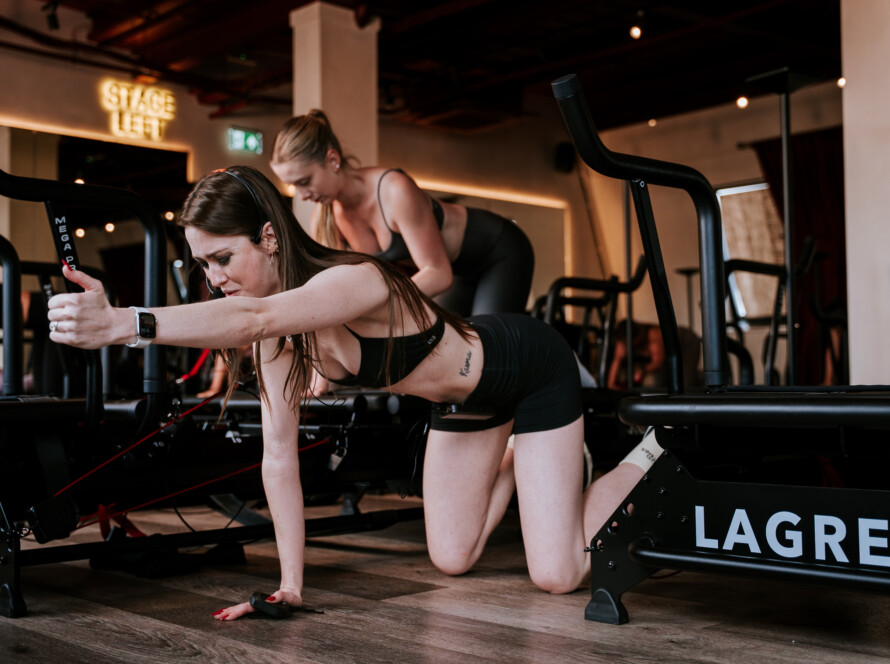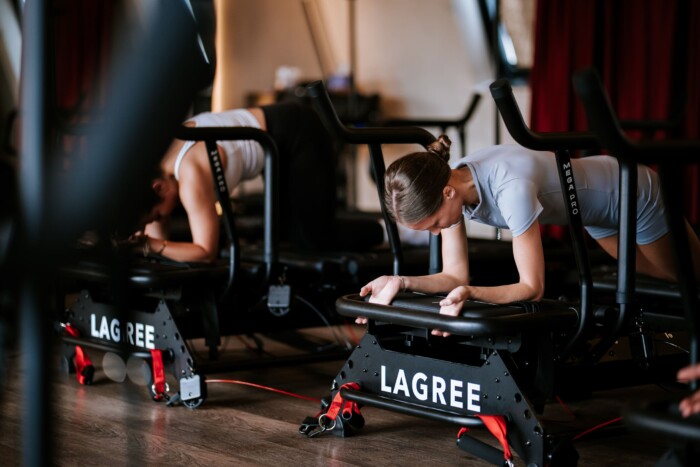
Lagree is a high-intensity, low-impact workout on a spring-loaded machine called the Megaformer, where you move slowly and keep each muscle working for a minute or more with almost no rest, building strength and endurance while your heart rate climbs. The name comes from its creator, Sebastien Lagree, so “Lagree” simply means his method. It is not Pilates. It’s Lagree.
If you would like to feel it rather than read about it, you can book a class in Angel.
What does Lagree mean? A simple definition
If you want to define Lagree in one line: it is a strength and endurance training method built on slow, controlled resistance on a moving carriage. You will also see it called the Lagree Method, Lagree Fitness or Lagree training. Lagree Fitness says the method is founded on five components of fitness: endurance, cardiovascular fitness, body composition, flexibility and strength.
A Lagree session is a group class led by an instructor. At Blood, Sweat & Tears, a class is 45 minutes, with one 50-minute advanced format, Full Body Pro 50.
Who created Lagree, and what is the Megaformer?
Sebastien Lagree is a French-born trainer who moved to Los Angeles and started developing the method in 1998, according to Lagree Academy. He began by teaching Pilates, found his clients wanted more intensity, and changed the workout until it became something else. He describes the method as built on bodybuilding principles rather than Pilates ones.
The Megaformer is the machine he designed for it. It has a carriage that slides on rails, fixed platforms, and springs underneath that set the resistance. Lagree Fitness lists several generations of the machine, from early prototypes to the Mega Pro. Lagree machines use springs rather than weights, so the instructor changes the load by adding or removing springs or by moving your hands and feet to a different spot.

What a Lagree class feels like, minute by minute
Every class is different, but the experience usually follows the same shape.
- The first minute. You step onto the carriage and it moves under you, which takes some getting used to. The pace is slower than you expect. Lagree Fitness describes a typical tempo of four counts to push the carriage out and four counts to bring it back.
- Minutes one to five. The first exercise lasts at least a minute, often longer, with no rest in the set. Somewhere past the first minute your muscles start to shake. Lagree calls it “the Lagree shakes”, and it means the muscle is working hard.
- The middle of class. One exercise flows into the next with little pause, working around the body: legs and glutes, core, arms and back. Your breathing and heart rate climb, even though you never jump or run.
- The last minutes. By the end of 45 minutes you have worked your whole body and you will probably be sweating. In your first few classes, it is normal to need short breaks. Take them, and tell the instructor about any injury before you start.
The principles behind the Lagree Method
- Slow tempo. Moving slowly removes momentum, so the muscle does the work rather than a swing or a bounce.
- Time under tension. Each exercise lasts at least a minute, and some run for several minutes, according to Lagree Fitness.
- Constant tension. The springs keep load on the muscle through the whole movement, so it does not get a rest at the top or bottom of a rep.
- Low impact. No jumping or running, so your joints are not absorbing landing forces.
- High intensity. Sets go on until the muscle is close to fatigue. Low impact does not mean easy.
- Minimal rest. Transitions between exercises are kept short, which is what keeps your heart rate up.
Is Lagree strength training or cardio?
Both, but it is strength training first. You work against resistance, which counts towards the NHS advice to do muscle-strengthening activities on at least two days a week. Because the sets are long and the rest is short, your heart rate rises as well.
More precisely, Lagree trains strength endurance: moderate loads held for a long time. That builds muscle and the ability to keep working when tired. If your aim is the heaviest single lift you can manage, a review of the research found maximal strength gains favour heavy loads, so a barbell programme is more specific for that goal.
The benefits of Lagree, stated honestly
- Whole-body strength and endurance in one session, with your core working throughout to keep you steady on a moving carriage.
- Low impact, which makes hard training easier to tolerate if jumping or running bothers your knees, hips or back.
- Time efficiency. You get a strength session and a raised heart rate in 45 minutes.
- Better movement and balance. Research on Lagree itself is limited. One small 2026 case series of eight healthy adults found six weeks of Lagree improved functional movement screen scores and balance on one leg, though the core endurance tests did not change significantly. It had no control group, so treat it as an early signal.
How does Lagree change your body? Mostly by making you stronger and firmer. Resistance training on its own reduces body fat modestly, but how lean you get depends on your overall activity, sleep and diet. No exercise lets you choose where fat comes off.
Who Lagree suits, and who should check with a doctor first
Lagree suits beginners as well as regulars, because the springs and your position can be adjusted to make every move easier or harder. It works well for people who want to get stronger without heavy weights, or who want hard training without impact.
Speak to your GP, midwife or a women’s health physiotherapist before you start if you are pregnant, have recently given birth, have pelvic floor symptoms, joint pain or arthritis, a recent injury or operation, or a heart or blood pressure condition. The NHS says it is not recommended to start a new vigorous activity in pregnancy, and we cover this in can you do Lagree while pregnant. In any class, stop if something hurts.
How Lagree differs from Pilates and reformer Pilates
People often search for “Lagree Pilates”, and the confusion makes sense: Lagree grew out of Sebastien Lagree’s Pilates teaching, and the Megaformer looks a little like a reformer. But the aim is different. Reformer Pilates centres on control, alignment, breathing and mobility, with pauses between exercises. Lagree uses a machine built for long, slow sets, keeps the muscle under tension with almost no rest, and pushes it to fatigue. We compare them in detail in Lagree vs Pilates.
How often should you do Lagree?
Two to four classes a week works for most people. If you are new, start with two or three on non-consecutive days. The American College of Sports Medicine recommends at least 48 hours between resistance sessions for the same muscle group, and Lagree classes work the whole body. Read more in how often you should do Lagree.
What it costs to try Lagree at BST
New clients can try two weeks unlimited for £139, which gives you time to learn the machine. BST is a Lagree-only studio on the 4th floor of 9 White Lion Street, London N1 9PD, about three minutes’ walk from Angel tube, and is rated 4.8 on Google. Ritual Cafe inside the studio serves coffee, acai and protein shakes for afterwards.
FAQs
Is Lagree the same as Pilates?
No. Lagree started as a reworking of Pilates but uses a different machine, a much slower tempo, longer sets and almost no rest. It’s not Pilates. It’s Lagree.
Is Lagree good for beginners?
Yes. The instructor sets your springs and gives easier versions of each move. Expect your first few classes to feel hard and a little wobbly while you learn the carriage.
How many calories does a Lagree class burn?
It depends on your body size, effort and the class itself, so any single number is a rough guess. We look at the estimates in how many calories Lagree burns.
How long is a Lagree session?
At BST, classes are 45 minutes, and the advanced Full Body Pro 50 runs for 50 minutes. That is long enough to work every major muscle group with almost no rest.
Try Lagree in Angel
A class at Blood, Sweat & Tears is 45 minutes on the Megaformer: full body, low impact and high intensity, with slow, controlled movement and constant tension. New clients can try two weeks unlimited for £139. Book your first class.