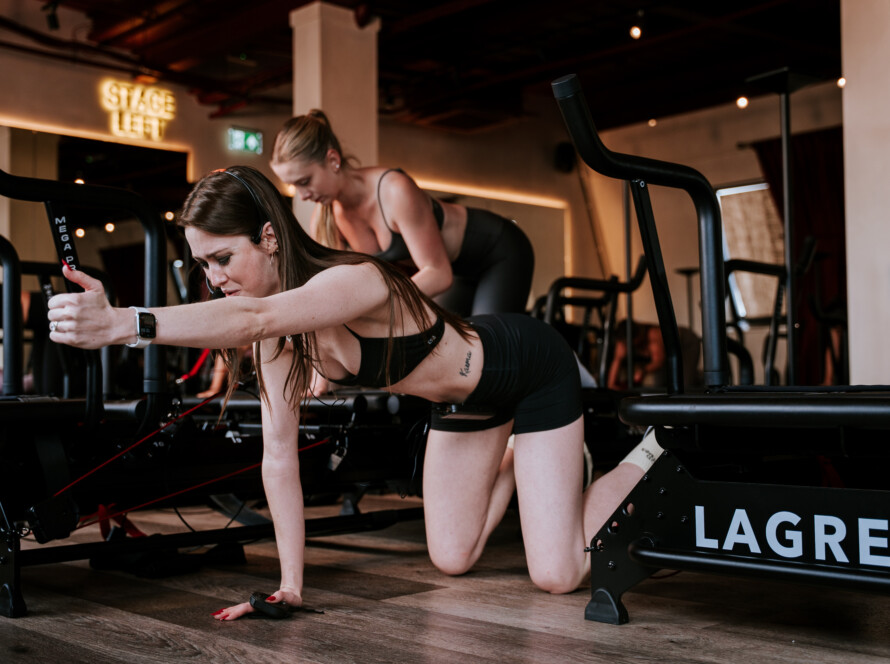
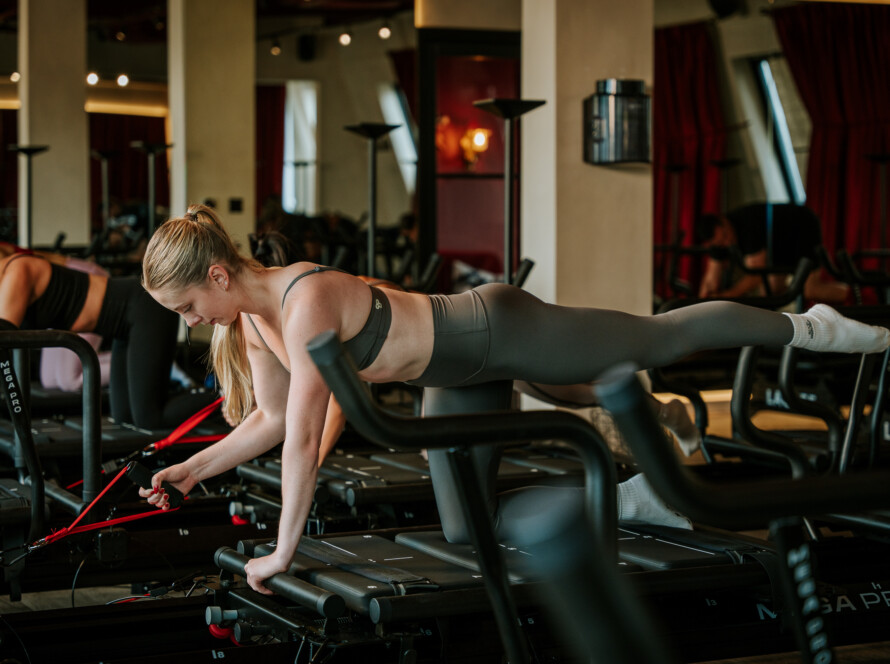
Lagree is a high-intensity, low-impact workout on a spring-loaded machine called the Megaformer. You move slowly, keep each muscle working for a minute or more with almost no rest, and your heart rate climbs without a single jump. The name is its creator’s surname, Sebastien Lagree, so “Lagree” simply means his method. It is not Pilates. It’s Lagree.
If you would rather feel it than read about it, the first class explains more than any page can.
What does Lagree mean? A simple definition
In one line: Lagree is a strength and endurance training method built on slow, controlled resistance on a moving carriage. You will also see it called the Lagree Method, Lagree Fitness or Lagree training, and it is all the same thing. Lagree Fitness describes the method as built on five components of fitness: endurance, cardiovascular fitness, body composition, flexibility and strength.
The method dates from 1998, and it was the first to break away from Pilates entirely. Sebastien’s first studio was called Pilates Plus, which is where the “Lagree Pilates” mix-up started. The method officially took his name in 2012, when Lagree Fitness officially started.
A Lagree session is a group class led by an instructor. At Blood, Sweat & Tears, a class is 45 minutes, with one 50-minute advanced format, Full Body Pro 50.
Forty-five minutes is the whole definition in practice.
Who created Lagree?
Sebastien Lagree is a French-born trainer who moved to Los Angeles and started developing the method in 1998, according to Lagree Academy. He came to it as a bodybuilder, not a Pilates teacher: he knew of Pilates but never trained in it, and saw the Reformer as a piece of gym equipment to use for circuit training. By 2003 he had run into the Reformer’s limits: too little resistance, a frame that was not built for what he was asking of it, and not enough variety in the exercises. The method was built on bodybuilding principles from day one, and the machine had to catch up with that.
In 2006 he built the Proformer, the first machine with a platform at each end and a full rear spring system, and refined it for three years. In January 2010 he started again from scratch, and the result was the Megaformer: a machine designed for the method rather than adapted to it, with faster transitions, new resistance systems and moves you cannot do on anything else. In 2012 Lagree Fitness officially started, and the method he had been teaching since 1998 officially went by his name.
Twenty-eight years of refinement, 45 minutes to feel it.
What is the Megaformer?
The Megaformer is the machine Lagree is taught on. It is two fixed platforms, front and rear; a moving carriage on rails attached to an adjustable spring system; cables, pulleys and handles for the variations; handlebars, foot bars and numbered lines on the carriage to position you; and, depending on the model, bungee cords and straps. More than 1,500 exercises can be done on it, and Lagree holds more than 200 patents on how its machines work.
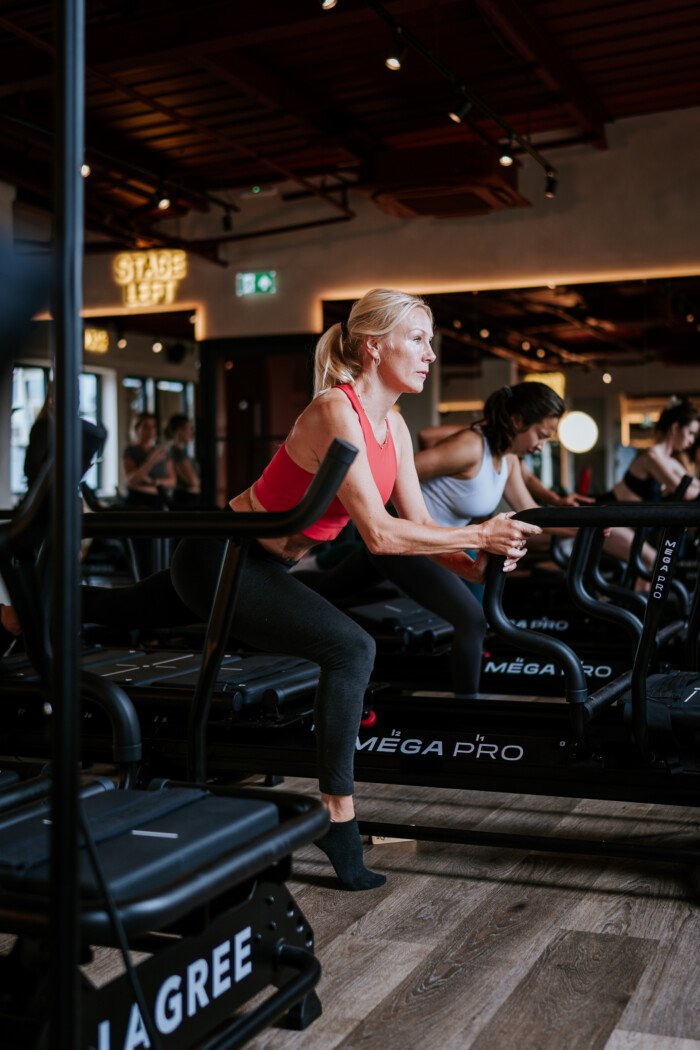
Every change you make on it changes three things at once: your body angle, the load, and which muscle is doing the work. Move a hand from one line on the carriage to the next and the exercise is different. That is why one machine can carry more than 1,500 exercises, and why two people in the same class can be doing the same move at very different intensities.
There are several generations: the M3 series, the Mega Pro, the EVO2 (the most advanced machine Lagree has built, with a near-silent carriage, redesigned platforms and adjustable foot bars), the Supra, and the smaller Mini, Mini Pro, Micro and Micro Pro. The Ramp is a base that tilts the whole machine to change the angle of resistance. Lagree updates and upgrades its machines every year. At Blood, Sweat & Tears, classes and teacher training run on the Mega Pro.
You will see it written as Megaformer, mega reformer or megareformer. People mean the same machine, but only the first name is right. The Megaformer is not a Reformer, and “Mega Reformer” is not the name of any Lagree machine. Instructors call it the Megaformer, or just the Mega.
The machine makes more sense under your feet than on a page.
How the springs work, and why the end of a lunge is heavier than the start
The resistance comes from springs under the carriage, not weights, and springs behave differently from weights in three ways that matter.
First, the tension is variable. The further you push the carriage from the front platform, the more the springs stretch and the harder they pull, so the end of a lunge is heavier than the start. There is no point in the range of motion where the muscle gets a rest.
Second, the machine has two zones that feel nothing alike. At the front, the springs support you against gravity. At the back, they work against you. The same spring and the same exercise give a completely different sensation depending on which end you are on, which is why a class can work around the whole body without changing the set-up every minute.
Third, the load can change without anyone touching a spring. Put your foot on line 6 of the carriage instead of line 3 and you have changed the tension. Your instructor uses the lines to position you and to make a move easier or harder in real time. When they do change springs, Lagree machines use three types, light to heavy, for the widest possible range of intensity. On the Mega Pros at BST, grey is the lightest, white is light to medium and black is heavy; a light spring gives roughly 3 kg at full stretch, a heavy one around 20 kg and an extra heavy up to nearly 40 kg. Other models use different colours.
Springs also make cheating impossible. With a dumbbell you can swing through the hard part of a lift. A spring only moves if the muscle is working, and it keeps working on the way back too.
The instructor guides every exercise. You just show up.
What a Lagree class feels like, minute by minute
Every class is different, but the experience usually follows the same shape.
The first minute
Class usually opens with a core exercise, so the first minute is about switching your core on before the carriage starts moving under you. Then you find out how slow slow is. Lagree Fitness describes a typical tempo of four counts to push the carriage out and four counts to bring it back; in practice that is eight to ten seconds each way, so one full range of motion takes 16 to 20 seconds.
Minutes one to five
Each exercise lasts at least a minute, and legs get two minutes minimum, with no rest in the set. Somewhere past the first minute your muscles start to shake. Lagree calls it “the Lagree shakes”, and it means the muscle is working hard. Shake, sweat and be sore the next day is the whole promise of a class, and the shake arrives first.
The middle of class
One exercise flows into the next with ideally no transition at all, a few seconds at most, working around the body: legs and glutes, core, arms and back. Your breathing and heart rate climb, even though you never jump or run.
The last minutes
By the end of 45 minutes you have worked your whole body and you will be sweating. In your first few classes it is normal to need short breaks. Take them, and tell the instructor about any injury before you start.
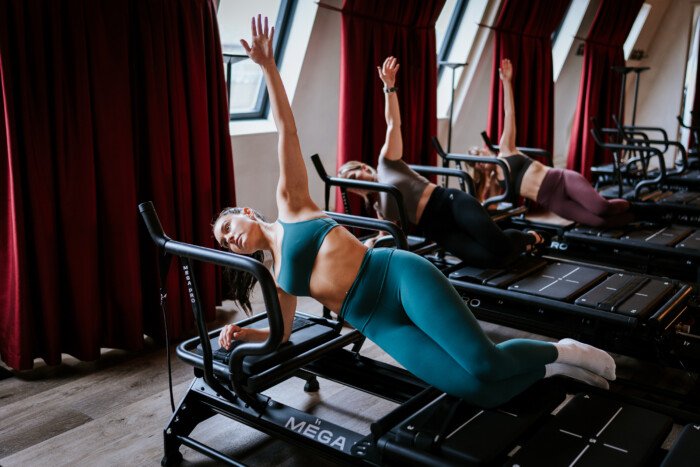
That is 45 minutes. The first one is the hard one.
The principles behind the Lagree Method
Slow tempo first. Moving slowly removes momentum, so the muscle does the work rather than a swing or a bounce. The speed is also constant: the same on the way out and the way back, which is harder than it sounds and is what keeps every muscle engaged from start to finish.
Time under tension next. Each exercise lasts at least a minute and some run for several, and the springs keep load on the muscle through the whole movement, so it does not get a rest at either end of the range of motion. Long, slow sets under constant tension mainly recruit the slow-twitch muscle fibres, the ones built for endurance, which is why Lagree builds muscular endurance before anything else and why you can train it several times a week.
Then the things your instructor is adjusting all class long without telling you: your form and body angle, which always come first because without them the right muscle is not working; your range of motion, kept inside the range that is safe for you; the resistance, from the springs or from where your hands and feet sit; the sequencing, so one exercise feeds the next and the same muscle stays under stimulus; and the transitions, ideally none at all, so your heart rate never drops. Low impact does not mean easy. Sets go on until the muscle is close to fatigue, and a well-taught class has you in the heart rate range usually reserved for interval training, 130 to 160 beats a minute, without a single jump.
Slow, constant, no rest. It is simpler to feel than to read.
Is Lagree strength training or cardio?
Both, but it is strength training first. You work against resistance, which counts towards the NHS advice to do muscle-strengthening activities on at least two days a week. Because the sets are long and the rest is short, your heart rate rises as well, into the range usually reserved for interval training.
More precisely, Lagree trains strength endurance: moderate loads held for a long time. That builds muscle and the ability to keep working when tired. If your aim is the heaviest single lift you can manage, a review of the research found maximal strength gains favour heavy loads, so a barbell programme is more specific for that goal.
Strength and cardio in the same 45 minutes, three minutes from Angel tube.
The benefits of Lagree, stated honestly
Whole-body strength and endurance in one session, with your core working throughout to keep you steady on a moving carriage. Low impact, which makes hard training easier to tolerate if jumping or running bothers your knees, hips or back. Time efficiency: a strength session and a raised heart rate in 45 minutes. And better movement and balance, with a caveat. Research on Lagree itself is limited. One small 2026 case series of eight healthy adults found six weeks of Lagree improved functional movement screen scores and balance on one leg, though the core endurance tests did not change significantly. It had no control group, so treat it as an early signal.
How does Lagree change your body? Mostly by making you stronger and firmer. Resistance training on its own reduces body fat modestly, but how lean you get depends on your overall activity, sleep and diet. No exercise lets you choose where fat comes off. For what to expect week by week, read how long it takes to see results from Lagree.
Two weeks is long enough to see the first change for yourself.
Who Lagree suits, and who should check with a doctor first
Lagree suits beginners as well as regulars, because the springs and your position can be adjusted to make every move easier or harder. It works well for people who want to get stronger without heavy weights, or who want hard training without impact.
Speak to your GP, midwife or a women’s health physiotherapist before you start if you are pregnant, have recently given birth, have pelvic floor symptoms, joint pain or arthritis, a recent injury or operation, or a heart or blood pressure condition. The NHS says it is not recommended to start a new vigorous activity in pregnancy, and we cover this in can you do Lagree while pregnant. In any class, stop if something hurts.
Never done it? Nobody has, the first time. Every move has an easier version.
How Lagree differs from Pilates and reformer Pilates
People often search for “Lagree Pilates”, and the confusion makes sense: the method started on a Reformer, Sebastien’s first studio was called Pilates Plus, and the Megaformer looks a little like a reformer. Sebastien Lagree was never a Pilates teacher, though, and Lagree was the first method to break from Pilates entirely. The aim is different, and so is the machine. The Reformer was created in the 1920s for one-to-one rehabilitation. The Megaformer was built in 2010 for group fitness classes. Comparing them is comparing an apple and an orange.
Reformer Pilates centres on control, alignment, breathing and mobility, with pauses between exercises. Lagree uses a machine built for long, slow sets, keeps the muscle under tension with almost no rest, and pushes it to fatigue. Saying Lagree is Pilates is like saying running is walking: similar on the surface, two different things in practice. We compare them in detail in Lagree vs Pilates, and the machines in Megaformer vs reformer.
Done reformer? The Megaformer feels familiar for five minutes and nothing like it after that.
Your first class: three things the instructor will tell you
Arrive 15 minutes early, because the machine run-down happens before class and the doors close when it starts. Wear grip socks; we sell them at the studio if you do not have a pair. And getting on and off is the one moment that needs care: hold the handles first, step onto the platform rather than the carriage, and stay between the side rails. After that, the instructor does the thinking. You just move slowly.
Weekday classes from 5:45am. Your first one is coached move by move.
How often should you do Lagree?
Three or more classes a week is where we see the best results, and two is where most people start. Because Lagree trains endurance rather than maximal strength, it can be done more often than heavy lifting, but if you are new, start with two or three on non-consecutive days. The American College of Sports Medicine recommends at least 48 hours between resistance sessions for the same muscle group, and Lagree classes work the whole body. Read more in how often you should do Lagree.
Two weeks unlimited exists so you can find your rhythm before you commit to anything.
What it costs to try Lagree at BST
New clients can try two weeks unlimited for £139, which gives you time to learn the machine. BST is a Lagree-only studio on the 4th floor of 9 White Lion Street, London N1 9PD, about three minutes’ walk from Angel tube, and is rated 4.8 on Google. Ritual Cafe inside the studio serves coffee, acai and protein shakes for afterwards.
One class a day for 14 days, from your first class.
FAQs
What does Lagree mean?
It is the surname of Sebastien Lagree, who created the method. Lagree means his method: slow, high-intensity, low-impact resistance training on the Megaformer. His first studio was called Pilates Plus; the method officially went by the name Lagree from 2012, when Lagree Fitness started.
Is Lagree the same as Pilates?
No. Lagree was the first method to break from Pilates entirely. It uses a different machine, a much slower tempo, longer sets and almost no rest. It’s not Pilates. It’s Lagree.
Is the Megaformer a reformer?
No. It has a sliding carriage and springs like a reformer, but it was designed from scratch in 2010 for group fitness, with a platform at each end, a spring system under the carriage, numbered lines for positioning and more than 1,500 exercises. “Mega reformer” is not the name of any Lagree machine.
What is the Lagree shake?
The trembling that starts somewhere past the first minute of an exercise. It is the muscle fatiguing under constant tension, and it is the sign the exercise is working. Everyone shakes, including the instructors.
Is Lagree good for beginners?
Yes. The instructor sets your springs and gives easier versions of each move. Expect your first few classes to feel hard and a little wobbly while you learn the carriage.
How many calories does a Lagree class burn?
It depends on your body size, effort and the class itself, so any single number is a rough guess. We look at the estimates in how many calories Lagree burns.
How long is a Lagree session?
At BST, classes are 45 minutes, and the advanced Full Body Pro 50 runs for 50 minutes. That is long enough to work every major muscle group with almost no rest.
Still got a question? The answer is usually in the first class.
Try Lagree in Angel
A class at Blood, Sweat & Tears is 45 minutes on the Megaformer: full body, low impact and high intensity, with slow, controlled movement and constant tension. New clients can try two weeks unlimited for £139.