Both use springs. Both claim your core. But Tower and Reformer Pilates work your body in opposite directions, and knowing which one actually matches your goal changes everything.
Tower Pilates is one of those practices that looks deceptively simple from the outside: a vertical frame bolted to a wall, a few springs, a mat on the floor. The common assumption among readers who’ve hit a wall with spring-resistance training is that switching apparatus, say, from Reformer to Tower, will restart progress through novelty and different resistance angles. Spend one session on it, and that impression dissolves fast.
The apparatus is precise, demanding, and deeply classical, built around a design logic that most people misread entirely. Tower Pilates is a vertical spring-resistance system fixed to a wall or bolted to the end of a mat table. According to The Kind Motion’s studio planning guide, the apparatus features a push-through bar, a roll-down bar, arm springs, and leg springs, each positioned at variable heights along the frame to change the angle and load of resistance.
That vertical range is what gives the Tower its versatility: springs at chest height load the upper back and shoulders differently than springs anchored near the ankle, and the practitioner works against all of them from the same fixed mat below. The fixed mat is the apparatus’ central engineering decision. com noted in January 2026, the Tower’s base stays stationary so the practitioner moves against fixed spring resistance rather than on a sliding platform.
When the surface beneath you cannot absorb effort or shift to compensate, the skeleton has nowhere to hide. Spring load travels vertically and diagonally through the body, and every deviation in alignment becomes immediately apparent. com, January 2026).
The Tower traces directly to Joseph Pilates’ classical apparatus system, designed alongside the Cadillac as a tool for spinal rehabilitation and postural correction. That lineage explains the Tower’s priorities: slow, deliberate, articulation-led movement rooted in the original method’s principles. Practically, the Tower’s footprint is its other advantage. ReformerPilates.com’s January studio planning resource confirms it can be mounted directly to a wall or attached to the end of a Reformer as a combination unit, making it a space-efficient option well suited to smaller studio environments. The apparatus holds still so the practitioner has to do the work.

Key takeaways
- Tower and Reformer Pilates differ in resistance direction, movement pacing, and where the load lands, not in difficulty level, which means switching between them doesn’t restart progress, it just rearranges it.
- Tower earns its place in injury recovery, postpartum return, and postural correction; Reformer earns its place in controlled, dynamic movement, but both share the same structural ceiling once your body has adapted.
- The plateau most women hit after months of consistent Reformer classes isn’t a motivation problem or a frequency problem, it’s a method problem.
- Swapping apparatus feels logical when progress stalls, but Tower and Reformer are the same method expressed through different equipment; the ceiling travels with you.
- Spinal decompression and loaded stability work are Tower’s two genuine mechanical advantages, useful, but neither produces the strength-building and cardio output that changes body composition.
- The women who stopped plateauing didn’t find a better Pilates class, they left the method entirely.
- BST’s Lagree studio in Angel, Islington offers 45-minute group classes that combine strength building and cardio in one session on the Megaformer, the same method behind Hollywood’s most popular workout, plus a health-focused café and official Lagree instructor certification courses for those ready to take it further.
What Is Reformer Pilates and What Makes the Moving Carriage Matter
Reformer Pilates accounts for a significant share of the boutique fitness boom that has reshaped London’s studio market in recent years, which means most women reading this have already spent time on one. That familiarity is part of its appeal, but it also breeds a specific frustration: classes that once felt challenging begin to feel routine. When the same spring settings, the same carriage drills, and the same sequencing repeat week after week, the motivation to keep showing up quietly erodes, and results plateau long before most clients realise why.
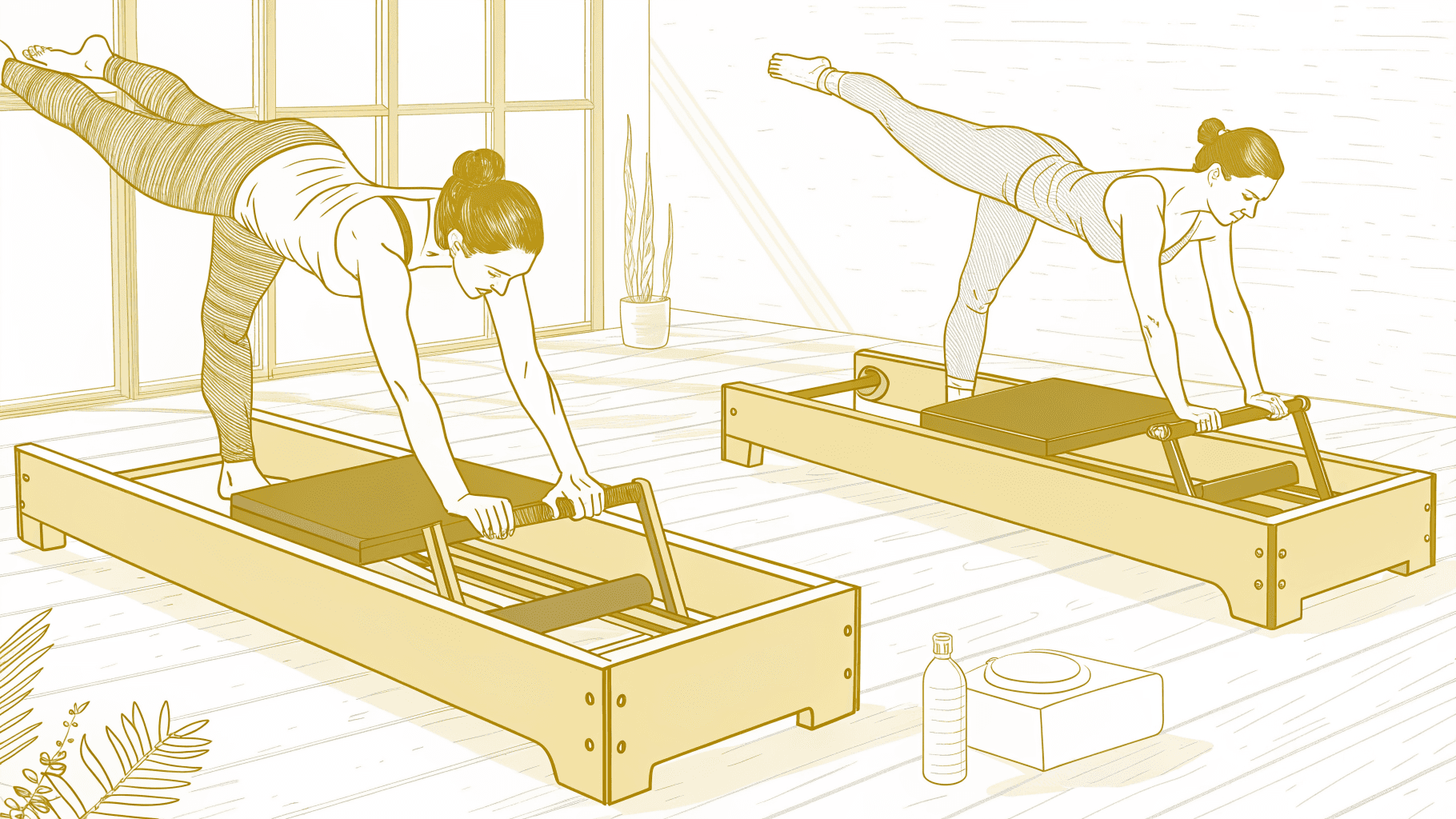
Understanding why requires a closer look at what the machine actually does. The Reformer is a sliding carriage mounted on a horizontal frame with tracks, propelled and resisted by adjustable springs attached between the carriage and the frame, with a footbar at one end, shoulder blocks to brace the user, and long straps for hands or feet. The footbar is the fixed anchor against which your legs push the carriage away, or pull it back.
That relationship between your body and a moving platform is what makes the Reformer structurally distinct from any fixed-base apparatus. When those studio classes start feeling repetitive, the natural exits seem to be a cheaper home machine or free YouTube tutorials, though neither addresses the underlying mechanical limitation. The moving carriage is the mechanical promise of the Reformer.
Because it slides along the track, it creates a dynamic and unstable base that demands continuous proprioceptive engagement and neuromuscular control throughout every exercise. Your nervous system cannot switch off. The nervous system adapts, though, efficiently and quickly. Once the carriage stops feeling unpredictable, the proprioceptive demand drops, and so does the stimulus.
Horizontal Resistance – The Direction That Defines Reformer Movement
Resistance on the Reformer travels horizontally, producing fluid, multi-planar movement patterns that differ fundamentally from the largely vertical, fixed-point resistance of Tower spring work, a distinction that holds across the market regardless of brand or studio format. Resistance changes dynamically as the spring extends further from its resting position during carriage travel, so the load shifts across the range of motion. That adaptation ceiling is exactly what the Lagree method at BST Lagree, based in Angel, London, was engineered to address.
It is a structurally different discipline that keeps the low-impact feel of Reformer Pilates while building visible strength and tone, combining spring resistance with sustained muscular time-under-tension and genuine cardiovascular demand inside a single 45-minute session. Membership options are structured to make consistent attendance straightforward, and that structure matters: transformation is a product of ongoing attendance, and the pricing is built to support exactly that.

Tower vs Reformer Key Differences Every Pilates Practitioner Should Know
The assumption that one apparatus is simply “more advanced” collapses the moment you look at what actually separates Tower and Reformer Pilates: not difficulty level, but direction of resistance, movement pacing, and where in your body the work lands.
| Dimension | Tower | Reformer |
| Resistance direction | Vertical, working with gravity | Horizontal, along carriage tracks |
| Base stability | Fixed, non-moving platform | Sliding carriage, dynamic surface |
| Pacing | Slower, targeted isolation | Fluid, continuous movement chains |
| Primary body focus | Deep core, spinal articulation, upper body | Lower body strength, dynamic stability, muscular endurance |
| Beginner suitability | High, no moving parts to manage | Moderate, coordination required from session one |
| Unilateral training | Yes, springs fixed independently on each side | Limited, carriage moves as one unit |
“Tower Pilates classes are hard to find and less widely available than Reformer classes, requiring practitioners to actively seek out specific studios that offer them.”
— what we hear from Pilates enthusiasts
1. Beginner Accessibility – Tower’s Stable Platform vs. Reformer’s Moving Carriage

Tower is the more accessible starting point for most people because the fixed frame removes the coordination variable entirely. You stand or lie on a stable mat and focus purely on alignment and muscle activation. The Reformer’s sliding carriage introduces an immediate proprioceptive challenge from the first session, as your body must stabilise against a moving surface while executing the exercise.
That is not a flaw; it is simply a different demand. One genuine frustration beginners in this space experience is being locked out of Tower or Cadillac work by studios even after many sessions, leaving them wondering whether the equipment restriction is protecting their progression or stalling it. That ambiguity is compounding: Tower classes are already harder to find than Reformer classes, and they require actively seeking out specific studios that programme them consistently, rather than simply dropping into the nearest Pilates venue. Most beginners find Tower less intimidating by design, which is precisely why studios that do offer it tend to route new clients there first.
2. Pacing Contrast – Tower’s Targeted Isolation vs. Reformer’s Fluid Movement Chains
Tower sessions are slower and more deliberate, isolating specific muscle groups, spinal articulation, deep core, and upper-body stretching and strengthening one at a time. Reformer sessions link movement chains continuously, producing a more fluid, almost choreographic feel. The trade-off is focus versus flow: Tower lets you sit inside a single movement and feel every layer of it; Reformer keeps you moving, which builds endurance but can mask compensatory patterns that a slower Tower sequence would expose immediately.
This is also where the low-impact character of spring-resistance training matters most. Because neither apparatus loads joints the way traditional weight training does, both formats let you keep the low-impact feel of Pilates while still building visible strength and tone, a combination that is harder to achieve in conventional gym environments and that consistent class attendance at a studio like BST materialises over time across an ongoing fitness journey, not in a single session.
3. Body-Area Emphasis – Tower’s Spinal and Upper Body Focus vs. Reformer’s Lower Body Dominance
The vertical resistance of Tower springs works directly with gravity, making it particularly effective for spinal mobility, postural correction, and upper-body strengthening. This is why physiotherapists and clinical Pilates practitioners frequently use Tower work for back rehabilitation and postural realignment, a demand pattern documented in industry survey data showing rehabilitation and postural correction among the primary reasons practitioners seek out Tower and Cadillac formats. Reformer’s horizontal carriage travel, by contrast, loads the legs and glutes through a full range of motion, making it the stronger choice for lower-body conditioning and dynamic, multi-planar stability.
Neither apparatus neglects the whole body; the emphasis is simply weighted differently by design, and both remain squarely within the low-impact spring-resistance framework that underpins visible, progressive results (De Pilates Store).
4. Difficulty Framing – Why Neither Apparatus Is Categorically Harder Than the Other

Advanced practitioners consistently report that Tower work becomes deeply demanding precisely because its fixed structure removes momentum as a compensatory strategy, forcing greater muscular precision at every level. Reformer can feel harder to a beginner because of the coordination overhead, but that overhead fades with practice. Difficulty on either apparatus is a function of programming and practitioner level, not the machine itself. The honest implication: if you have plateaued on one, switching to the other changes the angle of resistance and the stability demand while leaving the variable that drives visible results, progressive overload, completely untouched. Both share the same spring-resistance ceiling and the same Pilates principles, which means the adaptation ceiling follows you across the room.
5. Coordination Demand – Reformer’s Proprioceptive Skill Requirement From Session One
Difficulty on either apparatus is a function of programming and practitioner level, not the machine itself.
The Reformer’s moving carriage requires your nervous system to manage balance, timing, and muscle activation simultaneously from your very first class. This is a genuine skill-building demand, not just “harder.” It is most beneficial when training for sport-specific stability or when you want movement that mirrors real-world dynamic conditions.
The limitation worth naming: that coordination overhead can distract beginners from the foundational alignment cues that make Pilates effective in the first place, which is one reason many instructors recommend Tower as a technical grounding tool before progressing to carriage-based work. If you have mapped every one of these trade-offs and still feel stuck, there is a structural reason for that. It is not a harder version of Pilates; it is a separate method built on different physiological principles, with a stimulus ceiling that exists independently of the Pilates lineage.
If you are new to BST and want to experience the method before committing, the 4th-floor studio at 9 White Lion Street, Angel, Islington (N1 9PD) is minutes from Angel tube. Natural light and a city view (most studios sit in basements), brand-new Megaformer machines, couches and tables, designed women-first, it removes the access barrier that many beginners in this space encounter when trying to assess whether a studio and its programming genuinely fits their goals. From there, single drop-in credits and multi-class packs (from 3 to 10 classes) let you scale attendance at your own pace as the transformation-focused results accumulate with consistent sessions over time.
The differences above tell you what each apparatus does. The other half of the decision is matching those mechanisms to your actual goals, your schedule, and where your body is right now. That is exactly what the next section works through.
Related Reading
- Lagree Before and After 3 Months
- What To Bring To Pilates Reformer Class
- How Many Times A Week Should You Do Pilates Reformer
- Can You Do Reformer Pilates While Pregnant
- What To Wear To Pilates Reformer Class
- What Reformer Does Club Pilates Use
How to Choose Between Tower and Reformer Pilates Based on Your Actual Goals
Market growth in Pilates is driven precisely by rehabilitation, postural correction, and low-impact wellness demand, the use cases Tower was purpose-built to serve, as the Market Reports World Pilates Studios Market Report confirms. The same Market Reports World Pilates Studios Market Report confirms that Reformer-based classes dominate boutique studio offerings globally, making Tower and Cadillac access significantly less common for the average consumer. If you’re returning from a knee injury and need stable, low-load spinal work, Tower is the right answer.
Cost is a genuine constraint here: many clients who loved Tower Pilates at a specific studio found the pricing made regular attendance difficult to maintain, which shaped which modality they could realistically pursue long-term. That tension between format fit and financial reality is one of the most underacknowledged factors in the Tower-versus-Reformer decision.
Choose Reformer When Dynamic Lower-Body Strength and Movement Variety Are the Priority
Studio availability strongly favours this choice too: the Market Reports World Pilates Studios Market Report shows surging demand concentrated in Reformer-dominant boutique formats, which means more class times, more instructors, and more competitive pricing in most London postcodes. Even so, the evaluation problem doesn’t go away once you’ve chosen a format. A common experience for women who’ve been attending Reformer classes consistently is reaching a point where progress feels stalled and they’re genuinely unsure whether the issue is the studio, the instructor, or the method itself. That uncertainty, whether to stay or switch, is real, and it rarely gets resolved by more Reformer classes alone.
When Neither Tower Nor Reformer Is the Right Fit for Your Goals
Here is the honest caveat. Both apparatuses share the same spring-resistance system, and as the Market Reports World Pilates Studios Market Report confirms, switching between them changes movement angles but does not raise the absolute resistance ceiling. Neither machine is engineered to deliver simultaneous metabolic overload and progressive strength in a single 45-minute session.
She is asking an apparatus to do a job it was not built for. The expertise point that matters here: it is entirely possible to keep the low-impact feel of Pilates while building visible strength and tone, but that outcome requires a method specifically engineered for it, not simply more spring-resistance volume. The gap between what clients expect from spring-resistance training and what it reliably delivers is a defining pressure point for the sector right now.
If you’ve genuinely tried both formats and still feel like the needle hasn’t moved on strength or body composition, the gap isn’t which machine you’re on. That’s precisely the problem a Lagree studio in London like BST, located in Angel, is structured around: one 45-minute session that keeps the cardiovascular system working throughout while building the kind of muscular endurance that Pilates spring resistance alone cannot reach. If the cost question is part of what’s kept you from trying something new, BST’s pricing is structured to make the first step straightforward. New clients can claim a free Lagree workshop class, including a complimentary coffee, via the on-site form, with no obligation.

Why Women Who’ve Plateaued on Both Are Choosing the Megaformer Instead
The instinct to upgrade equipment is completely logical, but it runs into a structural limit, and understanding that limit matters more than any equipment swap.
The Lagree Method Is a Distinct Discipline, and That Architecture Is What Changes the Result
The Lagree Method is a categorically distinct discipline built around one physiological mechanism: sustained slow-twitch muscular endurance under continuous load, with cardiovascular demand built into every session by design. Exercises in the Lagree method are performed at a slow, controlled tempo with no rest between repetitions, so the muscle is never allowed to recover mid-set, a protocol that forces the cardiovascular system to respond even though the movement remains low-impact and joint-friendly. That architecture, progressive overload variables built directly into tempo, range of motion, and spring load, is what allows the stimulus to escalate continuously within the same session.
It is not a modification of another method; it is its own system, developed separately, with its own ceiling. The reason Lagree breaks plateaus that Pilates, on any apparatus, cannot is structural, not superficial: Lagree builds progressive overload directly into its variables (time under tension, tempo, range of motion, spring load), meaning the stimulus can be continuously escalated within the same session and the same machine. Pilates, by design, uses spring resistance for controlled technique with rest between movements, a methodology that produces consistent postural and rehabilitative benefits, but that is categorically not the same as sustained metabolic stress. A plateaued woman is not experiencing a machine problem; she is experiencing a method ceiling.
How Time Under Tension Creates Cardiovascular Demand That Spring Resistance Alone Cannot
Lagree Fitness describes exercises performed at a slow, continuous tempo with no rest between reps, so the muscle is never given a chance to recover mid-set. That sustained load forces the cardiovascular system to respond even though the movement stays low-impact and joint-friendly, a combination that distinguishes the method from anything spring resistance alone can produce.
That distinction is exactly what Karley, co-founder and head instructor at BST, the Lagree studio in London, brings to her teaching. Having trained and taught in LA, where the method was built, she applies that foundational understanding directly to every session. The honest trade-off: Lagree is genuinely harder than most women expect. The slow tempo with no rest is more demanding than it looks, and the first session will expose muscles that consistent Reformer training tends not to isolate, a result of the method’s sustained slow-twitch time-under-tension protocol, which differs structurally from Pilates spring-resistance pacing. That is precisely the point.
Related Reading
- Tower Vs Reformer Pilates
- Pilates Reformer Leg Exercises
- Pilates Reformer Glute Exercises
- Pilates Reformer Ab Exercises
- Best Pilates Reformer App
- Pilates Reformer Springs Explained
Benefits Of Each Equipment
Tower and Reformer Pilates each deliver distinct mechanical advantages, and understanding what each apparatus does best clarifies why practitioners eventually reach a ceiling with both. – Genuine spinal decompression: hanging or inverting from the Tower’s bar and spring system creates traction along the vertebral column, giving compressed discs and tight paraspinal muscles a form of relief that floor-based Pilates cannot produce. – A continuous demand for stability while the body is already under load: the spring attachments challenge the stabilising muscles of the spine throughout every movement rather than only at its peak, so the deep postural muscles, the multifidus, transverse abdominis, and spinal erectors, are recruited continuously.
Overhead spring loading through the push-through bar applies longitudinal traction to the spine, a mechanism that clinical Pilates practitioners use specifically for disc decompression and postural re-education. Fixed-frame stability means the nervous system can direct full attention to spinal articulation rather than managing a shifting base, which is why the Tower remains the preferred apparatus in post-surgical and postpartum rehabilitation contexts. The trade-off is real: that same stability eventually becomes the ceiling, and once the nervous system has fully adapted to a fixed frame, the stimulus that produced early gains no longer challenges the body in the same way.
Published research has found that Pilates interventions can significantly reduce chronic low back pain and improve spinal alignment across multiple study populations. Research on neuromuscular adaptation suggests the body reaches a functional plateau in a given movement pattern within weeks of consistent practice, after which the same stimulus produces diminishing returns without a meaningful change in load, tempo, or demand type. For many dedicated practitioners, this plateau arrives alongside a specific frustration: the tension between wanting the low-impact feel of Pilates and wanting results that are visible, genuine strength and tone that accumulates over time, not just postural awareness.
The women who arrive at BST’s Lagree studio having already done serious Tower and Reformer work are not abandoning something that failed them. They are recognising that their postural awareness and core stability are genuinely strong, and that the next adaptation requires a different physiological conversation: sustained slow-twitch time-under-tension, a resistance range and tempo protocol the Megaformer is specifically engineered to deliver, and a cardiovascular demand built into every 45-minute session by design. Transformation, visible and felt, materialises with consistent class attendance over time, not in a single session, which is why BST structures its pricing to reward exactly that commitment.
90 per class across ten sessions, a structure that reflects what the science of neuromuscular adaptation already tells us: real change requires consistent, progressive stimulus over weeks, though a single session at the Angel studio is the lowest-friction way to understand why this method works as it does.
Next steps
If your body has stopped responding despite consistent Reformer attendance, the path forward starts with recognising that apparatus is not the variable. Switching from Reformer to Tower changes the angle of resistance and the stability demand while leaving progressive overload, the single mechanism that drives visible change, completely untouched. Both machines share the same spring-resistance ceiling. The adaptation ceiling follows you across the room. Start with our Lagree classes in London.
Tower and Reformer each deliver genuine, evidence-backed benefits, but those benefits are of a specific, narrow kind: postural correction, spinal articulation, and controlled muscular endurance. Neither benefit profile overlaps meaningfully with simultaneous strength building and cardiovascular conditioning. And because Lagree builds progressive overload directly into its variables, including time under tension, tempo, and spring load, the stimulus can escalate continuously within the same session in a way Pilates spring resistance was never engineered to do. Together, those two facts point to one conclusion: the problem is not which apparatus you are on. It is the method’s shared ceiling.
Start with Lagree classes in London at BST Angel. New clients can claim a free introductory workshop class, no pack purchase required, and leave with real data about whether the method works for their body.
Frequently Asked Questions
Is Tower Pilates harder than Reformer Pilates?
Neither apparatus is categorically harder than the other, difficulty is a function of programming and practitioner level, not the machine itself. Advanced practitioners find Tower deeply demanding precisely because its fixed structure removes momentum as a compensatory strategy, while beginners often find the Reformer harder due to the coordination overhead of managing a moving carriage from session one.
If I’ve plateaued on the Reformer, will switching to the Tower actually fix it?
Switching changes the angle of resistance and the stability demand, but it leaves the variable that drives visible results, progressive overload, completely untouched. Both Tower and Reformer share the same spring-resistance ceiling and the same Pilates principles, which means the adaptation ceiling follows you across the room.
Can a Tower be used alongside a Reformer rather than instead of it?
Yes, the Tower can be attached to the end of a Reformer as a combination unit, making it a space-efficient option well suited to smaller studio environments. This also means the two apparatuses are not mutually exclusive choices; studios can programme both within the same setup.
Why do physiotherapists seem to use Tower more than Reformer for rehab?
The Tower’s fixed mat platform lets an instructor or physiotherapist isolate specific segments of the spine without the nervous system managing balance at the same time, which is precisely the demand that a moving Reformer carriage introduces from session one. The Tower’s vertical spring resistance also works directly with gravity, making it particularly effective for spinal mobility and postural correction, which is why it has continued use in post-surgical rehabilitation settings.
Which apparatus is better for beginners, Tower or Reformer?
Tower is the more accessible starting point for most people because the fixed frame removes the coordination variable entirely, letting you focus purely on alignment and muscle activation. The Reformer’s sliding carriage introduces an immediate proprioceptive challenge from the first session, and many instructors recommend Tower as a technical grounding tool before progressing to carriage-based work.