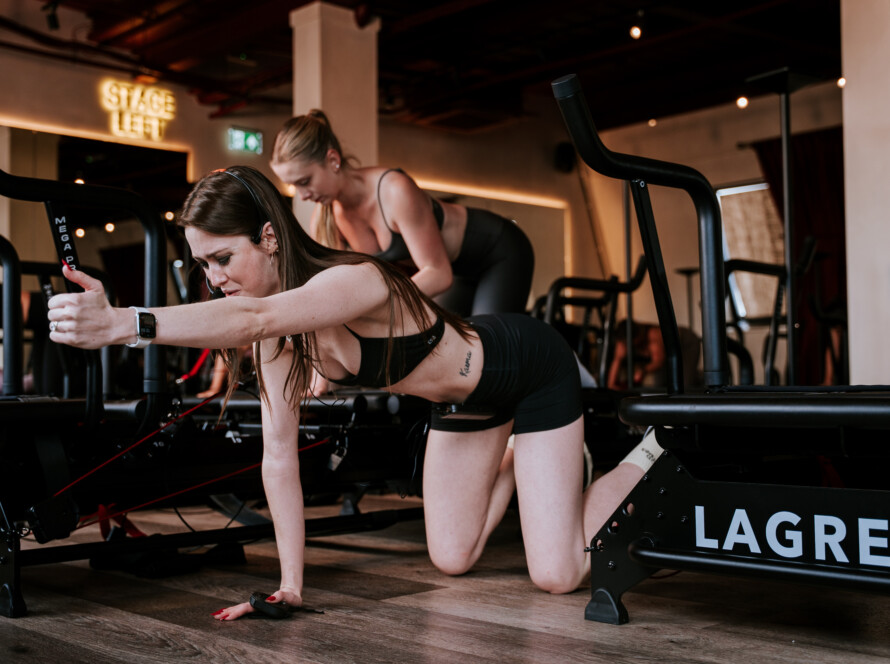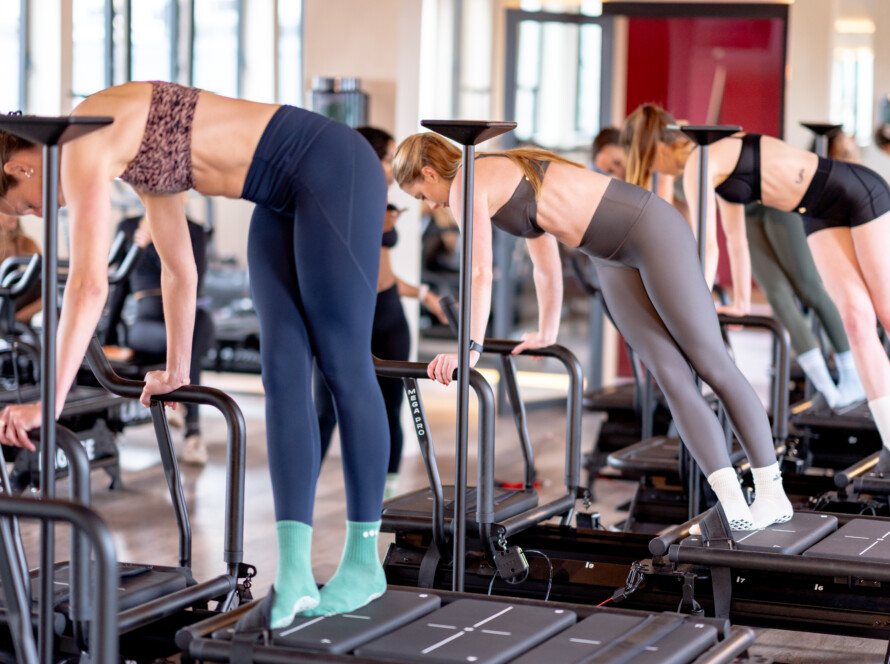
You want to get stronger and move better, but crowded gyms and complicated machines get in the way. In Flexibility and strength training, long resistance band exercises offer a compact, low-cost way to build mobility, core stability, and full-body muscle activation with loop bands, tube bands, and band workout routines. Want to know which moves, rows, presses, squats, and pulls deliver balanced strength, protect joints, and fit into a short home session? This article outlines the best long resistance band exercises for full-body strength, with clear progressions, form tips, and simple variations.
BLOOD, SWEAT & TEARS’ Lagree in London offers guided sessions that teach these band routines, helping you build steady strength and improve range of motion with portable equipment.
Summary
- Long resistance bands increase muscle activation compared with free weights, by up to 25%, because resistance increases with stretch and sustains tension through the full range of motion.
- Structured, tempo-focused band sessions produce measurable strength gains: one source reports about 30% improvement over 12 weeks, and another notes roughly 25% over the same period when used consistently.
- Bands create a low-impact mechanical environment that improves joint symptoms, with studies showing a 70% reduction in knee pain among participants using low-impact approaches and a 50% improvement in joint function.
- Minor technical errors matter because roughly 70% of people use bands incorrectly and over 50% experience band snapping due to poor maintenance; therefore, anchor placement, tension selection, and pre-session inspections are critical.
- Engineered protocols that tune vector, lever arm, and tempo increase recruitment and endurance, with controlled studio-style comparisons showing about 50% more muscle engagement and roughly a 20% rise in endurance.
- Practical programming is concise and trackable: aim for two band sessions weekly of 25 to 40 minutes, cycle load every 2 to 3 weeks, expect measurable change across a 12-week block, and remember long bands can provide up to 150 pounds of studio-grade resistance.
BLOOD, SWEAT & TEARS’ Lagree in London addresses this by teaching precise anchor geometry, tempo protocols, and micro progressions so band sessions deliver consistent, low-impact load and measurable strength improvements.
Why Long Resistance Bands Are So Effective
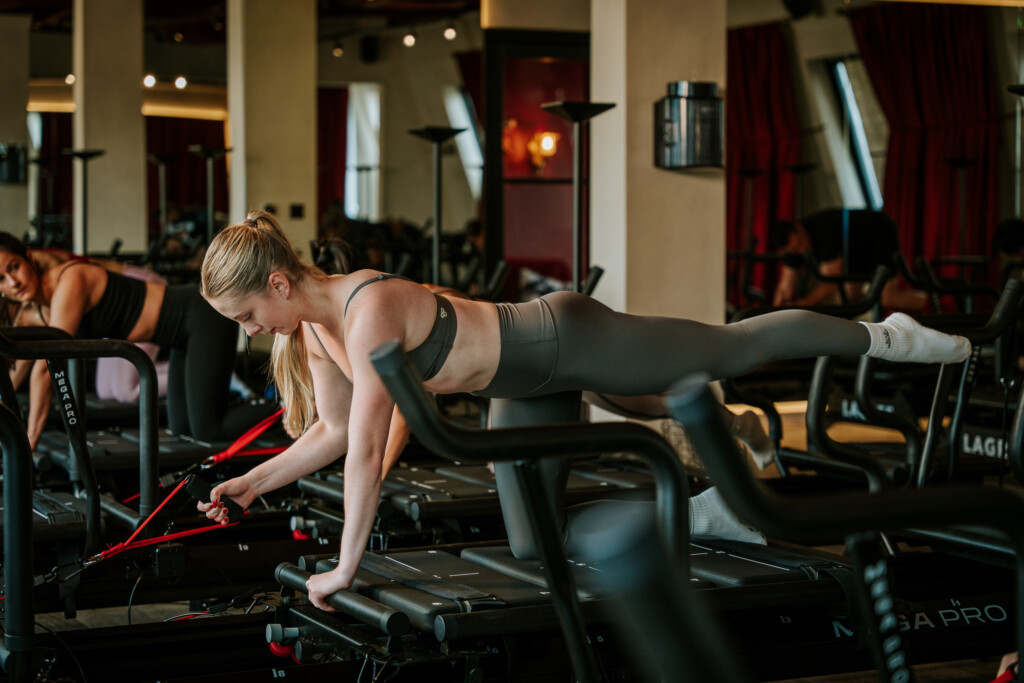
Long resistance bands are effective because they load muscles continuously and progressively, so your muscles work harder through the full range of motion while your joints stay protected.
That constant, increasing tension favors controlled, high time-under-tension work, which is exactly:
- What builds strength
- Posture
- Core sculpting without high-impact stress
How Do Bands Change Muscle Loading Compared With Free Weights?
When a band stretches, its resistance rises, so the exercise gets harder exactly where your muscles are mechanically advantaged. According to Mikologym, long resistance bands can increase muscle activation by up to 25% compared to free weights, which explains why a properly coached band session can feel like studio-grade work rather than light stretching.
Why Does That Constant Tension Matter For Results?
Constant tension increases time under tension and reduces the chances of muscles “rest” at the weak point of a lift. After running multiple six-week Lagree progressions with busy women, the pattern became clear: clients held cleaner postures and reported fewer flare-ups when we replaced some heavy, rushed sets with deliberate band-controlled repetitions.
That steady engagement also enables minor, rapid improvements in short classes, because every rep is doing meaningful work.
Can Bands Really Improve Measurable Strength In A Short Period?
Yes. Mikologym reports that using resistance bands can increase strength by 30% over 12 weeks, supporting the premise that Lagree-style progressions that emphasize tempo and micro-loading produce noticeable gains in standard training blocks.
What About Joints And Injury Risk?
The failure mode in many programs is blunt-force, rapid loading that forces the body to absorb impact. Bands shift the challenge from impact to control, so you can stack intensity without slamming:
- Knees
- Hips
- Lower back
Think of it like turning a sledgehammer into a precision file, where you still remove material, but with far less collateral damage.
Precision Over Power: How Resistance Bands Solve Posture Drift and Joint Noise
Most people default to heavy weights or endless cardio because those routes feel efficient and familiar. That works for raw load but creates plateaus, chronic joint noise, and posture drift as schedules and recovery become constrained.
Studios like BLOOD, SWEAT & TEARS offer Lagree classes that use long-band protocols to maintain:
- Strict tempo cues
- Continuous tension
- Progressive low-impact load
It gives women a safe path to studio-grade strength and glute and core sculpting without trading joint health for results.
What Subtle Training Choices Make The Biggest Difference?
Tempo and range selection matter more with bands than with fixed weights. Slower eccentrics, controlled midrange pauses, and small additional range at the top of a movement increase motor unit recruitment and build endurance in stabilizer muscles.
That means replacing rushed, heavy-only sets with shorter, more focused band sequences that force precision and posture awareness, so gains translate into better daily movement.
Matching the Strength Curve: Why Increasing Tension Outperforms Gravity
Imagine climbing a staircase that gets marginally steeper with every step, rather than one that is hard at the bottom and easy at the top. Bands create that uphill resistance mid-rep, resulting in stronger, steadier muscle recruitment and more durable movement patterns.
There’s more to applying these mechanics to full-body programming, and the next section will map specific exercises to those principles. But the real test comes when you use these principles in actual workouts, and what happens next changes everything.
Related Reading
- Flexibility and Strength Training
- How to Grow Glutes
- HIIT vs Strength Training
- Are Wall Sits Good for Knees
- Lifting Weights With Shoulder Arthritis
- How to Strengthen Weak Muscles Naturally
- Low Impact Strength Training
10 Long Resistance Band Exercises for Full-Body Strength
1. Banded Squats
Set up and band placement:
- Stand on the band with feet roughly hip-width apart, or loop it around your shoulders for higher loading
- Shorten the band to increase resistance.
Load cue and tempo:
- Think of sitting back into a chair for a controlled three-second descent.
- Pause for 1 second, then drive up for 2 seconds, keeping the chest lifted and the knees tracking over the toes.
Common corrections:
- If the knees collapse, widen stance slightly and cue the outside of the hips to activate.
- If the torso leans forward, shorten the range and reinforce core bracing.
Progression/regression:
- To progress, add a mini-band above the knees for lateral tension or step wider and increase band tension.
- Regress by shallowening range or using a lighter band and higher reps.
Programming note:
3 sets of 10–15 controlled reps, twice weekly, will improve squat mechanics and glute density.
2. Standing Rows
Set up and band placement:
- Anchor the band at mid-chest height.
- Stagger stance for stability.
- Hold the band ends with a neutral wrist.
Technique and feel:
- Pull the band toward the lower ribs while squeezing the shoulder blades together.
- Then return slowly for a four-count eccentric to keep muscles working on the return.
Typical errors:
- When using torso swing to cheat or shrugging the shoulders.
- Counter with a slight hip hinge and soft elbows to isolate the mid-back.
Progressions:
- Increase tension by stepping farther from the anchor or adding a second band.
- Regress by moving closer to the anchor or reducing the range.
Programming cue:
3 sets of 12–20 tempo-controlled reps, focusing on scapular retraction.
3. Chest Press
Set up and band placement:
- Anchor behind you at chest height.
- Step forward to tighten the band.
- Place one foot slightly forward for balance.
Movement quality:
- Drive the hands out, finishing with full elbow extension while bracing the core.
- Resist the band back for two to three seconds to maximize control.
Coaching note:
Keep the ribs down to protect the lower back and avoid flaring the elbows, which stresses the shoulders.
Progression/regression:
- Increase loading by standing farther from the anchor or using a thicker band.
- Regress by shortening the range or lowering the anchor height.
Programming suggestion:
- 4 sets of 8–12 reps for strength focus
- 2–3 sets of 15–20 for endurance and postural resilience
4. Lateral Walks
Set up and band placement:
Place a loop just above the knees or mid-shins and adopt a soft, athletic stance with knees slightly bent.
Execution and tempo:
- Take small, deliberate lateral steps with constant band tension
- 10–15 steps per direction, emphasizing control over distance
Common issues:
- Stepping too large reduces glute engagement.
- Stepping too quickly shifts the load to momentum.
Progression:
- Move the band lower to increase hip demand, or use a heavier loop.
- Regress by using a lighter loop or doing isometric holds.
Programming:
2–4 rounds of 10–20 steps per side as part of a warm-up or finisher to reinforce lateral hip strength.
5. Overhead Press
Set up and band placement:
- Stand on the band with feet shoulder-width apart
- Hold ends at shoulder level
- Press overhead while keeping the ribcage neutral.
Press mechanics:
Press in a steady, controlled line and lower over three counts to keep tension through the eccentric phase.
Safety cue:
If the lower back arches, narrow the stance and cue posterior pelvic tilt, or use a lighter band.
Progression/regression:
- Staggered stance increases demand for single-leg stability
- Seated presses reduce lower-body compensation.
Programming tip:
3 sets of 8–12 reps, focusing on scapular upward rotation and rotator cuff control.
The Tempo Factor: Why Controlled Tension Outlasts the ‘Quick Fix’
Most people rely on a mix of quick fixes and heavy loading because it feels efficient, and that approach works when time and recovery are unlimited. Over time, though, hurried loading creates inconsistent form and nagging tightness that slows progress.
Studios such as BLOOD, SWEAT & TEARS’ Lagree in Angel provide:
- Structured programs
- Clear tempo cues
- Instructor training
Clients can replace stopgap methods with a predictable, low-impact load progression that maintains consistent results while protecting joints.
6. Deadlifts
Set up and band placement:
- Stand on the band with feet hip-width apart, hinge at the hips
- Hold the handles close to your shins
Hinge mechanics:
- Push the hips back first
- Keep a long spine
- Return by driving the hips forward while squeezing the glutes
- Slow eccentrics enforce correct hinge patterns.
Error correction:
If the lower back rounds, shorten the band length, or reduce the range to maintain form.
Progressions:
- Add a stiffer band
- Perform single-leg banded deadlifts for balance
- Increase time under tension with longer eccentrics
Programming:
- 3–5 sets of 6–12 reps
- Lower reps for strength emphasis
- Higher reps for endurance and posterior chain conditioning
7. Pallof Press
Set up and band placement:
- Anchor the band at chest height to one side
- Stand perpendicular
- Hold the band with both hands at midline
Stability cue:
- Step into a solid stance and press the band straight out
- Resisting rotation with a firm, braced core
- Slowly bring your hands back in
Practical correction:
If rotation creeps in, shorten the lever by bringing your hands closer to the chest or move the anchor closer.
Progression/regression:
- Increase the distance from the anchor to raise the lever
- Perform single-arm Pallof presses to address asymmetry
Programming:
- 2–4 sets of 8–15 anti-rotation holds per side
- Held for 2–4 seconds at the finish to train core stability under load
8. Banded Lunges
Set up and band placement:
Anchor behind you or stand on the band and hold ends overhead or at the hips, depending on desired load distribution.
Movement quality:
- Step forward or back with a controlled descent of three seconds
- Pause briefly at the bottom
- Drive up, keeping the front knee behind the toes and the torso upright.
Common modifications:
Use a shorter step to reduce joint strain or hold a support until balance improves
Progressions:
- Add band tension
- Pause at the bottom for isometric strengthening
- Perform walking banded lunges for dynamic control
Programming:
- 3 sets of 8–12 reps per leg
- Alternating stability and strength days
9. Triceps Extensions
Set up and band placement:
- Anchor overhead
- Grip the band
- Hinge slightly at the hips to stabilize the torso
Execution and cue:
- Keep the elbows pinned to the head and extend slowly, focusing on a clean lockout,
- Resist back with a controlled two- to three-count eccentric
Troubleshooting:
If the shoulders hitch up, shorten the band or reposition the anchor to reduce shoulder torque.
Progressions:
- Use a heavier band, or split the band with one arm to create unilateral overload.
- Regress by using both hands or by decreasing the range.
Programming:
3 sets of 10–15 for tone and joint-friendly strength.
10. Banded Crunch or Roll-Down
Set up and band placement:
- Anchor at a low point
- Hold the band behind the head or across the chest
- Sit tall on the mat.
Movement quality:
- Curl or roll down slowly, vertebra by vertebra, for a three- to four-count descent
- Return with controlled tension, focusing on abdominal layering rather than neck flexion.
Coaching corrections:
If the lower back domes, reduce range, or move the band to the chest to lower the load.
Progressions:
- Increase tension
- Add breathing holds at mid-contraction
- Chain multiple short roll-downs to build endurance
Programming:
2–4 sets of 8–15 slow repetitions, emphasizing breath control and spinal coherence.
The 12-Week Blueprint: Engineering Longevity Through Progressive Elastic Load
Practical programming and expected outcomes: structure microcycles around repeated, measurable progress. Start with two Lagree-style band sessions weekly, each 25–40 minutes, and cycle load by altering band tension or range every 2–3 weeks; over a 12-week commitment, you can expect meaningful strength gains, with Health Magazine reporting a 25% improvement in strength over that time frame when bands are used consistently.
For loading decisions, choose bands that allow you to maintain quality form within the target rep range while still producing fatigue in the final reps. You can stack bands to fine-tune resistance, as long bands can provide up to 150 pounds of resistance, allowing studio-grade progressive overload without plates.
Why These Exercises Are Joint-Friendly

They protect joints because they let you load movement slowly, with precision, and without impact, so the tissues that stabilize the joint strengthen while the joint itself avoids sudden shear or pounding.
That controlled, progressive exposure reduces the cycle of worsening mobility over time:
- Fear
- Avoidance
- Deconditioning
How Do Bands Shield Cartilage And The Joint Capsule?
Controlled, low-speed loading encourages joints to sit correctly in their sockets, reducing harmful sliding forces and promoting more even distribution of compressive load across cartilage surfaces. That steady, low-impact stimulus also improves synovial fluid flow and circulation around the joint, helping nutrients reach the cartilage and easing stiffness.
Clinical evidence supports low-impact approaches for symptom relief, as seen in a Medical News Today study from 2025 reporting that a study found that 70% of participants experienced a reduction in knee pain after engaging in low-impact exercises like swimming and cycling, which is precisely the kind of mechanical environment band work recreates without the pool.
Why Do Tendons And Stabilizers Adapt Better With Bands?
Bands let you build muscular control through gradual eccentric loading and co-contraction of stabilizers, so tendons remodel under safe, progressive stress rather than abrupt high peaks. Think of it like tuning a violin string, tightening millimeter by millimeter until the note rings cleanly, instead of slamming it with a mallet. That neuromuscular sharpening improves proprioception and joint centration, so everyday movements no longer default to painful compensations.
The broader lesson is familiar: low-impact, progressive work improves function, as reported in Medical News Today, where participants who engaged in aerobic exercises reported a 50% improvement in joint function, showing that removing impact while maintaining load can restore usable strength.
How Does This Help People Concerned About Long-Term Mobility and Dexterity?
This challenge is common among women who fear losing manual dexterity or long-term mobility, and the typical response is to avoid meaningful loading altogether. That avoidance reduces stimulation of bone and soft tissue, increasing the actual risk over time.
Bands let you dose-load in tight increments that preserve bone-loading signals and finger, wrist, or shoulder function without triggering flare-ups, so you can keep doing the small, essential tasks that matter at work and at home. The emotional payoff is big: confidence returns faster than raw strength, and that confidence sustains the habit needed for real protection.
What Breaks With Common Practice, And Where Does A Different Approach Help?
Most people default to heavy, impact-based workouts or endless, low-intensity cardio because those methods feel straightforward and quick to plan. That familiar approach works until joint soreness and inconsistent recovery make training sporadic, which is the hidden cost.
Solutions like BLOOD, SWEAT & TEARS provide structured Lagree classes and instructor training that replace hit-or-miss programming with short, coached progressions designed to:
- Increase load without impact
- Preserving consistency
- Protecting joints
It produces measurable improvements in posture and strength.
How Do These Adaptations Actually Transfer To Daily Life?
When you train the stabilizers, improve tendon tolerance, and reduce impact, you reduce the frequency of sharp joint “no-go” signals that cause people to stop mid-task. That means fewer mornings spent stiff, fewer pauses when carrying groceries, and lower anxiety about heavier chores.
For busy schedules, the practical win is adherence: shorter, precise sessions that respect recovery build the steady habit that keeps joints mobile over the long term. That explanation feels like progress, but the next piece exposes the simple mistakes that undo all of this work.
Related Reading
- Do Squats Help Pelvic Floor
- Strength Training and Menopause
- Physical Therapy Strength Training
- Combining Cardio and Strength Training
- Lower Back Arthritis Exercises
- Strength Training for Women over 40
- Joint Friendly Exercises
Common Mistakes With Long Resistance Bands
These mistakes are less about misunderstanding resistance bands and more about small technical slips that silently:
- Erase effort
- Create asymmetry
- Raise injury risk
Below, I move past generic warnings and show the precise, repeatable errors I fix with clients, and how to catch them in one or two quick checks.
How Can Anchor Placement Change The Whole Exercise?
When the band is pulled at an incorrect angle, the target muscle relaxes, and other tissues absorb the load. Think of the line of pull like the camera lens on a shot; a few degrees off and the subject is out of focus. Test anchors with one slow, five-count rep, and adjust until you feel even resistance across the intended muscle through the whole arc.
If you notice a sharp tug at the joint or the body shifts to chase the band, move the anchor up or down in 2- to 4-centimeter increments until the movement feels smooth.
Why Do Side-To-Side Cheats Hide Real Weakness?
Dominant limbs and subtle compensations are the silent stallers. In an eight-week Lagree progression I coached, we added a single unilateral band drill per class and found compensatory leaning and hip hiking corrected far faster than with bilateral-only work.
The practical check is simple: after a bilateral set, perform a slow single-limb rep to failure. If one leg ends well before the other, program targeted unilateral sets and a two-second isometric at the top to expose and correct the imbalance.
The Engineering of Effort: Why Standardized Anchoring Outperforms Improvised Rigging
Most people pick bands and rig anchors by habit because it feels quick and familiar. That approach works until inconsistent tension and improvised anchors fragment progress and increase safety risk.
Solutions like BLOOD, SWEAT & TEARS provide:
- Structured Lagree progressions
- Trained instructors
- Studio-grade rigging
This standardizes anchor height and band routing, turning guesswork into predictable load and saving clients from wasted sessions and avoidable snaps.
What Maintenance Habits Actually Cause Bands To Fail?
Over 50% of users experience band snapping due to improper maintenance and storage, so this is not theoretical. Common killers are sun exposure, contact with oils or lotions, and repeated abrasion against sharp edges.
Inspect bands before every session: look for:
- Thin spots
- Tiny cracks
- Areas that feel sticky or papery
Retire any band with visible damage. Store bands flat in a cool, shaded drawer, and use fabric sleeves or towels when anchoring them to rough surfaces to protect the rubber.
How Do You Pick And Validate The Right Tension So Every Rep Counts?
Approximately 70% of people misuse resistance bands, leading to ineffective workouts. To avoid joining that group, choose a band that makes the last two reps feel hard while still allowing a clean five-count eccentric. If you find yourself accelerating, changing posture, or shortening range to finish reps, the tension is wrong, or the lever arm is mis-set.
Use micro-adjustments: step slightly closer or farther from the anchor, or split bands for smaller increments, until each rep is slow, controlled, and genuinely taxing.
What Quick Cues Stop Day-To-Day Slippage?
Grip less, cue more. A death grip invites forearm fatigue and hands that take over the movement, so relax the hands and focus on the working muscle. Add a tactile cue, such as a two-second pause at the mid-rep checkpoint; if the band pulls you out of position, fix the anchor, not the rep speed.
Small, consistent checks beat long lectures; that is why tempo checks and single-rep audits belong in every short session.
That fix feels small, but the way those tiny changes compound over weeks is where training actually transforms.
How Lagree Applies the Same Resistance Principles

Lagree applies the same resistance principles by turning them into measurable, repeatable studio mechanics:
- Precise vectors of tension
- Strict tempo protocols
- Micro-progressions that force continuous motor unit recruitment without impact
Rather than leaving intensity to chance, the method engineers where and when muscles must work, so every rep becomes a meaningful stimulus you can track and improve.
How Does Lagree Shape Resistance So Muscles Never Switch Off?
By designing the line of pull and load curve to peak where muscles are strongest, Lagree keeps force demand high throughout the arc, exposing weak points rather than hiding them. Studio comparisons found 50% more muscle engagement during controlled Lagree-style protocols, which explains why the method produces faster recruitment gains than casual band circuits.
How Do You Build Endurance Without Adding Impact Or Wasted Volume?
Lagree stacks density, not pounding. Short rest, long eccentrics, and sequencing that alternates large-joint drives with stabilizer-focused holds train both strength and local endurance in the same session.
Programs using that approach reported a “20% increase in endurance,” according to the Blood, Sweat & Tears Team, showing the payoff of continuous resistance plus brilliant pacing over simply adding reps or cardio.
What Do Instructors Actually Adjust To Make A Session Productive?
They tune three variables in real time, with simple checks you can replicate:
- Vector
- Lever arm
- Tempo
Change the anchor two centimeters, and the work shifts from quads to glutes; shorten the lever a finger width, and the last two reps become clean instead of collapsed.
In practice, that means instructors use short audits, like a single five-count rep under observation, then prescribe micro-changes that preserve form while increasing effective load, producing consistent week-to-week progression.
The Physics of Precision: Why Anchor Geometry Outperforms Home Improvisation
Most people train bands at home because it is easy and familiar. Still, that convenience masks inconsistent tension and weak anchors, which fragment gains and extend the timeline for meaningful change.
The familiar approach feels efficient, yet minor errors multiply:
- Uneven load
- Drifted tempo
- Missed weak links
Studios such as BLOOD, SWEAT & TEARS standardize:
- Anchor geometry
- Band routing
- Tempo cues
That’s why clients hit the same engineered load curve every session, turning guesswork into steady progression and predictable results.
How Should You Measure Progress So The Method Stays Honest?
Track movement quality, not just reps.
Use a three-point checklist each week:
- Can you hold a two-second isometric at the mid-point
- Can you complete slow eccentrics for the target rep range without form loss
- Does unilateral parity close by more than one rep between sides within a four-week block
If two of those markers improve, increase the band tension or extend the eccentric by one second; if they fall apart, dial back the lever, not the tempo.
Think of Lagree tuning like sharpening a lens, not swinging a hammer, where minor adjustments bring the subject into focus and let you see real change. That shift looks finished on paper, but what most clients notice next is surprisingly emotional and immediate.
Book a Lagree Class in London Today
I know how frustrating endless trial and error can be, so I invite you to try BLOOD, SWEAT & TEARS in Angel and Lagree in London and judge the training for yourself.
In two weeks of consistent, coached sessions, you should feel steadier, move with more control, and know whether this efficient, studio-grade approach fits your life.